
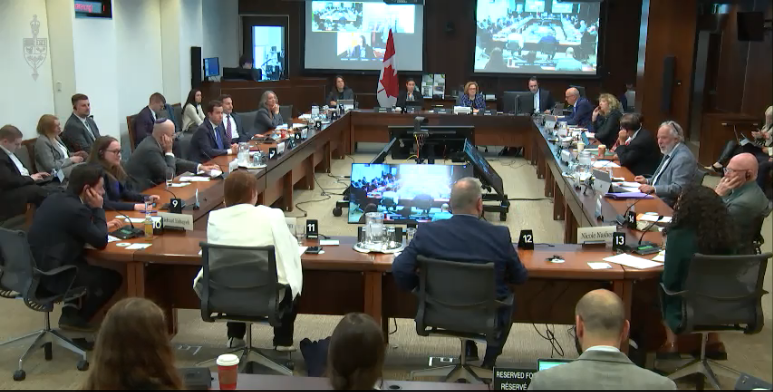
 Committee in session at the House of Commons on May 9, 2024. Over a dozen people are sitting facing each other at tables in a rectangular shape.
In December 2023, after the U.S. Congress held hearings about campus antisemitism, five MPs sent a letter to Canadian university presidents noting that U.S. university presidents had “embarrassed themselves” and asked the Canadian presidents what they would do about antisemitism at their universities. At the time, one of the letter-writers, Liberal MP Anthony Housefather, said there would later be a study on campus antisemitism.
Housefather initiated that follow-up effort, which officially got underway on May 9 under the title “Antisemitism and Additional Measures that Could be Taken to Address the Valid Fears that are Being Expressed by Canada’s Jewish Community” as part of the House of Commons Committee on Justice and Human Rights. The methodology of the “study” is opaque and seems to consist of invited witnesses speaking to the committee and written submissions posted online.
Four students and two non-students appeared as witnesses on May 9, and a press conference including three additional students was held the day before. Much of the discussion focused on pro-Palestinian protest, including the current encampments on campuses.
Media reports did not note that all seven of the students who spoke hold or recently held positions in pro-Israel advocacy organizations.
Independent Jewish Voices Canada (IJV) national coordinator Corey Balsam told The Media Co-op he believes the objective of the hearing “was clearly not to hear a diversity of perspectives or even to genuinely investigate antisemitism on campus. It was a sham hearing, an exercise in propaganda. It almost seemed choreographed. There were so many terrible comments, it’s hard to narrow them down.”
No anti-Zionist Jews, many of whom are supportive of the pro-Palestinian movement, were heard at the committee nor cited in national media reports.
National media reported after the first hearing that Jewish students in Canada are "terrified" and “don't feel safe.”
An April 27 request from a representative of IJV to appear as a witness remained unacknowledged by the committee as of May 17. IJV has 23 chapters across Canada and is an anti-Zionist Jewish group that is very critical of Israel.
Balsam says the hearings are “clearly inspired by the neo-McCarthyist witch-hunt of university presidents in the U.S.” which contributed to the resignation of the president of Harvard University.
Hours after the hearing, Calgary police raided a pro-Palestinian encampment which had recently gone up at the University of Calgary, hitting students with batons and firing non-lethal munitions at them. Two days later in Edmonton, police acted similarly to clear the encampment at the University of Alberta.
The next hearing on May 23 includes witnesses from four community groups with pro-Israel positions as well as two professors, then the last hearing will bring in university presidents.
The Media Co-op sent questions about the study’s process, how witnesses were selected, the exclusion of Jewish anti-Zionist perspectives and more on May 13, 14 and 15, asking for responses from any relevant committee members. The request was acknowledged but no comment was sent.
Who Were the Witnesses for the Student-focused Hearing?
Four students and two non-students appeared in person for the committee’s study on May 9, and three other students spoke to the media on May 8.
Current student Nati Pressmann was a Campus Fellow for the pro-Israel media advocacy organization Honest Reporting Canada in 2022-2023. These fellows are paid $1,000 to advocate for Israel in the media.
Pressmann is also the founder of the Canadian Union of Jewish Students, which launched publicly a week before the hearing, according to multiple media reports including a National Post profile on the group. In response to a thread I wrote on Twitter on May 10, she stated the organization had been “up and running for eight months.” It does not have a website, but an Instagram account was created in Oct. 2023 and then a Twitter account in Dec. 2023.
Michael Eshayek is VP External Affairs of the Concordia student group StartUpNation, which promotes Israel as a tech hub. In March, the group co-hosted an event that invited Israeli Defense Forces (IDF) reservists to talk about the "fight against the delegitimization of Israel." The group’s tagline is “Bringing Israel On Campus.”
Nicole Nashen was the president of Hillel Concordia from 2021-22. Hillel is a national organization, according to Yosh Tarshish, a Hillel representative who was a witness at the committee, and it fosters student connections with Israel. In Quebec, it appears to be part of Federation CJA and works with CIJA (Centre for Israel and Jewish Affairs), both of which have strongly pro-Israel positions.
Rachel Cook worked as chief of staff to Reut USA's president in 2022-23. Reut USA opposes the Boycott, Divestment and Sanctions (BDS) movement and takes pro-Israel positions.
Yosh Tashish works for Hillel Ontario at Queen’s University and is not a student. The organization works to “confront antisemitism and anti-Zionism,” according to Hillel Ontario’s website.
Witness Neil G. Oberman is a Montreal lawyer who has unsuccessfully sought an injunction on behalf of two McGill students to get the pro-Palestine encampment there cleared by police. Oberman has also represented pro-Israel students at Concordia taking legal action against the university regarding protests critical of Israel.
At least three other students spoke at a related press conference held the day before the committee proceedings.
Sydney Greenspoon is currently an Emerson Fellow with StandWithUs. Anastasia Zorchinsky is currently president of Concordia’s StartUpNation (where witness Michael Eshayek is a VP), and Claire Frankel is or has recently been involved with Hillel McGill, Chai fellowship, Hasbara fellowship, Honest Reporting Canada Media fellowship, and the Canadian Jewish Political Affairs Committee (CJPAC).
No organizational affiliations of the seven students, except for Pressman’s position with CUJS, were mentioned in major media reporting. The students are referred to only as being “Jewish students,” along with their university and program. That is the case in the the Canadian Press article by Stephanie Taylor which was published by CTV News, CP24, Global News, The Toronto Star, The Globe and Mail and others. The same is true of the CBC’s article by Raffy Boudjikanian and the Postmedia article by Ryan Tumilty published in the National Post, Toronto Sun and elsewhere.
The Canadian Press article does not indicate that Tarshish works for Hillel Ontario, writing instead that he “directs the Queen's University chapter of a national Jewish organization.”
No anti-Zionist Jews spoke, despite the April 27 request from Independent Jewish Voices to have a representative, retired sociologist Sheryl Nestel, as a witness for the study. And anti-Zionist Jews were not quoted in media reports about the committee. Two letters sent on May 9 from IJV members, one from a student and one from a retired sociologist, were posted to the committee website a week later on May 16.
Regarding the students who spoke at the committee and the press conference, Balsam with IJV writes in a statement, “I think they were chosen because they parrot the usual hasbara (Zionist / Israeli PR) talking points. I suppose it’s not a surprise, since this was Housefather’s initiative, but it was even worse than expected.”
Committee Composition
“It’s hard to imagine a more reactionary, pro-Israel committee composition,” Balsam says. “Note that several of the MPs present at the first hearing are not normally on the committee — which is already quite bad — but were subbed in.”
Those subbed in included Liberal Julie Dabrusin and Conservatives Melissa Lantsman and Marty Morantz.
Committee regulars who asked questions included Liberals Anthony Housefather and Marco Mendicino, who Balsam notes are the most pro-Israel members of the Liberal caucus, Randall Garrison with the NDP, who Balsam says is an outlier in that party for his pro-Israel positions, Conservatives Marilyn Gladu and Tako Van Popta, and Rhéal Éloi Fortin with the Bloc Québécois.
Five of those MPs are in the top 10 most lobbied by the Centre for Israel and Jewish Affairs (CIJA), a stauncly pro-Israel advocacy group: Housefather, Mendicino, Lantsman, Morantz, and Garrison.
Opinions on Israel Within the Jewish Community
Regarding how much agreement or disagreement there is about support for Israel within the Jewish community, “we have nowhere near as much data on Canadian Jews as we do on American Jews and there remain a lot of questions,” Balsam tells The Media Co-op.
In the U.S., a 2022 study by the American Jewish Committee found that 44 per cent of American Jewish millennials don't feel that an attachment to Israel is a significantly important part of their Jewish identity.
In Canada, a 2024 study by sociologist Robert Brym found 70 per cent of Canadian Jews feel “very” or “somewhat” emotionally attached to Israel, meaning 30 per cent do not feel that way.
“The data that we have can be interpreted in a number of ways,” says Balsam. “Take the ‘attachment’ question, which is often surveyed, for example. I, like many IJV members and fellow anti-Zionist Jews, have a strong emotional attachment to Israel-Palestine as a place — its cultures, landscapes, peoples, histories, etc. — but not as a genocidal ethnostate that privileges Jews at the expense of Palestinians. It's part of what motivates me to fight for freedom and justice for all in the region. Many surveys read ‘attachment to Israel’ as support of Zionist beliefs, but that simply isn't true.”
One of the students who spoke at the committee press conference responded to my Twitter (X.com) thread to say that the pro-Israel views and positions held by all seven students make sense given the affiliations are with mainstream Jewish organizations.
A JSpaceCanada and New Israel Fund Canada 2023 survey found “there is a significant ambivalence within the Jewish community towards those legacy institutions that purport to represent it. Respondents were asked to evaluate ‘mainstream Jewish advocacy organizations in Canada’ vis-à-vis their position on Israel. Equal numbers approved of how these organizations are positioned (32%) as those who felt they should be more critical of the Israeli government (31%).”
What Was Said at the Committee?
The committee’s study on May 9 lasted approximately two hours, beginning with statements from the six witnesses and then rounds of questions from MPs.
The majority of the examples of what the witnesses identified as antisemitism were either criticism of Israel or expressions of support for Palestinian resistance.
Rachel Cook’s opening comments focused less on Israel-Palestine, instead discussing antisemitic graffiti on an interactive art installation on the University of Alberta campus, and the university deciding against putting up a Menorah on campus during the holiday season. She then turned to Israel-Palestine.
Nearly all of Michael Ishayek’s examples had to do with Israel-Palestine. He continually referred to pro-Palestinian protests as “antisemitic protests” and “pro-Hamas.” A walkout and sit-in on Oct. 25, 2023 in solidarity with Palestine was called “antisemitic” by Ishayek because of chants such as “From the river to the sea, Palestine will be free.”
He discussed a Nov. 8, 2023 interaction between supporters of Israel and Palestine inside a Concordia University building. His group, StartUpNation, and a pro-Palestinian group selling keffiyehs (Palestinian scarves) were unexpectedly tabling next to each other. This was peaceful for the first hour or two, and then, according to reporting in The Maple, two pro-Israel individuals asked women in hijabs whether they support terrorism. Concordia student paper The Link reported reported that around that time a student with family connections to Palestine got into an argument with the president of StartUpNation. Fights broke out and non-students on both sides came onto campus, as did police.
After the event, the Centre for Israel and Jewish Affairs (CIJA) posted then deleted a video on Twitter claiming to show a pro-Palestine supporter calling someone there a “fucking kike,” which is an offensive antisemitic slur. Many people quickly pointed out that in the video the person actually says “fucking cunt.” The individual who said that in the video clarified quickly in November that the pro-Israel non-student who they were talking to had been asking them sexually invasive questions about whether they were gay and said that they would get raped in the Middle East.
CIJA deleted their post with the video (but the French language Le CIJA account left it up), then made a different post saying, “It’s not about the language used or not used, it’s about the hatred with which individuals are screaming at their Jewish peers that should be what shocks you.” CIJA soon after deleted that tweet as well, without explanation.

At the committee, Ishayek asserted Jewish students were called that antisemitic slur that day. This may be in reference to the debunked CIJA post, or it could refer to another instance which has not been publicized.
Ishayek also said someone told him that day, “You better get off campus or you will not get to see tomorrow.” Around then, Ishayek and the president of StartUpNation Concordia, Anastasia Zorchinsky, who spoke at the committee press conference, hired private security for themselves.
Ishayek mentioned comments made towards him and other students since Oct. 7, such as that they should go back to Iraq (where his family is from) or Europe.
As examples of “hateful chants” that have caused “great pain and immense fear,” Nicole Nashen mentioned three examples of Palestinian resistance or solidarity chants and one other phrase. “Viva, viva intifada,” “Yemen, Yemen make us proud, turn another ship around,” and “Resistance is justified when people are occupied” are common chants in the pro-Palestine movement which Nashen said are hateful. The other expression Nashen called attention to in the same sentence was “Go back to Poland.” That expression is not a typical chant but has sometimes been said by individuals.
One video in April of a group outside the McGill encampment briefly includes a chant “Leave Palestine alone and go back to Europe.” Encampment organizers say that group was not part of the encampment.
Nashen said that groups supportive of Palestinian resistance at McGill are “hateful and antisemitic,” and in her opinion that includes those involved in the current encampment. She noted a “No Zionists Allowed” sign there and argued that “Zionism should not be controversial.”
She acknowledged that “campus anti-Israel activists tolerate the religious aspects of Judaism,” but says that “they have created a litmus test by which Jewish students are told we must denounce our affiliation to our ancestral homeland in order to be accepted.”
As Balsam with IJV notes, this statement equates affiliation to the land with support for the current nation of Israel, an understanding not shared by IJV.
The 2024 survey by Brym reiterates the distinction between attitudes towards Israel versus attitudes towards Jews. Canada’s non-Jewish population has a generally very positive attitude toward Jews, the survey found, while attitudes toward Israel are almost evenly spread between positive, neutral and negative (see graphs). The researcher found with over 99.9% confidence that this difference in attitudes towards Jews and Israel is statistically significant.


In an interview with The Media Co-op after the hearing, a Jewish student who is a member of IJV’s McGill chapter says, “The [McGill] encampment has been an amazing place for me. We had workshops about Palestinian resistance. Anything to do with Palestinian culture – it has been incredible to be surrounded by that as a different type of education. On top of that, I’ve been surrounded by my anti-Zionist Jewish comrades. We have a decently-sized Jewish representation within the encampment. We have held Shabbat (dinners) twice now outside for the community to join in. We had a Passover Seder, which was incredible.”
The student, who did not want to be named due to McGill’s history of not protecting its students and of making disciplinary charges against students, said they have experienced no antisemitism in the encampment.
“This movement is inherently not antisemitic, and I feel that is a point we keep reiterating because McGill has a tendency to smear campaigns and encampments like this with claims of antisemitism when really it is anti-Zionism. The only unsafety we’ve felt is from Zionist antagonizers and from administration.”
At the committee, lawyer Neil Oberman’s comments focused on the pro-Palestine protest movement, portraying it as antisemitic and calling for stronger enforcement of laws. Since the hearing, another bid to get an injunction to clear the McGill encampment was rejected by a judge.
Nati Pressmann focused mainly on Palestinian resistance as well, for example seeing the call for “intifada revolution” as antisemitic. She also provided examples that were not about Israel-Palestine, including mezuzahs being torn off doorways at Queen’s University and a student living in residence at Dalhousie University writing “Never Again” on a whiteboard outside their door on Holocaust Remembrance Day and then someone erasing the word “Never.” She mentioned Holocaust distortion, saying it is antisemitic that a nursing student compared the actions of the Nazis with those of Israel today.
Yosh Tarshish with Hillel Ontario at Queen’s University gave more examples not directly about Israel-Palestine. These included: students posting a photo online of another student wearing a kippah and making fun of it, bad candidate responses and people laughing at a question during a residence assembly about fighting antisemitism that mentioned the mezuzahs being torn down as an example, a professor yelling at a student to go back to Poland, and a Jewish student having rocks thrown through her window.
He also spoke, related to Israel, about the push to remove Zionist institutions from campuses, such as Hillels, and sever ties with Israeli institutions. This has become an increasingly loud demand of the pro-Palestine movement as Israel continues to bomb and invade Gaza and withhold aid, killing over 35,000 Palestinians since October.
University of Guelph student and IJV member Anna Swanson’s written submission to the committee states, “we hope to see governments and universities prioritize and fund work to prevent antisemitism as part of a combined effort to oppose racism, antisemitism, and all forms of oppression, and which approaches these forms of oppression as interconnected.” She notes that “antisemitism is real and dangerous and we take it seriously,” but adds, “If, in their effort to protect one specific group of students in isolation, universities resort to policies and legislation that chill or silence freedom of expression, this could hurt the entire academic community. We do not want special treatment for Jewish students, but respect and safety for all students. We ask our government to recognize that the real danger of antisemitism comes overwhelmingly from white nationalist, neo-nazi, and other far right groups, not movements for Palestinian solidarity, which include many Jewish members.”
Questions and Comments from Committee Members
The first committee member to ask questions was Conservative MP Marty Morantz. He used part of his time to talk about a controversy around an explosion at a hospital in Gaza. He didn't name the hospital but he appears to refer to Al-Ahli Hospital.
Morantz said he thought it was irresponsible that months earlier the Canadian government had blamed Israel for an explosion on the hospital grounds. At the time, Israel had blamed it on a misfired Hamas rocket while Hamas said it was an Israeli airstrike, and an international debate followed with multiple investigations. Twenty-four hospitals in Gaza had been damaged or destroyed, Al-Ahli Hospital runs at 30 per cent capacity and relies on solar power for electricity, and mass graves of Palestinians have been found at multiple hospitals.
Morantz criticized the government for not backing Israel more strongly through international policy, including its decision to resume UNRWA funding, despite Israel not providing evidence of its claim that UNRWA staff were involved in the Oct. 7 attacks or that UNRWA was responsible.
Morantz asked the students whether these government actions supposedly critical of Israel fanned the flames of antisemitism on campuses.
Liberal MP Anthony Housefather began his remarks saying, “I asked for this study to happen, I moved the motion for this study. ... I was very much hoping for a non-partisan study that would allow the voices of Jewish students to come forward.” His questions focused on Israel and the pro-Palestinian movement.
Conservative MP Melissa Lantsman noted that other MPs have visited the pro-Palestine campus encampments and immediately followed that by saying there are people who “have made it more dangerous to be a Jew in the country.” Lantsman asked a series of yes-or-no questions. The question of whether the students feel safe on campus elicited four “no” responses and was published in national media, including an audio clip of the exchange airing on CBC Radio’s hourly news updates just after the meeting.
Bloc Québécois MP Rhéal Éloi Fortin asked what could be done about all this and indicated he was in agreement with Oberman that the police weren’t intervening enough.
Liberal MP Marco Mendicino’s questions focused on Israel. The exception was a question of whether the witnesses had heard claims that Jewish people were exaggerating the extent of the Holocaust, to which they all replied they had heard this.
Liberal MP Julie Dabrusin asked about whether Holocaust Remembrance Day events were held on campuses this year. Pressmann noted that at Queen’s it wasn’t held due to the university administration saying it was unsafe to do so. The other students said they didn’t know what happened in previous years that was different from this year, but that they hadn’t seen this event take place. Cook noted she saw antisemitic graffiti on an interactive art display that day (as mentioned earlier), though it is unknown when the graffiti was written.
Conservative MP Marilyn Gladu began her remarks with two incorrect claims. First she spoke about protests blocking “critical infrastructure” on Avenue Road in Toronto, when it was police not protesters who multiple times blocked the road on the bridge over Highway 401 in Dec. 2023 and Jan. 2024. Police also arrested protesters for walking on the sidewalk onto the bridge.
Next, Gladu said people should have been criminalized for the “blocking of the road outside Mount Sinai hospital.” As I documented for The Grind, a February protest against Israel’s bombing of Rafah snaked through downtown Toronto, stopping at a number of intersections, and went along on University Ave, as many protests do, pausing momentarily while going by Mount Sinai Hospital. The crowd had cleared out of the area in the course of around 15 minutes and did not block entrances.
Her question was about whether the government has taken enough action to make sure the rule of law is enforced.
Ishayek responded that Concordia had set up a taskforce called Standing Together Against Racism and Identity-based Violence, but criticized it because “one of the three co-chairs appointed is a supporter of BDS (Boycott, Divestment and Sanctions against Israel), is against the IHRA (International Holocaust Remembrance Alliance) definition of antisemitism and is an anti-Zionist." He did not mention that this person, history professor Rachel Berger, is Jewish.
Housefather, in his second round of questions, asked which university presidents needed to be called in front of the committee. Pressmann prioritized the presidents of the Ontario College of Art and Design (OCAD), Toronto Metropolitan University (TMU), and Emily Carr University of Art and Design. Housefather then asked the other students if their university presidents should be called, and the students answered yes. That includes the presidents of the University of Alberta, McGill University, and Concordia University. Oberman said if the McGill and Concordia presidents “don’t come, you should subpoena them,” and that “Concordia is a top offender.”
Housefather concluded saying of the student testimonies: "Having those voices, having the national media cover those voices, and having Canadians, all those Canadians of good faith understanding your stories and understanding what's happening on campuses, I think it's going to cause many more Canadians to rally around this cause and to push university administrators and all levels of government to do better."
Anti-Zionist Jewish Student Perspectives
University of Guelph student Anna Swanson’s submission to the committee, which was endorsed by eight campus chapters of Independent Jewish Voices, is reproduced here in part.
“We are Jewish students across Canada who support the call for a permanent ceasefire, an end to genocide in Gaza, and full human rights for all Palestinians.
…
We notice that, of all the applications put forward, the witnesses approved to testify, especially in this first round representing Jewish students, overwhelmingly represent the view that Jewish
students are under threat on Canadian university campuses and require additional protection.
Here’s what we would say if we were there, drawn from the experiences of our student chapters across the country.”
We, too, are Jewish students.
We are Jewish students begging our governments not to support genocide in our names.
We are Jewish students begging our universities not to invest endowments with arms manufacturers, whether the weapons are used by the Israeli military or elsewhere.
We are Jewish students begging our elected representatives not to implement repressive policies that criminalize and silence dissent in our names.
We are asking you to understand that Jewish people are not a monolith. That we have a wide range of political opinions and views.
We are asking you to understand that anti-Zionism and criticism of the state of Israel are not, in and of themselves, antisemitic.
Support or criticism of Israel is not a matter of Jewish identity but of political opinion, with Jewish students on both sides.
Jewish people have a wide diversity of views and political opinions. To assume that we all share the same view, and that if you’ve heard from one Jewish person you’ve heard from all Jewish people, is a type of antisemitism. Jewish opinions about the actions of Israel are split, with support for the Israeli government’s actions declining most dramatically in the younger generation, a typical age for university students. Because of this, and the divisiveness of opinions on this subject, there is no single Jewish organization or student group that represents all of Jewish opinion, not even groups that call themselves umbrella service organizations or multi-denominational or student unions.
If you are not used to hearing from a large number of Jewish students who criticize Israel, part of the reason is that it carries significant risk for many. These students worry about future employment, online harassment, doxing, retribution, and relationships to their communities.
The letter goes on to point to “a concerning trend across the US and Canada where claims of antisemitism, and policy adopted in the name of preventing antisemitism, are used as an excuse to suppress or criminalize student protests, Palestinian solidarity movements, and even the right to express certain political views in public.”
The evening of the May 9, after the hearing, Calgary police used batons and shot non-lethal munitions at students to clear a pro-Palestine encampment at the University of Calgary. And a few days later, Edmonton police acted similarly at the University of Alberta.
IJV's Edmonton chapter posted on Twitter, “Members of IJV saw bleeding wounds from baton strikes and also bruises from non-lethal munitions. We are told one camper is in emergency with injuries. This is how @UAlberta treats students who speak out for justice in Palestine.”
Swanson also writes about “aggressive pro-Israel counter-protesters on our campuses, and the way those experiences are later depicted online as experiences of antisemitism.”
She continues, “Many of us have experienced being yelled at, physically intimidated, pushed, threatened with doxing, and more, simply for holding signs or otherwise expressing our views. Many of us have been targeted by other Jews specifically because we are Jewish and supporting Palestinian solidarity.”
For Swanson and the IJV campus chapters, “the types of policies that are often suggested to ‘protect’ Jewish students often end up instead supporting the goals of far-right groups who want to undermine academic institutions. If we can distinguish true threats of antisemitism from instances where Jewish people experience fear or distress based on a difference of political views, we will be better equipped to fight against the real threats when they arise.”
IJV tells The Media Co-op that witnesses have been contacted for the next hearing of the committee, but the request to have IJV member Sheryl Nestel speak at the next hearing has gone unanswered. The list of eight speakers for the second session on May 23 includes representatives of four pro-Israel groups: B’nai Brith Canada, Centre for Israel and Jewish Affairs, Simon Wiesenthal Center Canada and the Network of Engaged Canadian Academics. Hours this article was published on May 21, Deborah Lyons, who is very pro-Israel, was added to the witness list. Lyons was Canada's ambassador to Israel and is Canada's Special Envoy for Preserving Holocaust Remembrance & Combatting Antisemitism. Two professors are invited as well, at least one with pro-Israel views.
NOTE, MAY 22, 2024: An earlier version of this article named the wrong hospital referred to by MP Morantz at the hearing. The hospital he was referring to was Al-Ahli, not Al-Shifa. We apologize for the error.