
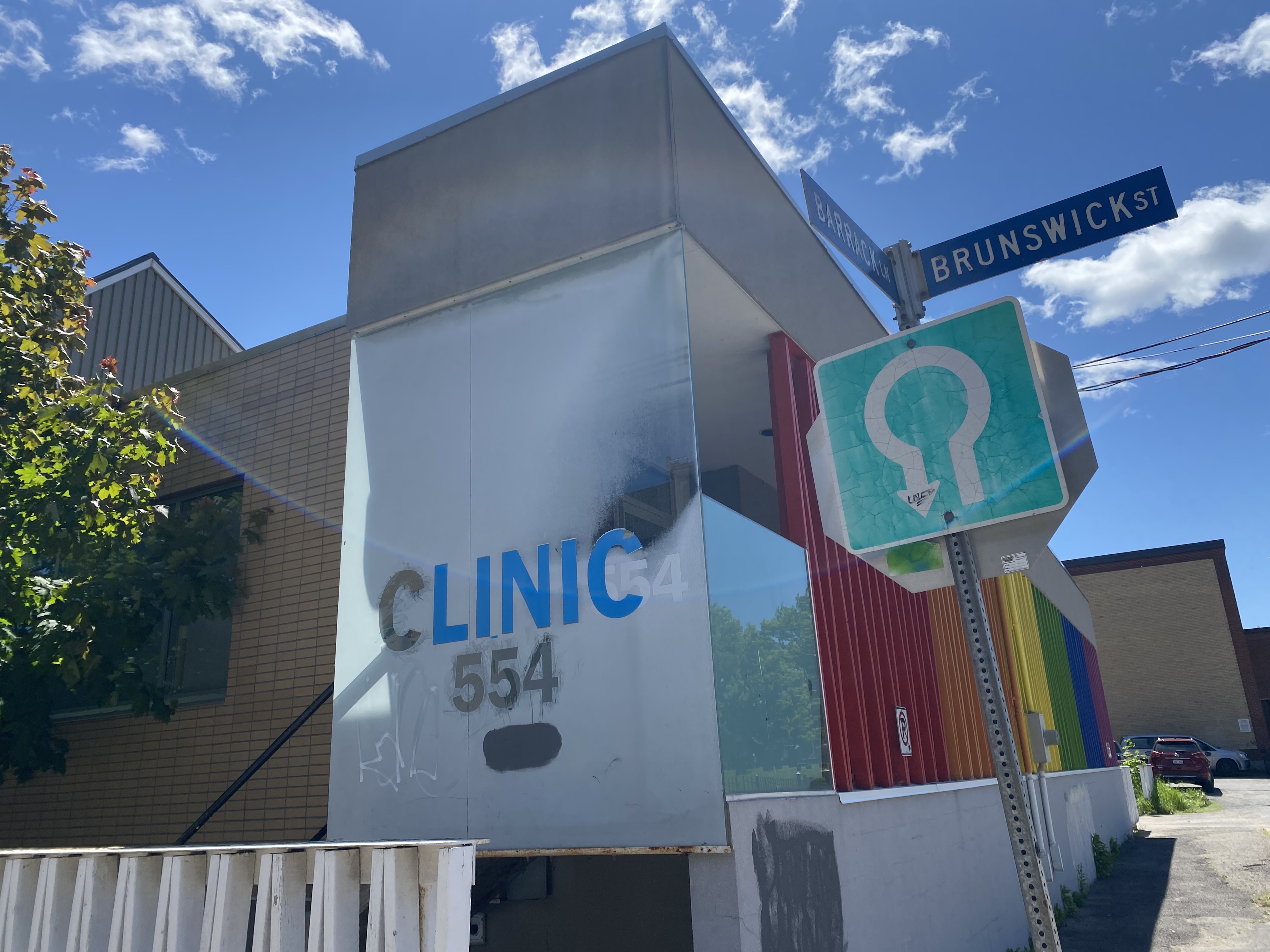
 Clinic 554
Abortion was decriminalized in Canada in 1969. To this day, however, many women across the country still encounter hurdles in exercising this right to its fullest extent. Most notably, New Brunswick has long imposed crucial restrictions on surgical abortions. These restrictions have been met with resistance.
The Media Co-op spoke to three activists who integrate Reproductive Justice New Brunswick (RJNB) about the present situation of abortion access in New Brunswick. RJNB was established in 2014 in response to the closure of the Morgentaler Clinic. According to its website, RJNB has since “continued to work with community partners, lobby the government, and educate and inform the public regarding the issues related to reproductive health and justice in the province.”
Before thinking about the present, however, it is necessary to delve into the province’s recent and troubled past with access to abortion.
‘Unequal,’ ‘unreliable,’ and ‘unconstitutional’
These are some of the adjectives that activists use to describe the current state of abortion access in New Brunswick. Following the decriminalization of abortion in Canada, successive administrations in New Brunswick endeavored in a decades-long effort to restrict access to the procedure.
Underlying these restrictions is the question of funding. According to regulation 84-20 of the 1989 Medical Services Act, surgical abortions will only be covered by Medicare if they are performed in hospitals. However, there have never been many hospitals in New Brunswick that perform the procedure.
The numbers have, historically, varied between two or three. Currently, only three hospitals perform surgical abortions: one is located in Bathurst, in the far north of the province, and the other two are located in Moncton, towards the southeastern boundary with Nova Scotia. On a geographic level, this unequal distribution leaves most of the province uncovered.
Most notably, none of the hospitals located in Fredericton provide surgical abortions. For the last three decades, abortion care in the capital region was provided through two free-standing clinics: the Morgentaler Clinic and Clinic 554. The Morgentaler Clinic was established in the 1990s, and remained open until 2015.
In 2015, a group of activists and providers united themselves to open Clinic 554 where the Morgentaler Clinic had once operated. Unfortunately, Clinic 554 found the same fate as its predecessor, ceasing operations permanently in February 2024.
The reason behind the closure of both clinics is the same: lack of provincial funding. For the longest time, both clinics operated at a loss. It was their policy that they did not turn away clients, even if the clients did not have the funds to pay for their own care.
Throughout the two years that preceded the closure of Clinic 554, activists urged New Brunswick’s government to change its long-standing policies. Activists’ calls to fund Clinic 554, even when heard, were denied.
When the provincial government announced that Medicare would be covering cataract surgeries performed in clinics, Health Minister Bruce Fitch defended the government’s stance on not funding Clinic 554.
“The big thing that we have to point to is the wait line and the wait time. On the abortion question, we’re not seeing the wait line or the wait time,” he said. “People have access through various means. Some of the methods have improved.”
As reported by the CBC, this comment referred to the so-called “abortion pill,” or Mifegymiso. In 2017, New Brunswick became the first province in which Medicare would cover Mifegymiso.
The approval of Mifegymiso as a Medicare-covered drug shows that, in some important ways, access to abortion care has changed for the better in New Brunswick. In 2014, the provincial government also struck off the infamous “two-doctor rule.” The rule prescribed that someone seeking surgical abortion should acquire the sign-off of two doctors to undergo the procedure. Moreover, the doctors should deem the abortion “medically necessary.”
In spite of these undeniable advancements, accessing abortion in New Brunswick is still a challenge for many women. According to the Canadian Civil Liberties Association (CCLA), the brunt of inaccessibility falls the strongest on the shoulders of Francophone, rural, and/or low-income communities.
The organization argues that the unequal nature of abortion-related care in New Brunswick is unconstitutional. In 2021, the CCLA took the provincial government to court to prove that its restrictions on surgical abortions are infringing the Canada Health Act.
The talk on the ground
Valerya Edelman is a member of Reproductive Justice New Brunswick (RJNB) and served as the manager of Clinic 554 before its closure. About her involvement with the group, she said: “I collaborate with members to ensure that correct information about abortion access is available to the public.”
Spreading information to the public is a great prerogative of Reproductive Justice New Brunswick. People seeking a surgical abortion may find information on RJNB’s website, or may encounter them in events where the group distributes handbills and flyers with information.
“We have had a long campaign since 2014 to remove the barriers to abortion access that [are] in the Medical Service Payment Act,” she says.
With elections coming up in the fall, Edelman says “RJNB will be pressuring candidates to speak about their plans for abortion access in the province. … including what they would plan to do with [regulation] 84-20.”
Even though the majority of New Brunswick’s population is pro-choice, Edelman thinks that anti-choice (or pro-life) people still bear influence in the province.
“The people who work in the government, not just the elected officials, but also people who are employed in the Department of Health and other institutions, have a great influence on how policy is maintained and how policies are created,” she explains, adding that “there are people who are anti-choice, or pro-life, who have had very vital roles in these institutions.”
“So, in various aspects of the government, they have a strong influence even if they are not marching in numbers, even if they don’t stand in front of the hospital.”
Where activism meets research
In the past, so-called “pro-life” activists did stand in front of clinics. Historian Christine Hughes has been an activist for reproductive rights in New Brunswick for the last 10 years, and she recounts counter-protests against the anti-abortion crowd.
“I started when I was still in late middle school, early high school, and I did take part in counter-protests at the clinic while the anti-choice folks were still out in full force,” she stated, noting that she helped organize the campaign to “get the funding the first time the clinic closed.”
“I have been working on this the whole time. I was very involved. It is kind of a family affair,” she says, as her mother was also part of the movement for reproductive justice.
Nowadays, Hughes deems herself a “project person” at RJNB.
“I come in when there is work to be done on particular projects, but I am not one of the core members at the moment, although that might change in the future.”
Sociologist Tobin LeBlanc also has a long history of activism in New Brunswick, where she volunteered at the old Morgentaler Clinic as an escort.
“The anti-choice protesters were able to protest quite closely to the clinic and harass patients or people they perceived to be patients,” she recalls.
LeBlanc does not consider herself a member of RJNB, but has been greatly involved with matters of reproductive justice in New Brunswick. She, Hughes, and other collaborators helmed the University of New Brunswick’s Reproductive Justice Access Project New Brunswick (RJAPNB). The group published their findings in late 2023.
“One of the things we found when we did this work on something that goes through our own work on a grassroots level is the lack of clarity that comes from political leaders on abortion care in the province,” LeBlanc says.
“We know [things] get messy if you don’t have a family doctor, we know about self-referral, we know about different sexual health clinics that you can call or access,” she explains.
“But if you don’t know it, if you don’t have access to [information] at your fingertips, it is really difficult to find it.”
LeBlanc says underlying these gaps in information, and even in the unwillingness to change long-standing policies, is the misconception that abortion access is not important.
“It is the result of an attitude that this is not an urgent matter, that this is not something that is pressing, then it isn’t something that should be prioritized,” she says.
And what is the road ahead? Hughes has an answer: “The fight continues.”
“We need to improve access regardless, we need to get it out to folks who are in smaller communities. …We need strategies outside the clinic that address those needs,” she says.
“That is where my fight is, and that is where a lot of people’s fight is.”