
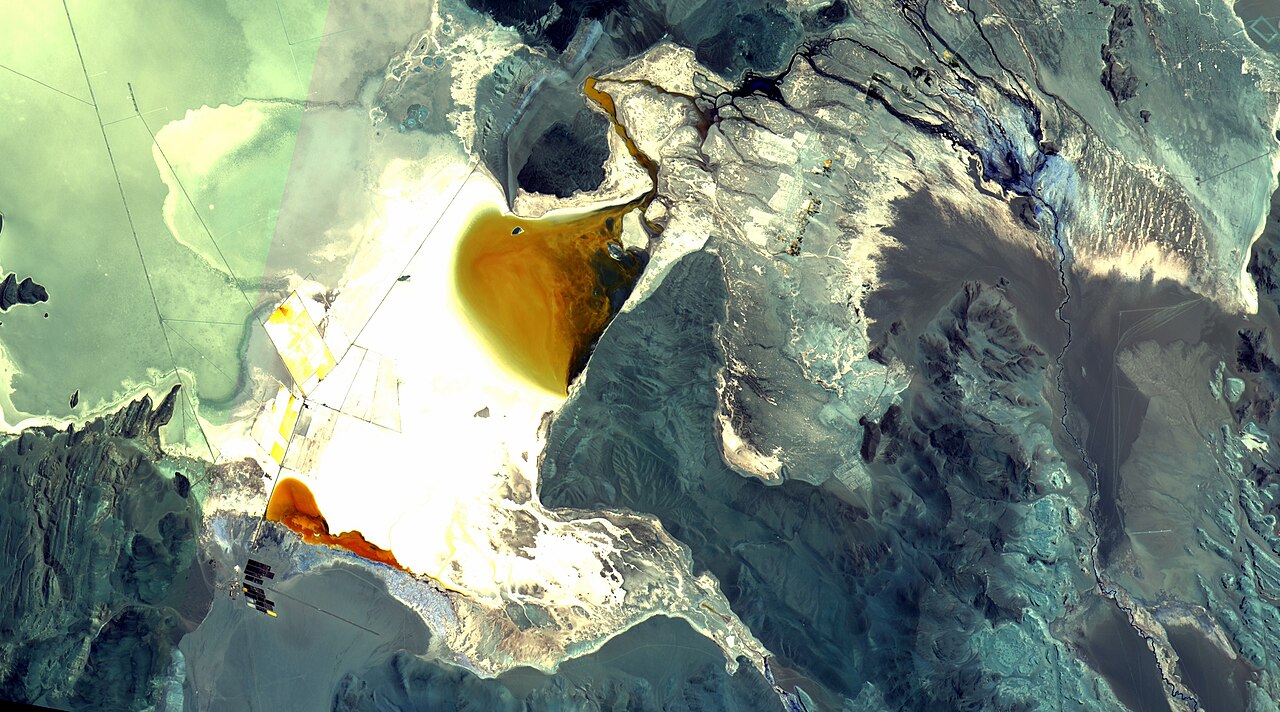
 Lithium Mining at Salar del Hombre Muerto, Argentina. (Source: Wikimedia)
Since taking office in December 2023, Argentina’s libertarian president Javier Milei has pushed a wide-ranging deregulation of the country’s mineral industry. In these efforts, he has the support of the world’s leading capitalists, including Elon Musk, whom Milei claims called him after his election. “[Musk] is extremely interested in lithium,” said Milei, “and the United States government and many companies from there are also very interested. But they need a legal framework that respects property rights.”
Musk, one of the world’s richest men, has praised Milei for his shock therapy reforms, recommending companies invest in Argentina. Not that they’ll need much encouragement. As mining companies scramble to take advantage of rising demand for minerals needed to manufacture products like solar panels, electric vehicle batteries, and more, Milei is putting his country at the mercy of transnational corporations, including those involved in mining.
A presidential decree from Milei reads, “Mining is another area with great potential in the country that is notably underdeveloped. To that end, we must eliminate costs.” The “costs” Milei wants to eliminate, however, are those paid by large transnational corporations, not workers, mining-affected communities, or the nation’s ecology.
As part of a “chainsaw austerity” economic plan – which has seen Milei cut 70,000 state jobs, end fuel and gas subsidies, and slash public investment – the Argentine president is reducing government oversight of mining projects, thereby handing a massive gift to the transnational mining industry. He has revoked laws that would require mining companies to submit data on equipment, employment, and more to the state. At the same time, he has offered companies a suite of tax, fiscal, and customs benefits under the Large Investments Regime (RIGI) and stripped environmental protections related to extraction. As an example, his reforms include measures to allow deforestation and glacier mining.
While some mineral-rich countries in the region – including Bolivia, Chile, and Mexico – are taking advantage of rising demand to increase state revenues from mining and develop local industry, Milei is swinging in the opposite direction. His reforms will allow mining companies to expropriate more value from Argentine minerals while giving less back to the national economy. In other words, it’s exactly what Canadian mining companies want.
Canadian companies like Lundin Mining, First Quantum Minerals, and McEwen Copper Inc. are eager to cash in on Milei’s reforms. Rob McEwen, founder of McEwen Copper, has lavished praise on Argentina’s hard-right turn, describing Milei as the “Prince Charming who’s given [Argentina’s mining industry] the wake-up kiss.”
Meanwhile, the latest issue of the pro-industry Canadian Mining Journal singled out Argentina as “a trove of mineral wealth,” especially copper and lithium. An article by Gordon Feller noted that “Argentina’s government is actively promoting the mining sector, offering attractive investment incentives and streamlining regulations.” Feller notes that “environmental concerns, community engagement, and regulatory hurdles” present challenges for mining companies, but with Milei in power, “the opportunities may now outweigh the challenges.”
As elsewhere, mining is controversial in Argentina. While transnational investors and the businesspeople in the Argentine Chamber of Mining Companies (CAEM) celebrate Milei’s liberalization measures, many workers are opposed. The Argentine Mine Workers Society (AOMA) and ASIJEMIN mining union have participated in a series of general strikes against Milei’s reforms. In Jujuy, Argentina’s poorest province, Indigenous-led organizations have rallied against Governor Gerardo Morales’s efforts to restrict the right to protest and open the door to lithium extraction across Indigenous lands.
Many provincial governments disagree with Milei’s selling-out to the mining industry. For instance, numerous provinces have banned open pit mining and the use of cyanide, mercury, and sulfuric acid in mining projects, including Chubut, La Pampa, Mendoza, Córdoba, San Luis, and Tucumán. Milei’s mining secretary Luis Lucero has criticized such protections, stating, “Those who prohibit the activity must take responsibility for the economic damage they cause.” Meanwhile, the province of Catamarca has issued a freeze on new lithium projects.
Mining may be divisive in Argentina, but that hasn’t stopped Milei and his allies from courting investment from Canadian companies – and it certainly hasn’t prevented Canadian companies from pursuing new profit opportunities in Argentina.
In early March 2024, Argentina’s Ministry of Foreign Affairs coordinated the participation of a mining delegation in the 2024 gathering of the Prospectors & Developers Association of Canada (PDAC) in Toronto. Mining industry figures, plus the governor of San Juan province and high authorities from Catamarca, Salta, La Rioja, Sancta Cruz, Mendoza, and Jujuy, flew to Toronto for the event. The first day of PDAC was titled “Argentina Day” – it saw Argentine representatives openly court Canadian investment. Staff from Argentina’s consulate in Toronto organized meetings between provincial authorities and companies interested in Argentine minerals.
Prime Minister Justin Trudeau has spoken with Milei on multiple occasions. Press releases always emphasize the leaders’ common ground. In January 2024, shortly after Milei’s inauguration, Trudeau and Milei spoke of “continuing to grow the trade and investment relationship” between their countries while “strengthening supply chain integration.” In late May, the Prime Minister’s Office claimed that “the two leaders discussed shared priorities, including economic co-operation.” Trudeau has made no mention of Milei’s attacks on critical journalists or his repressive response to anti-austerity protests.
Economic cooperation between Canada and Argentina means, among other things, cooperation on mining projects. As of 2022, there were 56 Canadian mining companies operating in Argentina, their projects valued at over $9 billion. In fact, most Canadian imports from Argentina are metals, as the Government of Canada website notes: “Canadian imports from Argentina had a value of $1.3 billion in 2022, of which the vast majority were metals (principally gold) due to Canada’s significant presence in the Argentinian mining sector.”
The magnitude of Canadian investments in Argentina, and the Milei government’s hard-right economic turn, explain Ottawa’s friendly relations with Milei. In Latin America and elsewhere, the Canadian government backs states that support Canadian companies’ ability to invest and profit – in other words, the right. When states intervene in the private sector and divert value toward public needs – in other words, when they enact leftist reforms – relations tend to sour. As the Working Group on Mining and Human Rights in Latin America explains, the ability of the mining industry to profit influences Ottawa’s decision to cooperate with some foreign states over others.
In the past few years, Ottawa has vocally supported the violent right-wing government of Dina Boluarte in Peru, which massacred over 70 protestors after seizing power from elected president Pedro Castillo in December 2022. There are 72 Canadian mining companies invested in Peru with assets valued at over $10.6 billion. In Ecuador, meanwhile, Canada backed a series of extremely unpopular right-wing governments which repressed progressive uprisings in 2019, 2020, and 2022. There are 15 Canadian mining companies in Ecuador, their assets valued at close to $2 billion.
The disparity of Canadian mining investments between Ottawa’s allies and foes is striking. For instance, in the Latin American countries that Ottawa most criticizes – Cuba, Venezuela, and Nicaragua – there are a total of 5 Canadian companies working. In public records, the value of their assets is noted “x” for confidential.
Like Washington, Ottawa wants to build a Western supply chain of critical minerals to counter China’s dominance of the sector. To this end, Canada’s federal Critical Minerals Strategy identifies 31 minerals as “essential to military and security technology supply chains for national security [and] Canada’s economic security and prosperity.” Of these 31 minerals, six are prioritized “for their distinct potential to spur Canadian economic growth and their necessity as inputs for priority supply chains.” These six include copper and lithium – minerals in which Argentina is very rich.
In the context of geopolitical competition with China and the so-called “sustainable transition,” Canadian mining companies and the federal government are eager to extract critical minerals domestically and around the world. For the transnational mining industry, more concerned with profit than anything else, Milei’s Argentina appears to be a lucrative opportunity, as long as he is able to bulldoze his opponents in government and popular movements.
As Milei confronts his opposition and pushes for further neoliberal reforms, it is obvious whose side Canada is on.