
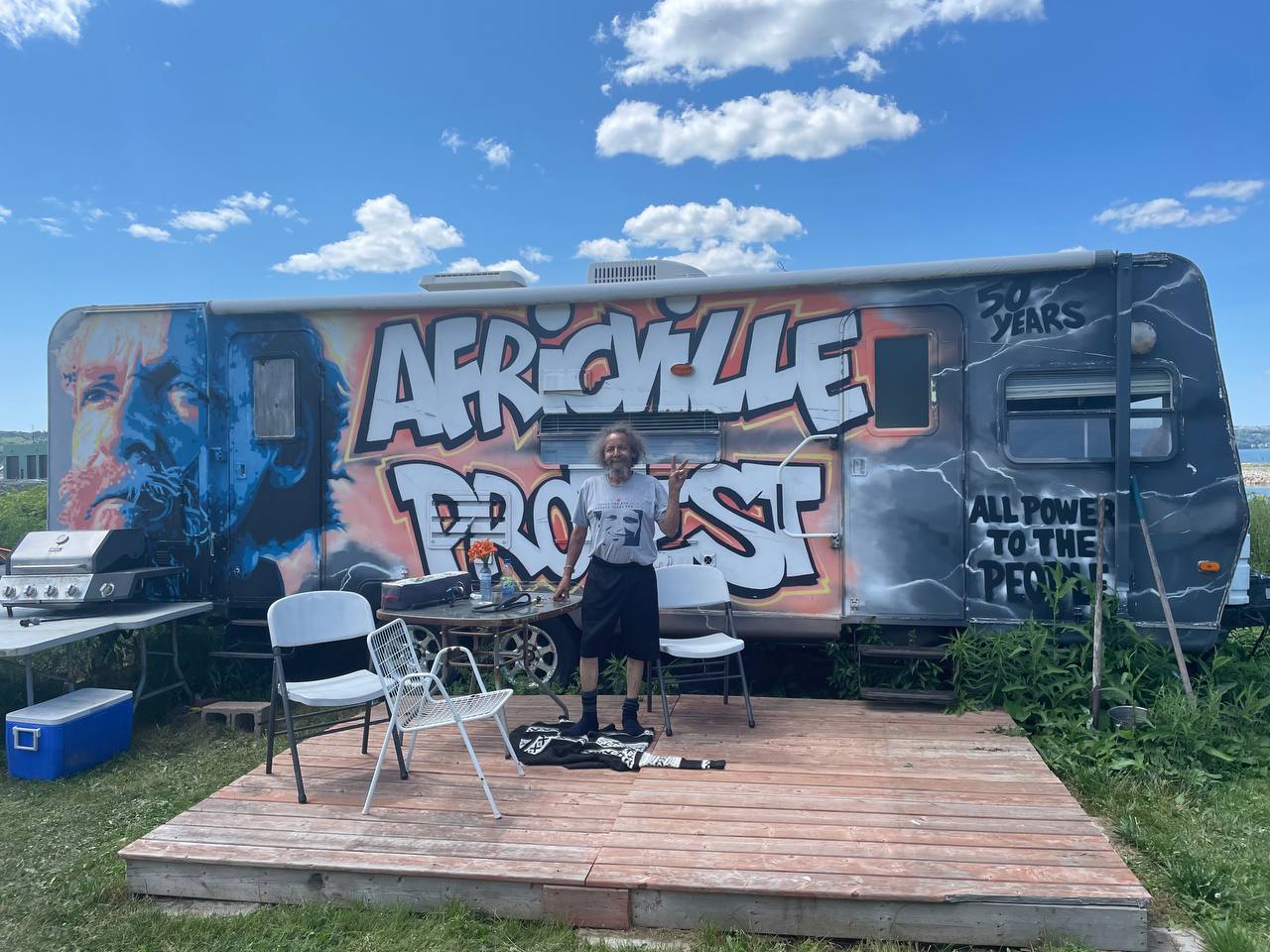
Writer and activist El Jones calls him “the longest symbol of protest in this country,” while Lindell Smith, city councillor for Halifax Peninsula North, describes him as “the most significant activist” to emerge from Africville, a community of Black Nova Scotians founded in the 18th century. His name is Eddie Carvery, and for 54 years, he has lived on a protest site in Africville, drawing attention to the injustices inflicted on his community by the City of Halifax.
Eddie Carvery was 24 years old when the city government wiped his community off the map. Carvery’s recollections of his childhood in Africville, the community’s destruction, and the Canadian government’s refusal to engage with his demands are a vital contribution to the vast and always growing record of racial injustice in Canada. More than that, Carvery stands as a powerful inspiration for activists worldwide, someone who has muscled through decades of racist assaults – from the city, the police, the Ku Klux Klan – without wavering from his cause. Yet he remains firmly outside the Canadian mainstream, unrecognized, ignored. It is past time that Canadian society recognizes the importance of Carvery’s protest – and indeed, the importance of Carvery the man.
On July 19, 2024, I visited Eddie Carvery in his trailer outside the Africville Museum in Halifax. He is now 77 years old. He has suffered several heart attacks and a stroke. His left eye is nonfunctional, threaded by blood, but he speaks with clarity and fervor, voice sometimes rising with anger, sometimes sagging with resignation. He punctuates his points by smacking the wood table in his trailer, which sits a stone’s throw from the Africville Museum, constructed in 2010 following a compensation agreement between the City of Halifax and the Africville Genealogical Society. The 2010 agreement followed the Mayor of Halifax’s apology for the demolition of Africville and the relocation of its residents. However, while funds for the museum followed, individual compensation for survivors of Africville’s destruction did not. Genuine compensation, and the restoration of the Africville community, are Carvery’s main demands.
Though beset by health problems, Eddie Carvery has retained his love for humanity, his faith in God, and his belief that through sustained organization, Canada’s future can improve upon its shameful past and present.
Eddie Carvery: My name is Edward Leo Carvery. I was born in Africville, Nova Scotia on October 5th, 1946. I was not born in a hospital. I grew up in Africville, and I’ve lived here all my life. We had our own church, our own school. We were great at fishing – as a matter of fact, we sort of made a living from the sea.
Owen Schalk: What are some of your most significant memories from growing up in Africville?
EC: What the city imposed on us was just unbelievable. The war [Second World War] had ended, and they needed a place to put soldiers that came back with diseases, but they didn’t want them among the general population. So they built a contagious disease hospital [near Africville] called the Basinview Hospital. They put it up at the head of our community, and they dug a sewer that led from that hospital right down to Africville. We had a pond at the edge of the water…it was a fishery, it was a place where we learned to swim. That’s where the sewer from the contagious disease hospital led. We didn’t know what it was until we all started breaking out in sores and catching diseases.
Then they gave us the toxic waste dump…they put it on my uncle’s land. That dump was there for twenty years or so, and in that amount of time, it filled with toxic waste and stuff from the hospitals. The garbage trucks would be full of syringes, bloody blankets, body parts. The SPCA used to bring the carcasses of animals. We had a rodent problem from the dump, which resulted in the city deciding to poison that whole area, which they did. They sprayed the whole ground [around the dump]. Now today, all these years later, everybody from Africville who lived around that dump has either died of cancer or they’re dying of cancer.
We’re still sitting here trying to get a public inquiry as to what happened to our community, how come everybody’s dying of cancer, and we’re not getting no answers. We never received our compensation package.
Half of my ancestors were Maroons. They were here before white people. We built the forts, the streets, the houses. We were there on the front line [yet] they took our farms. We had all the little jobs in the city – maintenance jobs, things like that – and they took that from us. They took away our livelihood, our work, but we managed to survive for over a hundred years. Though we never did get running water. We didn’t get electricity until the ‘60s. We never got sewage – they gave us their sewage, but we never got a sewage system.
People came from all over to worship at our church. We were strong, religiously speaking. A solid, open-door community. But they gave us these negative institutions like the city dump, like the hospital, and they wouldn’t service our needs. The snowplough wouldn’t come out in the wintertime.
They made life miserable for us, until eventually, if you didn’t have a deed to your property, you were given $500 and escorted out of Africville as they bulldozed your house. And the same dirty dump trucks that picked up the garbage in Halifax were the trucks they used to take us out of Africville. Dirty dump trucks.
We had something they wanted – right here, this piece of property, they wanted to put that bridge here…Same with the container pier. They get two billion dollars a year [from that]. It’s on our land and we get nothing. Now they sold that container pier to China. How can they do that?
We were here first, we built this city, and they turned their back on us. They were racist, they treated us very mean, and they stole our community. They took our church – at three o’clock on Sunday morning, they had the bulldozer take our church and everything that was in it.
We used to have a school. They took that and said, ‘we’re going to integrate you into city society and give you a better education.’ They lied. When they took us and put us into their school in the city, they invented an auxiliary class for the kids from Africville. Those kids never had a chance for an education. The city of Halifax did that to us, and they got away with it. [On top of that] we were discouraged from going into town. They’d use racist slurs towards us. It was very difficult in Africville.
OS: How old were you when the city bulldozed Africville?
EC: I was young. Between the years of fourteen and eighteen, I watched my community disintegrate, and in 1970, I started the Africville protest. I was [about] twenty years old. I’ve dedicated my whole life to fighting for justice.
Our community was here before Halifax. It was our community that built Halifax, starting with Citadel Hill. In the Depression, we were the ones that started the first soup kitchen in Nova Scotia, to feed people in Halifax. It was black hands from Africville that did that. When the explosion in 1917 wiped out the whole north end, it was black hands, hands of the Africville people, that ran up over the hill and saved so many lives…And instead of helping us, they took our farmland and put houses on it, but not for us. For white people.
OS: Back in 1970, was there any question in your mind that you needed to challenge the injustices you were witnessing?
EC: It was my understanding that our community couldn’t be sold, it couldn’t be stolen. As a young man, I was sleeping on the ground and they were trying to force me out of Africville. They pulled all kinds of mean tricks on me. I remember them driving by shooting bullets at me, and I wouldn’t leave. I remember Ku Klux Klan, in their uniforms, chasing me. I wouldn’t leave.
My own people, they thought I was holding them back and they weren’t getting what they wanted because I was protesting. I still wouldn’t relent. I fought for what I believed was right, and I’m still here today saying what the city did was wrong, it was illegal, and the only way they can make it right is to give Africville back to the people and compensate us for the pain and suffering they created.
We deserve a future, not so much for us, but for our children and our children’s children. That’s why until they make it right, I’m in their face. I’m doing what everybody should be doing: protesting that what they did then was wrong, and it’s still wrong. We, the people of Africville, lost something very precious and the City of Halifax did it knowingly. They took our heritage and our future. I’m not quitting until they do the right thing.
OS: Who were your political inspirations? I know you were particularly influenced by Martin Luther King Jr.
EC: He was a great leader. There was also Jesse Jackson. Then there were the militants: Stokely Carmichael, the Black Panthers. It was a whole different setup. They [the conservative establishment] was scared what black people might do, so they made concessions.
Martin Luther King, he was my hero. And Nelson Mandela, he was a real champion of people. He fought apartheid in Africa, even though they put him in jail for that.
We’re all one people, just different flesh, different colours. We’re all one spirit. I believe there’s hope. I believe in tomorrow. I believe in God, and I believe that one day the right thing is going to happen and they will give Africville back to the people.
OS: Has there been anybody since Mandela and King who has inspired you?
EC: Not especially. I’ve sort of backtracked, and I’ve become like a hermit. I stopped reading, I stopped doing a lot of things. I was busy protecting myself and Africville. But I’m here, I’m still talking, and I’m trying to reach somebody.
There’s a whole new generation of people. Surely not everybody has that Nazi mentality. Surely there’s people that want to do the right thing. We deserve to love each other, respect each other, live in harmony, and do what’s right for each other’s sake, not cut throats and break hearts and ruin communities and take advantage of poor people.
OS: When you started this protest, did you ever imagine you’d still be protesting all these years later?
EC: No. In the first place, I never wanted to start the protest. I wanted to blow up the bridge. I wanted to blow up city hall. I’m not joking.
I took it to my mother. My mother listened to me, but when I got to city hall and what I was going to do to those guys, she shut me up. She said, ‘if you’re going to do that type of thing, you’re going to jail for the rest of your life and you’re not doing nothing for nobody. If you want to do anything, you’ll take a blanket, go out to Africville where you were born, and start the Africville protest.’
That’s what I did: I came out here and laid on the ground. A week went by. Then a month. Three months. Six months. A year. Another year, another, and I’m still here, trying to survive, trying to get someone to help me fight racism in Halifax. I turn around and I’m an old man.
I know this much: we have to all get on the same page, and it starts with big-letter Love. We got to have that in our hearts…We can have a different type of society. We can bury the gun, we can change the world. That’s what we have to concentrate on, because what they’re doing is crazy. They’ve got Donald Trump, they’ve got Putin, they’ve got this other fucking nut in Israel.
Look what that guy [Netanyahu] is doing in Israel. All those Palestinian people…look what he’s done to them. Thousands of people, and they’re getting away with it, because they have the support of the United States. It’s time for that shit to go away so we can have harmony, love, peace, and live a natural life like we’re supposed to. We don’t get that opportunity with warmongers.
Let’s realize we’re all important, we’re all special. We can do the right thing. Halifax: do the right thing for Africville. Federal government: do the right thing with Indigenous people.
OS: Do you consider yourself a socialist?
EC: I consider myself a rebel. I’m a realist. A protestor. I’m not going nowhere until I see justice. I believe in God, and I believe God’s put me here [to seek justice]. They can’t get rid of me, because I won’t go away.
They tried every dirty trick in the book. They even created a park to get me out of here, but I just don’t want to go. I’m in their face. I blocked the bridge, I blocked the road, I went down to city hall shooting off my mouth. I’ve tried everything I could possibly think of – now the only thing I can say is, I’m a witness. I’m looking for justice, and until justice comes, I’m not going nowhere. Africville will never die as long as I’m alive.
OS: Where do things stand between you and the City of Halifax?
EC: They don’t pay attention to me. The media don’t talk to me. Nobody comes and talks to me, because I’m the truth, and they know it.
They took our future, our children’s future, and we’re not supposed to say nothing because [they say] we’re dumb, we’re stupid. It’s up to us to take it back, and I suggest to anyone who wants to join this protest, come on out and let’s get started. If you want to fight racism, then get your hands dirty. Start swinging.
We’re all Canadians. We all deserve to be on the same page. I’m tired of people dying, I’m tired of my children suffering. Change society. We got to start sooner or later. If we don’t start learning how to love and appreciate and respect one another, we’re in trouble, because there’s a lot of Donald Trumps, there’s a lot of Putins, there’s a lot of Netanyahus. It’s hard, but this is what we got to do. Our children deserve a better life than we had.
OS: Considering what you’ve witnessed, what would you tell Canadians who still believe Canada to be a fair and just nation?
EC: It’s not really Canada, it’s the politicians. They’re crooked. They’ve got bad ideas. But they don’t count. What counts is this: we’re people, we’re alive right now, and we should be able to make a difference.
I believe in Canada, I believe in Canadians. I believe there’s a lot more people like us than we realize, and if we put our heads together, we should be able to control the destiny of our country. [The politicians] work for us, we don’t work for them. But they’re stomping on us, walking over us.
When they tore Africville apart, destroying our homes and church and community, that unleashed something in me and it’s given me the ability to stay here and fight. We all should do the same thing: fight for what we believe.
OS: So you’re not going away?
EC: Ain’t going nowhere. I packed it in a few times, but somebody’s got to be here to tell the story, and it’s me.
Look what’s happening in the States. Look at Russia. Look over in Africa. [Injustice] is happening all over the world. And Canada, we’re supposed to the champions and the leaders, and we’re the worst of the bunch. Think about it: look what we did to the First Nations people. Look what we did to Black people and other minorities. Canada’s supposed to be the land of the free, the land of milk and honey, but it’s all a bunch of crap. We’re the worst racist country in the world – one of the worst. Any time they can get away with taking a whole community and wiping it off the face of the earth like it never existed, [they’ll do it]. That’s what they did with Africville.
I’m illiterate. I got no education. The teacher I had when I left Africville’s school, in grade three, hated me so good. Every day she stood me up in the classroom and told the other kids they couldn’t go near me because I was contagious. I wasn’t allowed to play with the rest of the kids at recess. Each day she’d stand me up in the middle of the classroom and say, ‘this is what you must not be like.’
That was from grade three until I was sixteen. That’s what the system did for me. It abused me and the rest of the kids my age. [The city] created an auxiliary class for us, but we never had the opportunity to learn. When we left school at sixteen, we didn’t know what two plus two was. None of us got an education. They didn’t want us to know anything about fighting them, about lawyers, our rights. What can I say? I’m seventy-seven and I’m illiterate because I didn’t get an opportunity to learn in school, because somebody took that opportunity from me.
It’s up to all of us to be vigilant, and to correct injustice when we see it, so we can have a better society than what came before – a society of love and generosity. Make it a priority to be happy. Make it a priority to do the right thing. That’s all we got to do in order to make a better society. I don’t know if we can ever change politics, but we can change our attitude. We can start appreciating every day of our lives, because it could be the last day. We can make the world a better place than it was yesterday.