
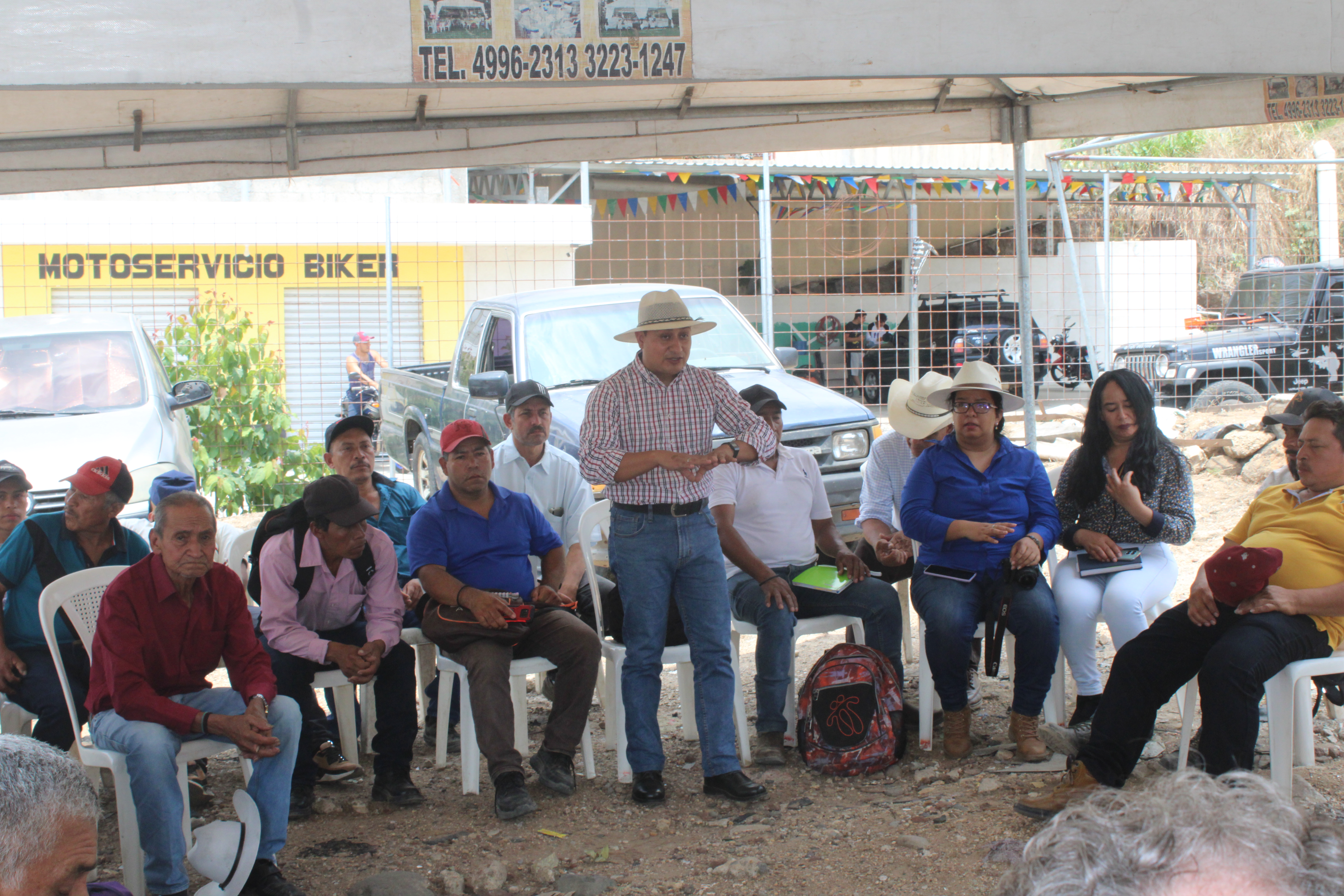
 A meeting of Xinca land defenders. (Photo: Helen Jaccard)
“Everything,” says Angélica Choc, “depends on the vital liquid – water.” Choc is a Maya Q’eqchi’ land defender from El Estor in eastern Guatemala. For years, she and other Q’eqchi’ villagers have opposed the development of the nearby Fenix mine, a massive mountain-top nickel complex in El Estor’s Izabal Department.
In early May 2024, I joined a delegation visiting several communities that are fighting against Canadian mining projects in Guatemala. The trip included opportunities to learn from the struggle at Asunción Mita, the Xinca-led resistance to El Escobal mine, and the Maya Q’eqchi’ resistance in El Estor, in which Angélica Choc is a leading figure. While each struggle has its own origins and context, Canada is directly involved in all of them – in opposition to the land defenders.
Canadian companies are heavily invested in Guatemalan nickel, silver, and gold. The webpage for the Canadian trade commissioner notes that the Guatemalan economy is “largely independent from the state,” and that the Guatemalan government aims to promote “strategic investments (including foreign investments).” This includes mining, a sector that has always been important to the Canadian state but that has become even more so with the announcement of Canada’s Critical Minerals Strategy (CMS) last year.
Fenix
The Fenix mine has been the site of local resistance and state repression for generations. In 1965, Canadian mining company INCO was granted a 40-year license in the area. One year later, Guatemalan colonel Carlos Arana Osorio launched a brutal counterinsurgency campaign in Izabal, backed by the US and allies, killing thousands and forcibly evicting peasants from the mining concession. Once the site was cleared of Indigenous people, Ottawa began funding the INCO mine through Export Development Canada.
INCO produced nickel from the Fenix mine for just three years: 1977 to 1980. However, those years coincide with the worst atrocities of the Guatemalan genocide. The Indigenous Maya in the area were targeted for assassination, eviction, and disappearances, and INCO participated directly in the violence through its EXMIBAL subsidiary.
Since the end of the war in Guatemala, the Fenix mine has changed hands several times. In 2004, Vancouver’s Skye Resources purchased the mine from INCO. Another Canadian company, Hudbay Minerals, acquired Skye in 2008, changing the Guatemalan subsidiary’s name from EXMIBAL to the Guatemalan Nickel Company (CGN). And in 2011, the Swiss-based Solway Investment Group purchased Fenix from Hudbay.
Atrocities against mining opponents and Q’eqchi’ civilians continued during these years, particularly under Skye and Hudbay. In January 2007, state forces and private security guards employed by Skye launched a violent eviction against the village of Lote Ocho in the mountains near Lake Izabal. Police, soldiers, and CGN employees allegedly gang-raped 11 Q’eqchi’ women, who later set a historic precedent by suing Hudbay Minerals in Canadian civil courts.
Angélica Choc’s husband was local community leader Adolfo Ich Chaman. In September 2009, mining company employees attacked Ich Chaman, hacked him with machetes, and shot him dead. That same day, a young Q’eqchi’ man named German Chub Choc was shot in an unprovoked attack by the head of CGN’s security and paralyzed for life from the waist down, the bullet still lodged inside him.
Although the Fenix mine is not currently operational, the repression and fear continues. In March 2024, police raided the homes of Angélica Choc and her family members. They speculate that this was due to her anti-mining activism, and was intended as pressure to drop the lawsuits.
The mine has had devastating implications for the surrounding ecology and the agricultural sector due to its impact on the water table. The dry season in Guatemala typically runs from November to April, and in the past, people didn’t have to worry about whether there would be enough water to grow corn and beans at a subsistence level. On a good year, they were able to produce enough food to last through the dry season. But as water supplies deplete and the dry season lengthens due to climate change, Choc doesn’t think this situation will last.
Choc sits in her backyard, overlooking a public field named in honour of late husband Adolfo. She motions to a small garden over her shoulder. “There’s my little plot. We’re praying for rain. We know that, with this drought, there’s a mini-famine coming just up the road.”
Choc dabs tears from her eyes with the hem of her huipil. “Life here is very hard,” she says. “So many people are forced to migrate. There’s no local economy. Wells and feeder rivers are drying up, and meanwhile, there’s open-pit mining down the road.”
German, survivor of the 2009 assassination attempt, says, “All we do is suffer. The last five months have been devastating here. The dry season is getting longer and hotter. Fishing has gone down. We can’t grow crops. Our water sources are drying up.”
Cerro Blanco
300 kilometres south of El Estor, outside the town of Asunción Mita, another mining complex hides behind kilometres of barbed wire fencing. The mine, Cerro Blanco, was originally proposed by the Vancouver-based Goldcorp in 2007, despite concerns about inadequate information on environmental impacts. According to locals, Goldcorp painted schools and funded a small clinic to persuade them to support the mine. These efforts failed. Facing opposition and technical complexities, Goldcorp sold Cerro Blanco to another Canadian company, Bluestone Resources, in 2017.
When Goldcorp owned Cerro Blanco, the company used a tunnelling method to extract gold from the hills. Bluestone Resources has adopted a new, more dangerous approach: open-pit mining, a process that will drain aquifers by hundreds of meters and make groundwater in Asunción Mita and the surrounding area much harder to access.
The problems don’t stop there. Bluestone plans to heap the mine’s waste rock into a mountain near the site. Residents are concerned that rainfall will cause the toxic materials to run into the Ostua River, Lake Guija, and the Lempa River, all of which flow across the border into El Salvador, potentially contaminating water resources in the neighbouring country as well. As a result, activists in Asunción Mita are working with Salvadoran water defenders to halt the Cerro Blanco project.
In September 2022, 89 percent of locals from Asunción Mita voted “no” in a referendum on whether to move ahead with the Cerro Blanco mine. Bluestone Resources and the Guatemalan Ministry of Energy and Mines contested the legality of the vote. Ultimately, Guatemala’s Constitutional Court nullified the referendum after an injunction filed by Bluestone’s subsidiary, Elevar Resources.
Officials in the US government have pressured Guatemala to push ahead with the Canadian-owned mine despite the vast majority of locals opposing the project. On June 6, 2023, acting commercial counsellor of the US Embassy Kayla Savage sent a letter to the Guatemalan Ministry of Environment, writing that “it is very important to continue promoting the attraction of American capital investment in Guatemala,” and therefore, “we are kindly following up on our previously sent note and to know the progress of the [Cerro Blanco] approval process.” A former Guatemalan Minister of Environment, Gerson Barrios, described the letters as “unusual” and “surprising.”
The Canadian government has never addressed concerns about Cerro Blanco’s environmental impact, mentioned the September 2022 referendum in Asunción Mita, or commented on US officials pressuring Guatemala to approve the Canadian-owned mine.
At a community meeting in Asunción Mita, a local activist with the anti-mining group Democratic Convergence (who did not share their name) asserts that the US and Canada are “corrupting ministers and officials to grease the wheels” on the mine. “They don’t want a strong, independent government. They want a corruptible government. And we, the people, suffer.”
In the words of another local water defender: “Corruption is not just in Guatemala. It’s in Canada as well. It’s the politicians in both countries advocating for these projects.”
El Escobal
A few hours west, Indigenous Xinca and Ladino land defenders assemble on a planton, or resistance encampment, near the town of San Rafael Las Flores. Shaded by corrugated tin, local activists share their experiences struggling against the nearby El Escobal silver mine. The Canadian company Tahoe Resources acquired the mine in 2011. In 2018, the Vancouver-based Pan American Silver purchased the Escobal project, but due to the Xinca-led resistance, the company has not been able to operate the mine.
Residents of San Rafael Las Flores and nearby Xinca communities depend on water from the mountains around the Escobal mine. Like mines owned by Solway Investment Group, Bluestone Resources, and others, the Escobal project requires massive quantities of water for extraction and processing. And like these other projects, the exploitation of local water resources disrupts community access. For these reasons, local referendums on the Escobal mine have massively and consistently opposed the project – leading former owner Tahoe Resources to file a lawsuit with the Constitutional Court of Guatemala to stop such referendums from taking place.
Throughout all stages of Escobal’s ownership, Xinca land defenders have been intimidated, kidnapped, shot, and even killed. In April 2013, Tahoe’s private security forces opened fire on twenty peaceful protestors outside the mine, wounding at least six. Shortly thereafter, Guatemala’s then-president Otto Pérez Molina declared a state of emergency and dispatched hundreds of police officers to the area around El Escobal mine, where they arrested twenty-six protestors for “unlawful assembly.”
The Canadian government has stayed quiet on the Escobal mine’s environmental harms and the repression of Xinca land defenders.
Most recently, residents brought an environmental assessment team from Colombia to deepen their understanding of the mine’s impacts. “This is not a short-term struggle against a mining company,” says Elson, a member of the community group CODIDENA. “It’s a struggle against a model of development. It’s a permanent struggle.”
On the question of US and Canadian support for the mine, the locals mince no words. “The US government is a bunch of thieves,” says a man named Rodrigo. “All they’ve ever done here is rob.”
Another man, Juan Monterrosa, states, “The US and Canada have been utter ingratos” – meaning “ungrateful.” He adds, “These people have evil in their hearts toward our country, our people. We will stay in the resistance until all these companies are gone. We’re here, come what may. If we die in the struggle, we die. We’re fighting for our homes, our lands, for Mother Earth.”
Canada has been interested in Guatemalan minerals for decades. Canadian mining companies helped rewrite the Guatemalan mining code twice, in the 1960s and 1997, to benefit foreign investors; meanwhile, the Guatemalan state repressed Indigenous peoples and progressive Ladinos who criticized this export-oriented economic model and the violence that accompanied it.
During the civil war of 1960 to 1996, 83 percent of the victims were Maya and 93 percent of the human rights violations were committed by Guatemalan state forces. Many opponents of mining were “disappeared” to make way for transnational investment, including by Canadian companies. As prominent US-based critic Noam Chomsky has written, “You can’t say the mining companies are responsible for the [Guatemalan state’s] slaughter but they are benefitting from the structures that were left in place after those many years of savagery and violence and repression.” In the era of the Critical Minerals Strategy, Canadian companies continue to benefit.
Today, half the population lives below the poverty line of $5.50 USD per day, with 25 percent of recorded employed people living on $3.20 USD or less per day. Almost half of Central Americans who flee north every year are Guatemalan. Meanwhile, mining companies are only required to contribute 1 percent in royalties to the national economy. Catherine Nolin and Grahame Russell, editors of Testimonio: Canadian Mining in the Aftermath of Genocides in Guatemala, describe this as a system of "transnational plunder."
Canada’s Critical Minerals Strategy aims to secure a steady supply of minerals needed to produce “sustainable” technologies – aluminum, copper, cobalt, gallium, lithium, nickel, zinc, rare earth elements, and more. “Growing our supply of critical minerals and the products they go into presents a generational opportunity with domestic and global benefits,” the strategy claims. “Our efforts must be consistent with Canada’s priorities and objectives including, environmental protection and conservation, safe and responsible labour practices, and respect for the rights of Indigenous peoples.” But in the experience of grassroots opponents to mines in Guatemala, these operations are anything but sustainable. They deprive local communities of access to water, food, and healthy ecologies, and when they organize to protest, they are repressed by the US- and Canadian-backed Guatemalan state.
Opponents of the Fenix, Cerro Blanco, and El Escobal mines draw a direct line from the repression of earlier decades to the struggle against Canadian mining companies today. In the words of Shenny, a member of the Xinca resistance: “No to this vision of economics. No to this model of development – past, present, and future – and no to mining. It’s been ‘no’ since the companies got here.”