
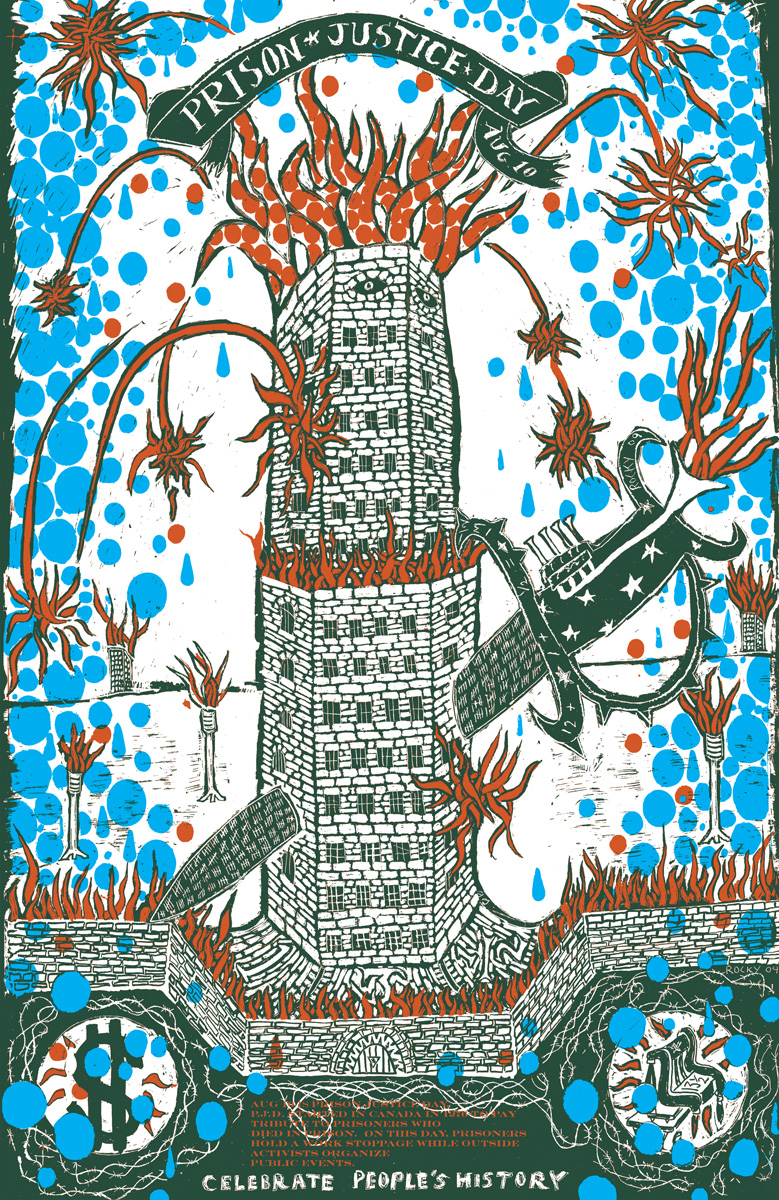
 A Prison Justice Day poster (Photo: Rocky Dobey)
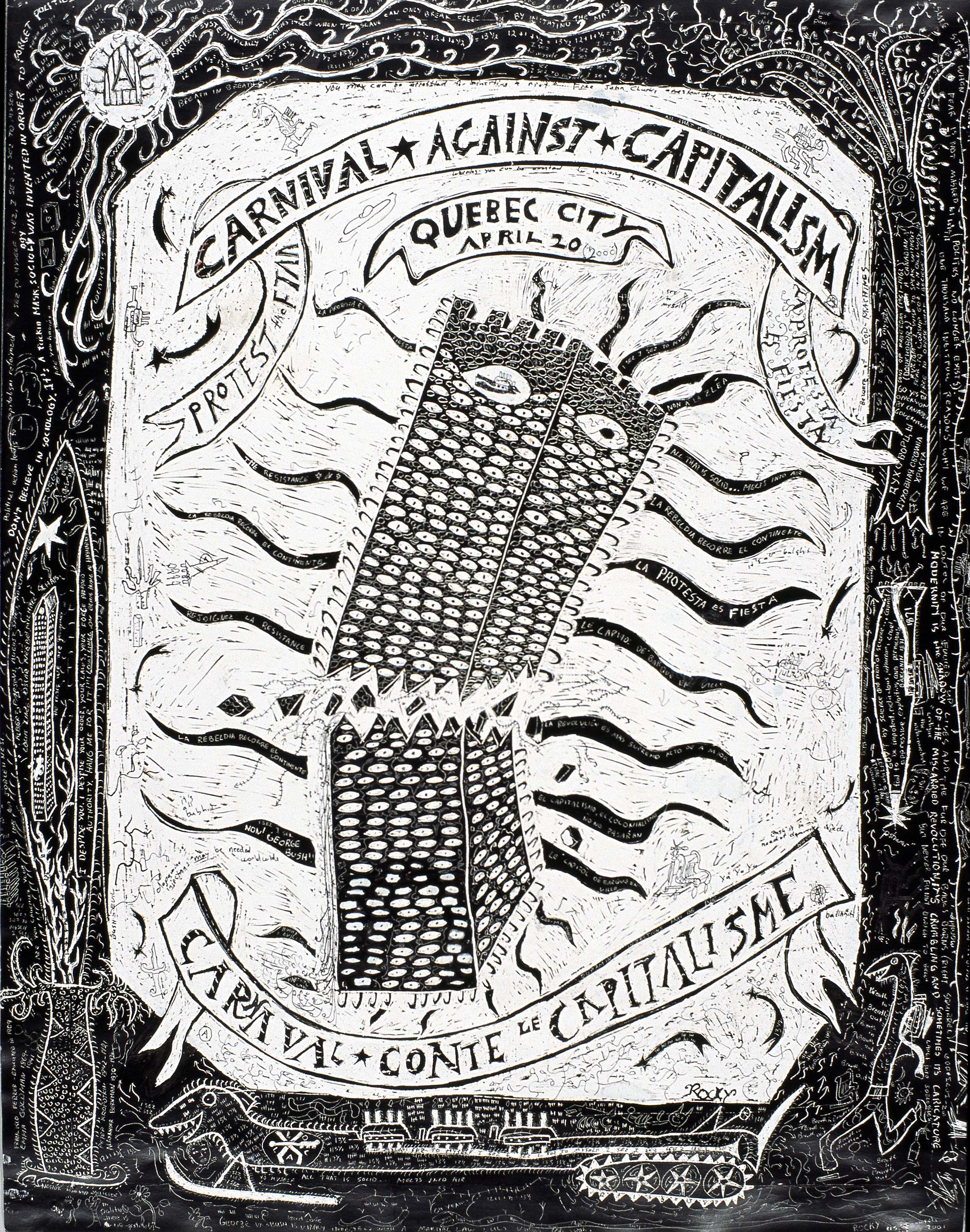 Poster for the Carnival Against Capitalism at the April 2001 protests against the FTAA in Quebec City. (Photo: Rocky Dobey)
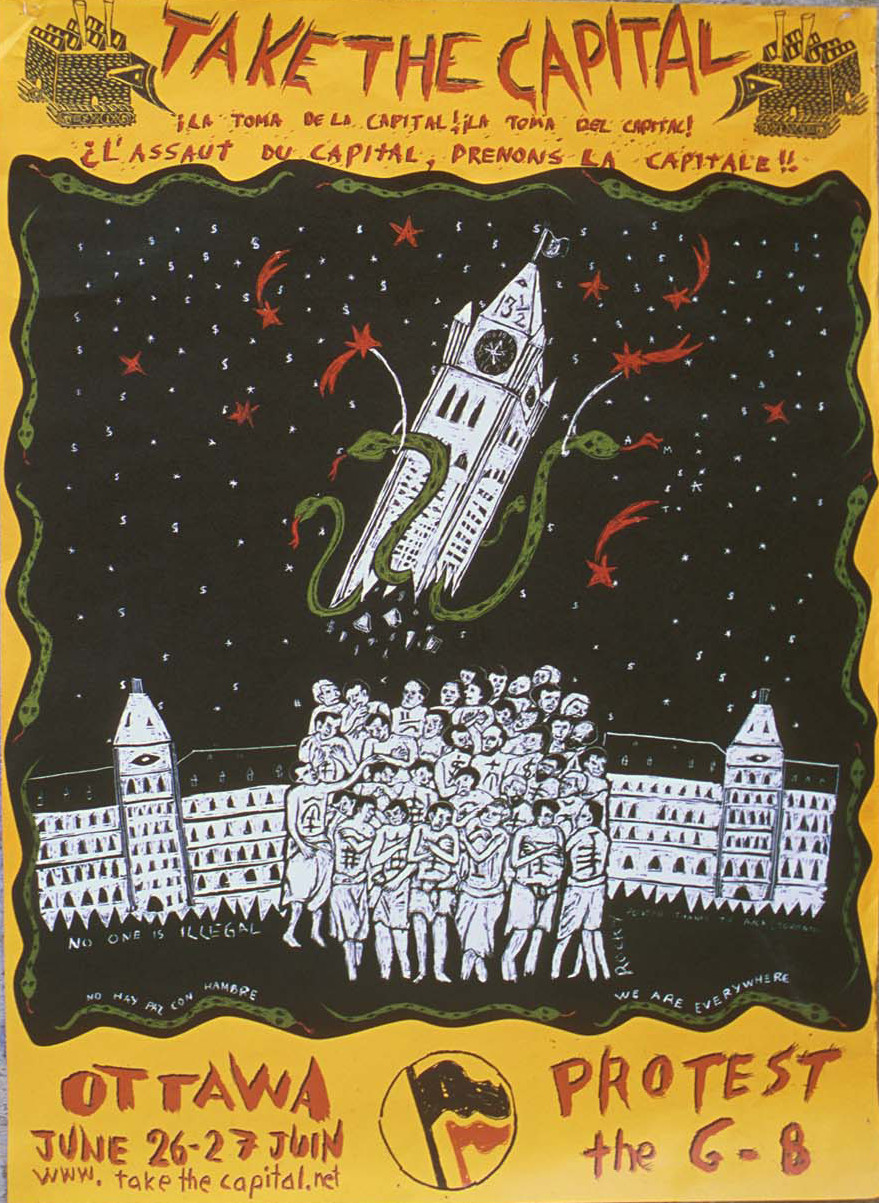 Poster for the Take the Capital anti-G8 actions in Ottawa, 2002. (Photo: Rocky Dobey)
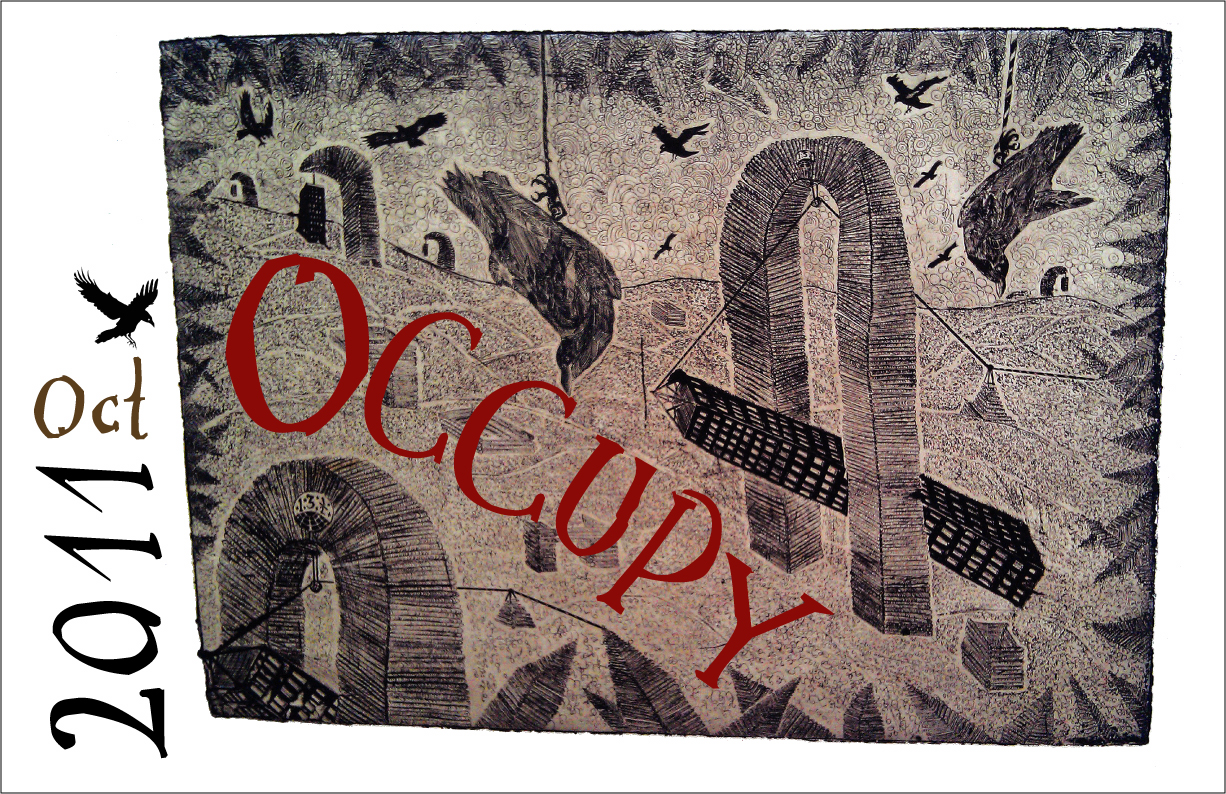 Poster for Occupy Toronto, 2011. (Photo: Rocky Dobey)
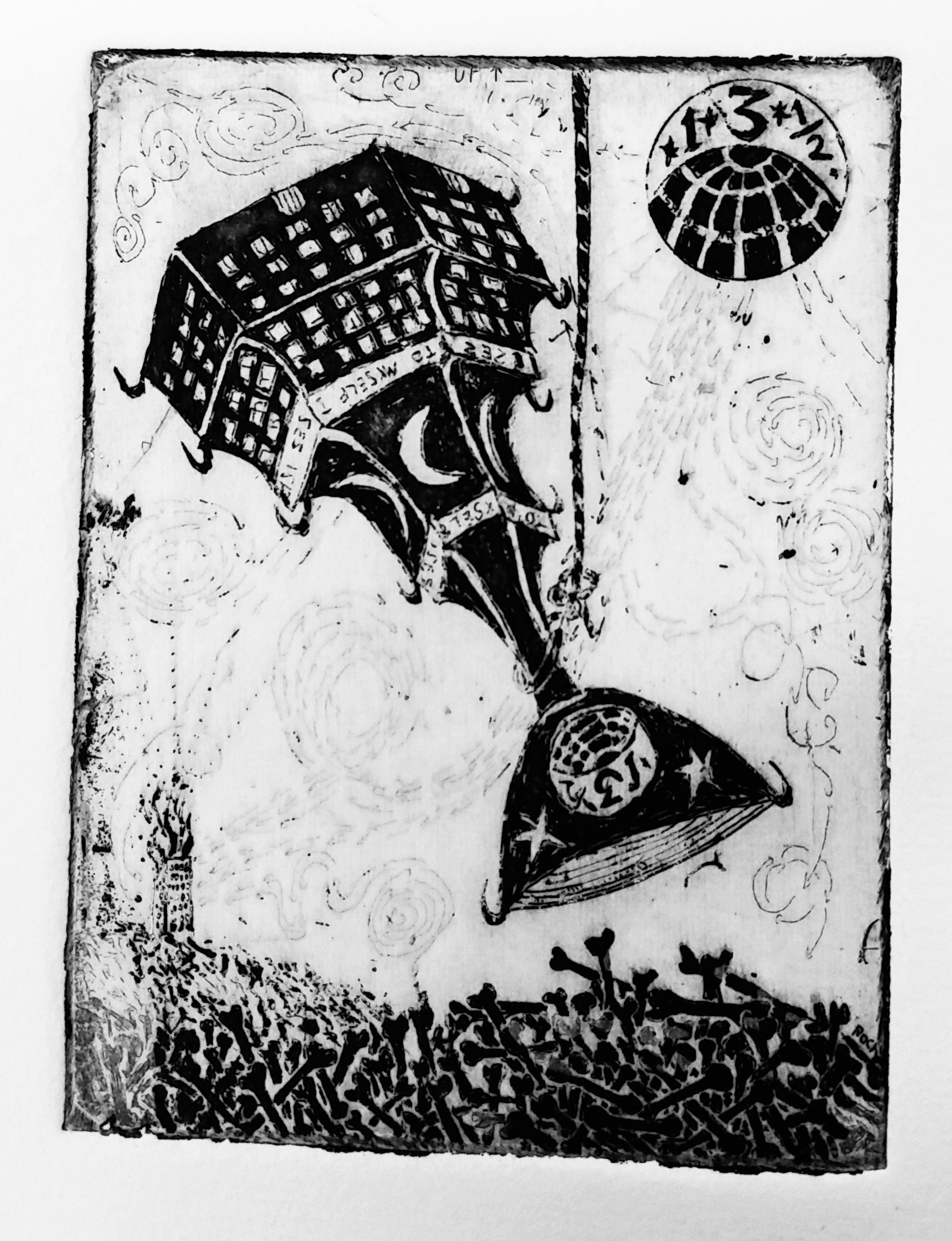 Prison Justice Day poster. (Photo: Rocky Dobey)
Even in this digital age, posters can play an important role in protest movements. Among other things, looking back at them after the fact can allow people to remember their own experiences of particular actions, while also serving as collective reference points.
Rocky Dobey has made a lot of art over the course of his life, including a lot of street art and a lot of political art. Two of his pieces that stand out for me are the posters he designed for the Carnival Against Capitalism in Québec City in April 2001 in opposition to the Summit of the Americas, and for the Take the Capital actions in June 2002 that took place in Ottawa to protest the G8 summit. For me and a lot of other people, these are pivotal reference points. 
The fact that these posters were widely distributed through grassroots gatherings of activists and were also pasted up on the streets are key reasons why memories of those actions and the visuals of the posters are fused in my mind. The posters featuring Rocky’s graphics felt not like they were speaking about the organizing that so many of us were doing, but rather that they were part of and emerging from the very same networks of resistance to colonial capitalism.
Over time, I learned more about Rocky’s work. I started seeing small metal sculptures fastened to electric polls during visits to Toronto. I also heard that Rocky was connected with prisoner justice organizing. All of this inspired me to speak with Rocky about his work.
This interview feels important to share in this context, as those of us who are engaged in grassroots organizing continue to experiment with ways to communicate urgent messages and crucial demands from the bottom up. The work of artists like Rocky points to both the critical importance of long-term engagement and also the ways that artistic expression can help give oxygen to movements for change.
Stefan: First I think that it would be interesting to hear about your practice as a street artist in the contemporary context, a context within which there has been a shift in discourse and focus around street art, as a lot of more mainstream art spaces are more interested in it. Could you start by introducing yourself and share some key points about your work and what you do?
Rocky: My name is Rocky. I have been doing street art for a long time. I started off by doing it so long ago that at the time it didn’t really exist as a thing for many people, it was seen as really weird. I was first doing it as a kid on Yonge Street, downtown. I was putting up stuff most of my life, mostly anonymous. This changed over time. There became different layers of anonymity.
 In talking about street art at this time, putting up street art is really different from 40-50 years ago. Then, at best, it was simply seen as holding the importance of missing cat posters, for example. But also, we didn’t know our value as street artists, at all. So I started out as a kid in downtown Toronto where my mother lived, just going around putting up street art, just like that – we improvised, specifically posters – at around 13 years old. So that was a long time ago.
I started doing political work, political posters. I was in a union. I got involved in union politics a bit and I started putting up posters. Also, I got involved with some anarchists in Toronto and also some marxists, so I started getting involved in these struggles and getting involved in the way that I knew how, which was through art and posters.
Stefan: Can you talk about some of the artwork and the posters you were making, and also the process of how you came to the ideas for the artwork?
Rocky: Actually, I was working often with organizations, sometimes with collectives, sometimes with informal groups of people. People coming together and just doing it. Also, I have done some street art that is legal and I have done some commissions, like the Toronto Drug Users’ Memorial. I have worked with people who are from communities where people are dying due to fentanyl overdoses.
Stefan: Can you speak and describe the way that you create the little metal sculptures that you put up on the streets of Toronto?
Rocky: Yes, the ones I am doing now, yes totally. They are made from little off-cuts of metal that I get, from bronze plates. I draw on them, paint on them, and then bolt them in. I put two holes in the back and then bolt them into a wooden street post. I have been working with bronze recently, but also I have worked with copper before. This started in around 1983/1984. I was working on a job site at the time on University Avenue and I would take the off-cut copper back then, so I have also continued to work with copper.
So all these pieces are made from little off-cut pieces of metal, nothing fancy, I just draw on them. Usually I do them in a series. I have been enjoying this, putting them up, often in Rosedale, or in Parkdale, in some of the richer parts, so I like how the meaning of the work changes depending on the part of the city that you put it up in.
Stefan: Can you describe the engravings and can you talk about the number that you always include 13½?
Rocky: The number comes from the work that I used to do with Prison News Service – and specifically with Jim Campbell, who put out the paper. The number comes from prisoner justice work, Prisoners' Justice Day, and a saying that is, “Twelve jurors, one judge, and half a fucking chance.” I always liked this phrase, because if you are bourgeois you would see the meaning as horrible, but if you are a prisoner, or working class, people can be like, yes, half a chance, that’s all I ever wanted!
I always saw class divisions in the ways that people reacted to this phrase because the upper class always thinks that they deserve a full shot at things. I have used this a lot. 
The meanings have changed over the years. Recently, I have been doing Indigenous prisoner support work where I don’t use this reference as much, as the meaning and context has changed over time. This is also important because Prisoners' Justice Day, August 10th, started in Canada. I always did prisoner justice pieces for many years, including works about the Don Jail and also I have made works for prison magazines.
Stefan: For some people hearing this, when you talk about prison justice in Canada, they are not going to be aware of the immense struggles that have taken place across Canada in this context. Please speak about why it felt important for you, this commitment to prisoner justice.
Rocky: I am for justice in general and also for the rights of prisoners specifically. Freedom means so much, the most and when we get thrown in jail. So prisoners just want a fair shot and a fair trial, this speaks to me and makes me want to support prisoners.
Often in Canada, in small towns with big Indigenous populations [relative to their total population], you can so quickly learn that the percentage of Indigenous people who have been to prison is extremely high, disproportionately high. I moved to Toronto when I was 8-years old but I grew up in northern Manitoba and the prison situation in rural Canada. I think about the town where I was, there were a lot of Ukranians, but for the prisoners, the majority were often Indigenous, and this repeats across Canada in the north.
The Canadian government can finance federal prisons, which are filled with a majority of Indigenous folks, while they can’t find the public funds to create access to safe and clean drinking water for Indigenous communities.
Stefan: In this conversation you have illustrated some of your own exposure to political organizing experiences. Why is this important context to share for your artwork? Anything you would like to share in relation to this on either an emotional or political level? How has your own work happened in parallel to these struggles?
Rocky: Good question. I am not always a big reflector. I do remember when I was in the Iron Workers union, working on a high rise, I was in my 20s and I got involved. I didn’t finish high school or anything, so I went into manual labour. But during this time, when I was involved in the union, I read a lot of marxism, I also took some community courses on Marx. This pointed me toward understanding that there were systemic issues at play, that there was something wrong in the way that the system is set-up, that there are political battles to be had.
In the union meetings, they were a hotbed for discussing these ideas at this time, some of the construction and carpenters union locals were becoming hot bread spaces  for radical organizing. I was doing posters around this time, this was part of overcoming my upbringing I grew-up in that wasn’t super political. So anyways I was doing small street art pieces around this time to express my thoughts and the political ideas that I was coming into contact with at the time in the union context, in the work context.
Also I remember putting up posters with my childhood friend Ronnie who died of an overdose and also I made a memorial to Ronnie – we both worked as shoeshine boys when we were small, right downtown. At the time we didn’t realize how political our poster art was.
Stefan: Can you talk about these designs of your posters? How did you work on them? The imagery? Also the fact that these are a different style from your sculptors as they aren’t one off prints, thousands were printed and pasted up all over the place.
Rocky: Actually the posters are a similar style, the drawings, like the sketches that are in the copper prints also. In a way I have a consistent style throughout my works, there is kinda a Byzantine feeling to it in a way, it is my go-to – a little bit tacky, a bit of a play on the old school church vibe, so this is a line through my work.
Actually, I have done a lot of drawings of crashing buildings, I was often thinking about the working class and towers. As an ironworker, I would think about the towers from the point of view of a worker who had worked on them.