
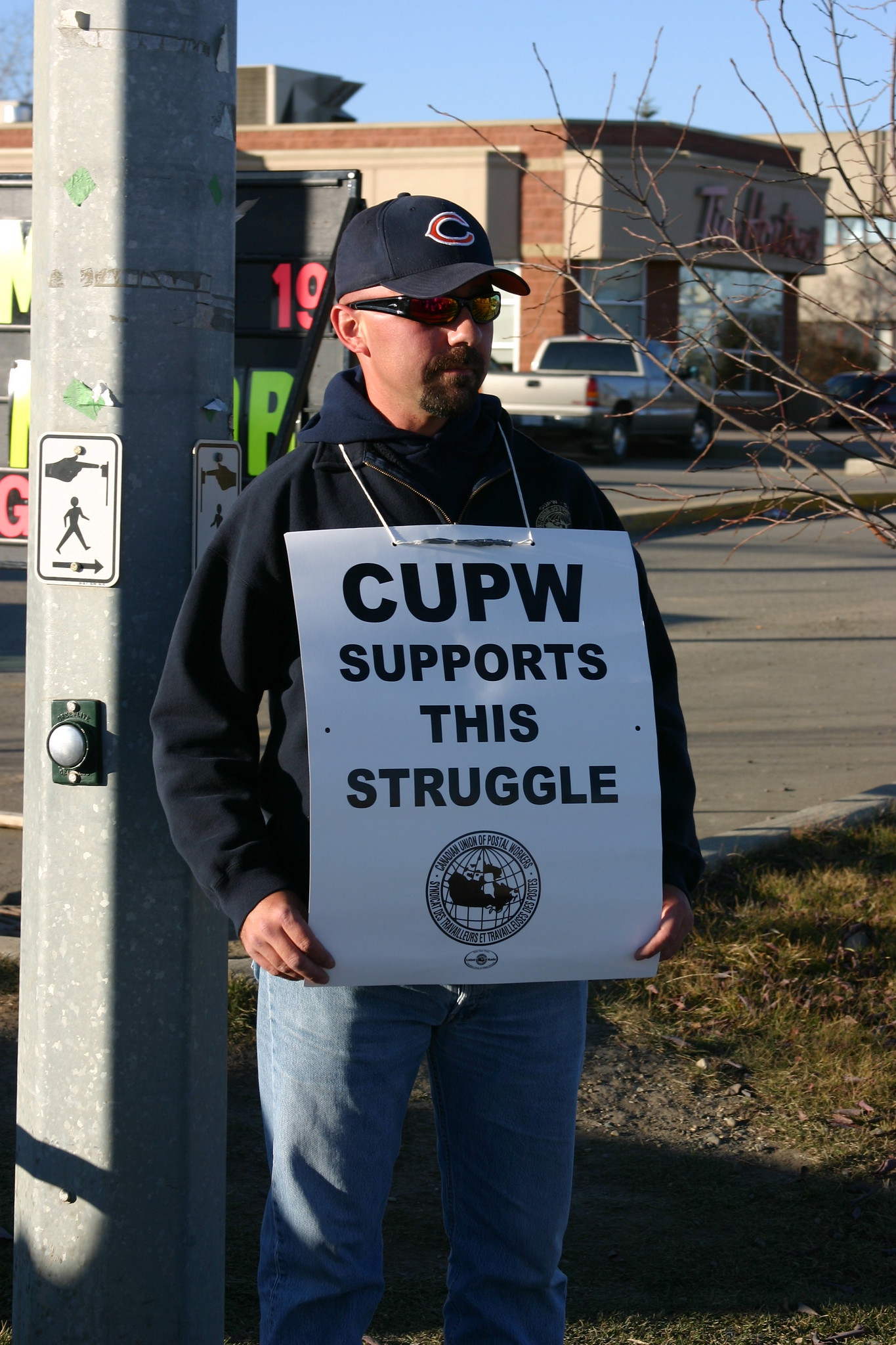
 A postal worker showing solidarity with a community struggle. (Image: Wade Kelly via Flickr)
On Friday, December 20, workers from various unions and community groups in Lekwungen/Victoria came together to support postal workers who had been forced back to work. By setting up their own picket line, these union/community activists followed examples from past CUPW strikes and gave postal workers an opportunity to exercise their right to not cross a picket line, and thereby take back control of their lives in defiance of the back-to-work order.
The solidarity picket was formed at the main entrance to the Glanford postal depot in Saanich at about 8:00 am. After a few brief conversations with the picket, dozens of postal workers parked their vehicles and said they would not cross a picket line under any circumstance, especially in the context of back-to-work legislation.
Management quickly came out and demanded to know what was going on as they called in the police to remove the picket line. Oddly enough, within a few minutes a union official from a non-associated union that shall not be named appeared and told the picketers that their point had been made and that they should disperse. In spite of these machinations, though, the solidarity picket line held firm for two hours.
When the local president of CUPW arrived, she addressed the gathered postal workers with an update on the situation. She thanked the solidarity picket, and then asked them to stand down so that the Canada Post Corporation couldn't use it as an excuse to punish the postal workers through the back-to-work legislation. The union/community activists said a few words in support of the postal workers, thanked the local CUPW president for her tireless work, and then left through the cheering crowd.
This solidarity action brought up a few points that should be mentioned.
Postal workers represented by CUPW have been at the forefront of social and international causes for decades. They have led the way in demonstrating the principled purpose of their trade union and set an example for what other trade unions should be doing. Through this solidarity on the ground they have broken down many of the barriers used to cut off workers and organized labour from the world they work in.
Perhaps because of this unflinching commitment to principled class engagement, postal workers/CUPW have also traditionally been used as the frontline – a punching bag, if you will – for what a neoliberal agenda can get away with. When they actively push back against austerity and imposed economic extraction, they face the wrath of the corporate order through legislation, fines, and arrests.
This solidarity picket was simply the reflection of what postal workers have been doing all along. Through five weeks of holding the line, postal workers have shown what organized and resolute picket lines look like. Just as labour struggle cannot be separated from the larger social and international context, postal workers cannot be isolated from other workers and community members in the region in which they work and live.
More people can, will, and must join the fight for social justice, the same as postal workers always have themselves. We cannot ignore the fact that authoritarian back-to-work legislation is being used more and more. We cannot remain ignorant of the fact that workers are forced to speed up the pace of work as wages lag behind a soaring cost of living. We cannot look the other way while employers and bosses reward themselves handsomely at the expense of workers and society.
The solidarity picket on December 20 was just one small skirmish in a larger fight for social and economic justice.
An injury to one is an injury to all!