
 Solidarity with Palestine and against Hindutva Fascism
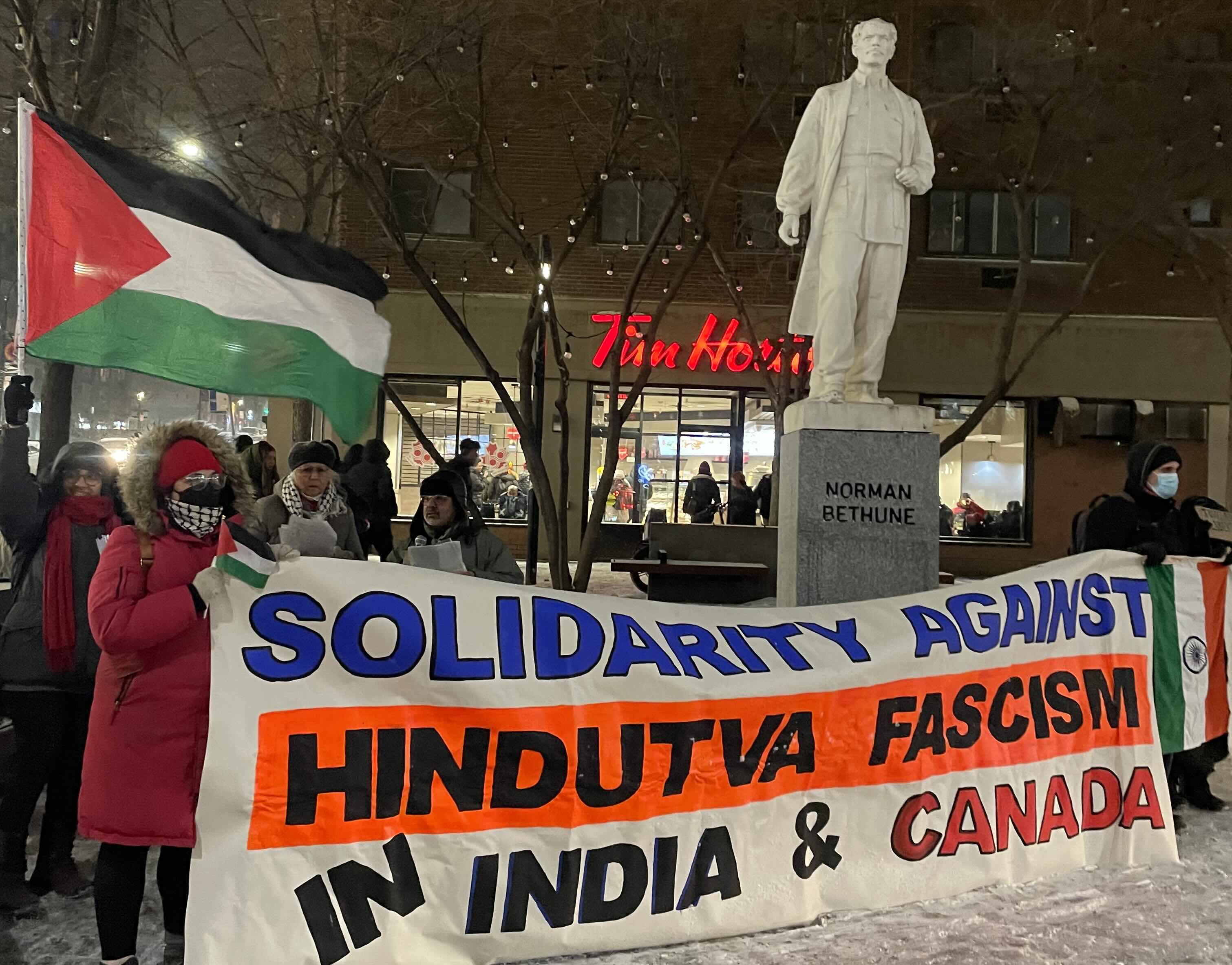
Here we publish a speech by a member of Academics for Palestine at the Speak-out! On India’s Republic Day: Expose the unholy alliance of HINDUTVA and ZIONISM, on Thursday 23rd January, 5:30 pm, at Norman Bethune Square, Tiohtià:ke (Montreal), organized by South Asian Diaspora Action Collective (SADAC) and CERAS (South Asia Forum).

Thank you all for being here today.
I’m speaking to you today as part of Academics for Palestine, a collective uniting members of the Concordia community—graduate students, faculty, staff, alumni, and organizations—who are committed to justice for Palestine and are active on Concordia campuses through the university’s local and international ties. We advocate for Boycott, Divestment, and Sanctions (BDS) as a means to hold Israel accountable for its apartheid regime and systemic oppression of Palestinians. I am here to tell you about what we have been doing in the last 18 months and draw some similarities between Zionism and Hindutva in how they stifle dissent and silence solidarity.
Over the past few months, our community has faced a relentless wave of attacks on Palestine solidarity—attacks not only targeting us but also our allies on campus and in the wider Montreal community. We’ve been organizing petitions, writing letters, hosting events, and holding protests. We’ve been advocating for students and faculty in precarious positions who have been targeted by Zionist organizations and/or by Concordia’s administration. But despite our efforts, the repression has been unrelenting.
Let me give you a few examples of what’s been happening right here at Concordia:
Events are being canceled, often under the false pretext of security risks or accusations of anti-Semitism. This includes BDS motions passed in the spring and summer by student groups and departments in adherence to PACBI. These motions have faced well-financed attacks by organizations like Honest Reporting, whose mandate explicitly aims to conflate criticism of Israel with anti-Semitism. There website defines them as ““an independent grass-roots organization promoting fairness and accuracy in Canadian media coverage of Israel , the Middle East and matters affecting Canada’s Jewish community, and which works to challenge anti-Jewish rhetoric, particularly when antisemitism hides behind a mask of anti-Israel criticism.”
Following this and other complaints about support for the Palestinian Campaign for the Academic and Cultural Boycott of Israel (PACBI), in November, a memo from the Provost required political statements to be taken down from Concordia’s department websites.
Violence on campus has escalated. Protests have been met with police violence, undercover surveillance, and increased security measures. Concordia even hired a security company run by veterans of the Israeli Defense Forces—directly embedding state violence into our campus. Students have faced profiling and violence.
For example, a peaceful pro-Palestine walkout, where students put up posters saying, “I will no longer be complicit in genocide,” resulted in five arrests, two suspensions, and students facing de facto expulsions while awaiting criminal charges. And the repression doesn’t stop there:
- On October 11, 2024, Concordia canceled the screening of Resistance, Why? by film collective Regards Palestiniens at the Ellen Gallery, claiming it posed security risks and involved “one-sided fundraising.” When the collective moved the screening outdoors, the administration escalated by calling the Montreal police, who surrounded fewer than 100 attendees with nine police cars, dozens of officers, and an arrest vehicle.
- On October 31, during a “Cops Off Campus” protest, police and campus security turned the Ellen Gallery into a prison, detaining students for two hours in front of works addressing liberation struggles in Haiti.
- On November 18, the administration terminated Pip Day, the Director of the Leonard & Bina Ellen Gallery, following these events.
Today, we have posted the letter of the Leonard & Bina Ellen Art Gallery Advisory Council resignation, as submitted to Concordia administration.
This resignation letter makes it clear that the Leonard & Bina Ellen Art Gallery does not in fact have artistic autonomy when it comes to political programming, but rather, when the politics don’t align with Concordia University’s administrative and donor interests, they opt for censorship, firing and repression. Given that the Gallery is part of Concordia’s research and pedagogy infrastructure, this is also an attack on academic freedom.
These actions expose the administration’s priorities: to appease donors and political interests rather than protect academic freedom, student activism, or justice. And this is not unique to Concordia. We see these patterns elsewhere where there is solidarity with Palestine—but also in India—where Hindutva fascism is destroying spaces for critical thought and student organizing. Universities are becoming sites of repression, with alliances between Zionists and Hindutva forces weaponizing discourse to suppress dissent.
Here in Canada, we’re seeing efforts to normalize harmful definitions of antisemitism, such as the International Holocaust Remembrance Alliance (IHRA) definition, which conflates critiques of Israel with hatred of Jewish people. Meanwhile, Hindutva forces are pushing to label critiques of Hindu nationalism as “Hinduphobia.” Let us be clear: our critique of Zionism is not anti-Semitism. Just as opposing Hindutva is not an attack on Hinduism. Yet, time and time again, these false equivalencies are weaponized to discredit movements for justice.
The connections between Zionism and Hindutva run deep. Both ideologies are rooted in anti-Muslim sentiment and are increasingly collaborating as right-wing governments align their political and economic interests.
But our struggles are connected too. The fight for Palestinian liberation is tied to the fight against Hindutva fascism, and both are part of the larger battle to resist authoritarianism, censorship, and the weaponization of “safety” to justify repression.
Right now, we have a chance to fight back. To stop these ideologies from taking root in Canadian institutions. To defend academic freedom and create spaces for critical knowledge and organizing.
Thank you for standing with us today.