
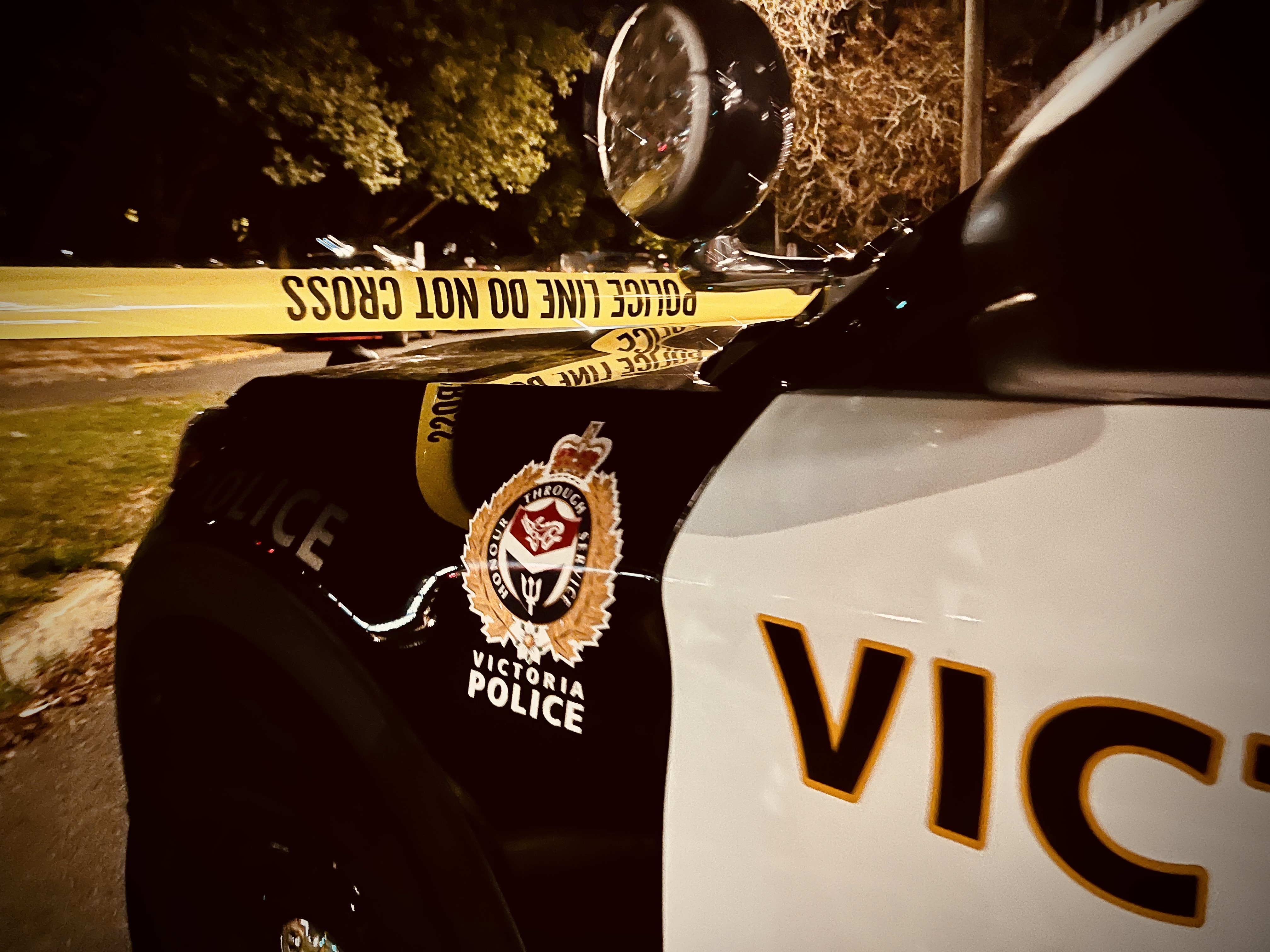
 Front of a Victoria Police car at night with caution tape in the background.
On January 30, British Columbia Education Minister Lisa Beare announced the NDP government was firing the Greater Victoria School Board because it was not yielding to pressure, largely from police, to restore the school police liaison program that had been cancelled in 2023 and put cops back in district schools. The firing of a school board over their concerns about police officers in schools is a deeply disturbing act by the provincial government and one that we should all be troubled by. Not only is it a heavy-handed intrusion on local democracy, it also flies in the face of established research on police in schools.
This is a move that increases harm to young people. As has been noted widely in discussions around police in schools, these detrimental impacts have been disproportionately centered on racialized students, especially Black and Indigenous students, as is the case for policing in communities more broadly.
It also raises questions about democratic governance, the extent to which police are calling shots, and how far governments will go to serve the interests of police forces in and against communities. Behind it all is a commitment of police to layered policing practices that allow them more extensive and intensive access to communities — and to community resources that can be mobilized for carceral purposes.
Evidence Says Get Cops Out of Schools
Research from across disciplines — criminology, educational studies, sociology, health studies — shows no evidence establishing that police officers in schools make these spaces safer, either interpersonally or institutionally. Conversely, there is extensive evidence that police in schools have numerous and diverse negative impacts, on students and school life both. This includes contributing to the school to prison pipeline. There are literally volumes of data from surveys of students that identify these impacts, including racial profiling and inequitable application of punitive measures.
A commentary by Kasari Govender, BC’s Human Rights Commissioner, published by the Victoria Times Colonist only days before the government firing, argued for evidence-based policy, and found that the evidence does not establish that cops in schools increase student safety or lead to more crime. According to Commissioner Govender, “I have reviewed the data from 2015 to 2024 made available by police whose jurisdictions include schools in the Greater Victoria district, and it shows no clear correlation between an increase in gang activity in schools and the end of the school police liaison officer (SPLO) program.”
Neither has there been an increase in police calls to schools since the program was suspended. Again, the Commissioner found that “the data also does not demonstrate a correlation between increased calls to police and the end of the SPLO program. Victoria and Esquimalt police data show that call-outs to elementary schools between 2015 and 2024 have remained relatively stable, reaching a high in 2020, while police callouts to high schools have decreased between 2015 and 2024.”
On the other hand, “What we do know is this: My office’s 2021 report, Equity is Safer, shows significant racial disparities in policing affecting Indigenous and Black people.”
The BC Civil Liberties Association (BCCLA) argues that the presence of School Liaison Officers or police in schools poses significant harms to students and staff, particularly racialized and marginalized students who live in already heavily policed communities. This includes, but is not limited to, rights violations. They point out that the BC Human Rights Commissioner has called for an immediate end to the School Liaison Officer (SLO) program. This was done on the basis of demonstrated impacts on Black, Indigenous, and other racialized people. It also identifies the harms done to students with disabilities or experiencing mental health challenges, and 2SLGBTQI+ youth.
The BCCLA has produced a “Police in Schools Pocketbook” in order to empower students with information regarding their rights during interactions with police at school, including searches, the arrest process, and the complaint process.
The harmful consequences of police in schools are so bad that in 2021, the Waterloo Regional School Board in Ontario apologized to students for the various harms done by their decision to put police in schools. Their apology read in part, “Members of the committee heard that both the presence of police and how and when they are used in schools can create a sense of fear, increased anxiety and vulnerability for some, and especially Black, Indigenous, and racialized students. The fact that any student felt this way is not acceptable. We apologize, unreservedly, to the students and communities who have been harmed.”
Apologies, of course, come after the harm has been done. Schools should not be putting students in harm’s way to fulfill programmatic desires of police departments.
Layered Policing in Schools
Schools should not be giving police free access to students. There are also questions about ulterior motives of police, whether for recruitment to forces or surveillance of youth. Questions abound about abuse of power, such as the treatment of students who might be critical of policing.
The push by police to get officers in schools comes at a time when more and more forces are relying on, and expanding, layered policing programs. Layered policing involves police partnerships with civil society organizations and civilians which both get non-police participants to work as adjuncts and extensions of policing (in surveillance and documentation, for example) and/or gain police forces access to spaces and events in which they would not otherwise be present in the absence of a formal investigation or response.
Crucially, police have used contact with youth and children as central parts of layered policing programs. This gives them intrusive access to carry out surveillance, especially of poor and racialized communities. It also gives police opportunities they would not otherwise have to develop hooks in communities, establish snitch lines, and gather information. All of this happens under coercive conditions, with a captive audience that might well fear retribution if they do not comply.
At a time when police actions and budgets are under increased scrutiny, layered policing gives police an opportunity to access new and additional funding sources (through community group or social service funding for example). It also gives them a prime opportunity to do public relations work to soften the police image or do the propaganda work needed for recruitment.
Layered policing is fundamentally a way for police to expand their role, growing into social areas where they have previously been less involved, and growing their scope of responsibilities. We have seen this in the vast expansion of policing into mental health issues, including partnerships with health care providers as in Car 67 in Surrey.
Then there is the matter of police judgement. For example, Vancouver police have placed in schools a police officer, Constable Hardeep Sahota, who was involved in the killing of Myles Gray. How can this make students feel safer? Sahota infamously tried to withhold information from the Independent Investigations Office (IIO) examining the killing. This must underline the key fact that police are first, foremost, and always institutions of extreme violence.
Plentiful Alternatives
Students have organized and fought to remove police from schools and to develop alternatives that provide greater safety and well-being in schools. Anti-racist, anti-oppression, and anti-exploitation education and practices, on an ongoing, rooted, and meaningful basis, need to be centered. They should be listened to and their examples followed.
There are also well-organized, steadfast, and committed campaigns being sustained by tireless organizers. These include, Policing Free Schools Canada, Policing Free Schools Edmonton, Cops Out of Schools Vancouver, the Asilu Collective in Ottawa, Ecole Sans Police MTL, and the Edmonton SRO Research Project, among others. The key organizing, of course, comes from the grassroots efforts of students themselves.
The alternatives provided by youth have been numerous and would be quite readily implemented, if governments actually prioritized student needs rather than the wishes of police forces. Youth put emphasis on building community and trusting relationships, and peer practices to develop these. They also emphasize transformative justice practices rather than punitive or carceral ones. Transformative justice does more to build accountability and repair harms. This includes ending carceral practices in schools, such as seclusion rooms.
They also call for the hiring of counsellors, school nurses, and educational assistants whose work is rooted in anti-colonial and anti-oppressive practices and is community and peer informed — instead of throwing public resources at police, who are not instituted or organized for any of these.
In addition, youth wish to see more sports, artistic activities, and after-school programs. As my own students advocated for in a local campaign in Surrey, schools should be kept open late and operated as community centres. They already have physical infrastructure and equipment that sit unused for many hours of the evening.
It is telling that a social democratic government chose to trample student concerns and local democratic governance, in a rush — cravenly and above all else — to serve police interests. It says a lot about the decrepit state of Canadian social democracy. The government must be made to answer all of these concerns. And it must be held to account for what appears to be an anti-democratic move against local governance that paid attention to student voices.
Jeff Shantz is a long-time anti-authoritarian organizer, researcher, and writer who lives and works on Kwantlen, Katzie, and Semiahmoo territories (Surrey, British Columbia).
Please subscribe to The Media Co-op's newsletter!