
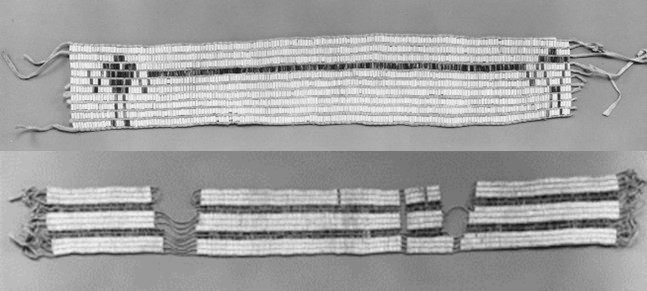
 (above) Tehontatenentshonteronhtáhkwa, “the thing by which they link arms,” a.k.a. the Covenant Chain. (Credit: Rick Hill) • (below) Tékeni Teyohà:te, “two roads or paths,” a.k.a. the Two Row Wampum. (Credit: Rick Hill)
We live in troubling times. Conflicts rage on all sides. Wars of occupation and wars over trade compete for our attention with the deepening crises in climate and the environment, while access to housing, employment, healthcare, and education is becoming precarious for more and more people.
Wampum was invented precisely for distressing times like these, so it is timely that the Two Row Research Partnership group based at Six Nations Polytechnic has published two books on the Covenant Chain-Two Row Wampum tradition, Deyohahá:ge: Sharing the River of Life (Wilfrid Laurier University Press) and Grandfather of the Treaties: Finding Our Future in the Wampum Covenant (Wolsak & Wynn).
Wampum’s story begins with Ayonwátha in a time when his “mind had been spilled upon the ground.” One by one his wife and children had died, and he now stumbled heedlessly through the woods. In the Northeast of this continent before Europeans arrived on the Hudson and St Lawrence River systems, the people were at war with themselves and each other. Murder, raiding, and violence were the rule of the day. Just before his devastating losses, Ayonwátha had met a remarkable person known as the Peacemaker, a Wendat from across Lake Ontario, who came among the people in what is today New York State. He explained that people need not live in violence and fear if they learned to sit down in council with one another and develop protocols for reasonable consensus decision-making. But then Ayonwátha’s family was decimated. His mind was cast upon the ground.
One day, he found himself sitting thoughtlessly undefended at the edge of a strange village’s cornfield. His fingers worked as if they had minds of their own, and he fashioned bead-tubes out of twigs he hollowed out and threaded in coloured patterns onto lengths of sinew. As his fingers worked, the turmoil in his mind settled. He added one bead, then another bead, then another. At one point, he looked up and saw sentinels from the enemy village coming for him, but he was amazed to see that instead of spears, they carried a string of threaded tubes like his. He realized that they were inviting him into the council fire, where he would be given food and shelter and he could tell the story of what he had learned from the Peacemaker before the message was interrupted by his family’s grief. Making that first string of wampum reminded him of the message of peace.
This is the Haudenosaunee (longhouse of Six Nations) story of wampum – how it quiets the troubled mind as it concentrates on one bead after another. Wampum establishes the possibility of peaceful communication between potentially violent people. Likewise, when strange people arrived in their territories from France, Holland, and Great Britain in the 16th and 17th centuries, Haudenosaunee people brought belts of wampum, now refined into a magnificent artform of shell-beads woven on looms, to greet these foreigners and to establish protocols of peaceful exchange and decision-making with them. The two most famous wampum belts created for this purpose are, in Mohawk language, Tehontatenentshonteronhtáhkwa and Tékeni Teyohà:te (or Deyohahá:ge: in Cayuga language).
The first of the two books, Deyohahá:ge: is edited by Daniel Coleman (Scots-Irish-Danish-Canadian), Ki’en Debicki (Mohawk), and Bonnie Freeman (Algonquin/Mohawk) and consists of chapters written by Six Nations authors and their neighbours, while Grandfather of the Treaties: Finding Our Future in the Wampum Covenant is written by Coleman. Growing out of the monthly discussions of the Two Row Research Partnership, these books look back to look forward.
They review the Covenant Chain-Two Row series of agreements through the oral and written histories of councils held between French, Dutch, and British colonials that established the principles of “peace, friendship, and respect” between the autonomous parties of these important early alliances. They demonstrate how these wampum agreements grew out of the Haudenosaunee political, spiritual, and environmental philosophies that had established the Kayanerenhtsherako:wa, the Great Law of Peace. They discuss how wampum protocols formulated peaceful and lasting alliances with surrounding Indigenous nations (an example would be the version of the Covenant Chain agreement with the Anishinaabeg) as well as with incoming Europeans. Because European colonial powers learned this way of making agreements when they first entered the continent, as Oren Lyons puts it in his contribution to Deyohahá:ge:, the Covenant Chain-Two Row tradition became the “grandfather of the treaties.”
In the turbulent times we live in, then, these books help us settle our minds as we recount the beads of these precedent-setting wampum agreements. They present not only historical, legal, and philosophical guidance for how to establish good minds and better land-back relationships with both humans and natural environments, they also show how people are putting these wampum principles to work in our times.
For example, Ellie Joseph (Mohawk, Turtle clan) and Jay Bailey (Canadian canoe guide and voyageur) write about the 10-day Two Row Paddle on the Grand River they organize each summer for Indigenous and non-Indigenous paddlers to get to know one another and to gather around teaching fires each evening as they learn from elders and storytellers about how to share the river of life. Suzie Miller (Mohawk, Wolf clan) and Scot Cooper (Scots Canadian) write about the pen pal project they developed between elementary students in the town and on the reserve at the height of the armed conflict over land at Caledonia, Ontario. Student participants in this project have exchanged letters, drawings, and art projects, and met each other for sports days and art exhibits over a decade since. Ten thousand youth have learned about the Covenant Chain-Two Row Wampum agreements and thus constitute a whole new generation of people who will know how to live out the principles of peace, respect, and friendship. Grandfather of the Treaties takes these covenant principles as guidance for new understandings of the environment, observing how the covenant to link arms and make family includes making family of the environment: the eco (from the Greek oikos, meaning "home") of ecology is the same home as that of economy.
The wampum covenants have never been rescinded by either Canada or the USA. They provide us with a model, an easy-to-follow thread, of how to restore good minds in confusing, troubling times. They can help us lift our minds off the ground.