
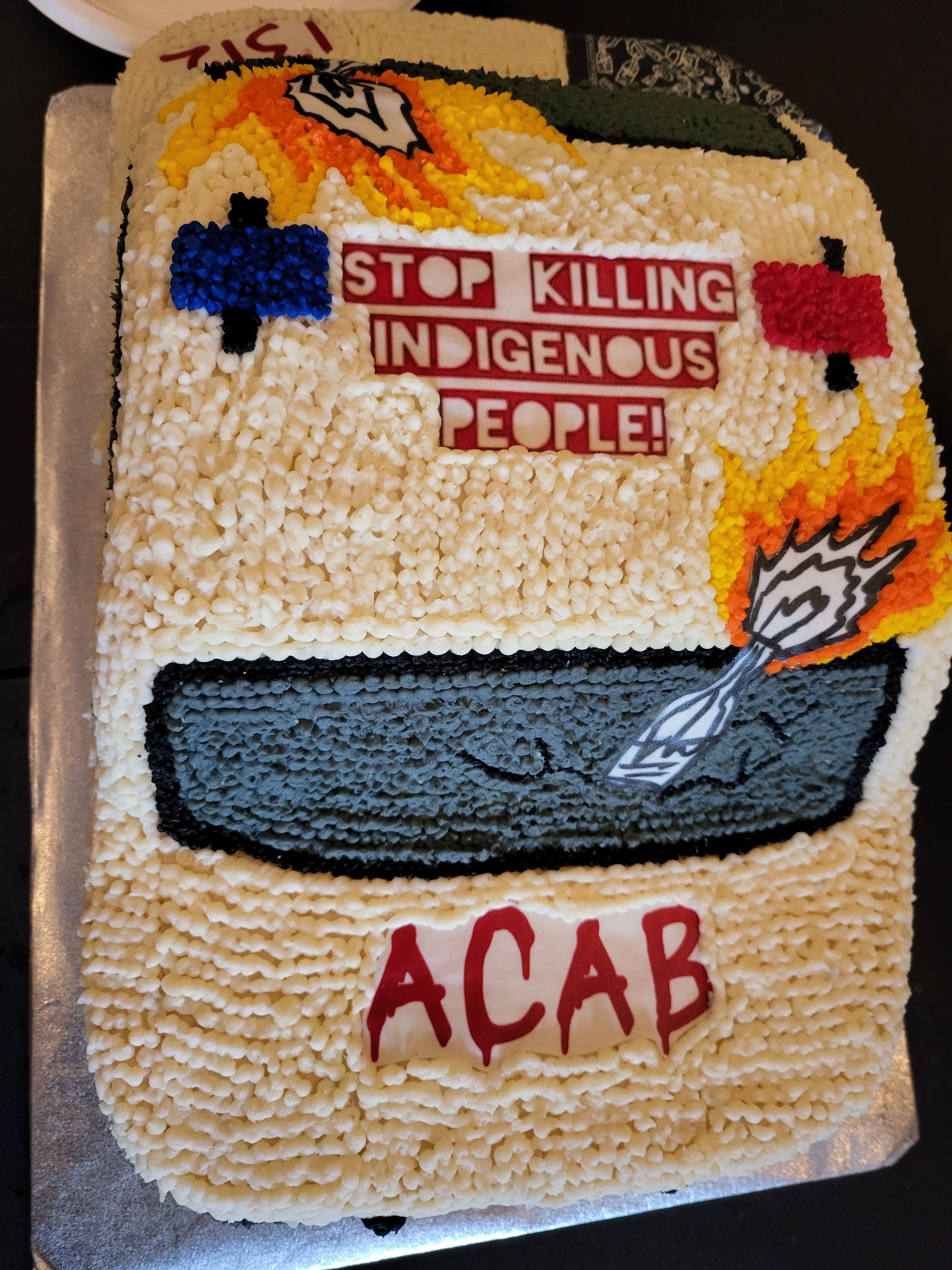
 ACAB Cake. In shape of cop car. Says, "Stop killing Indigenous people" on top.
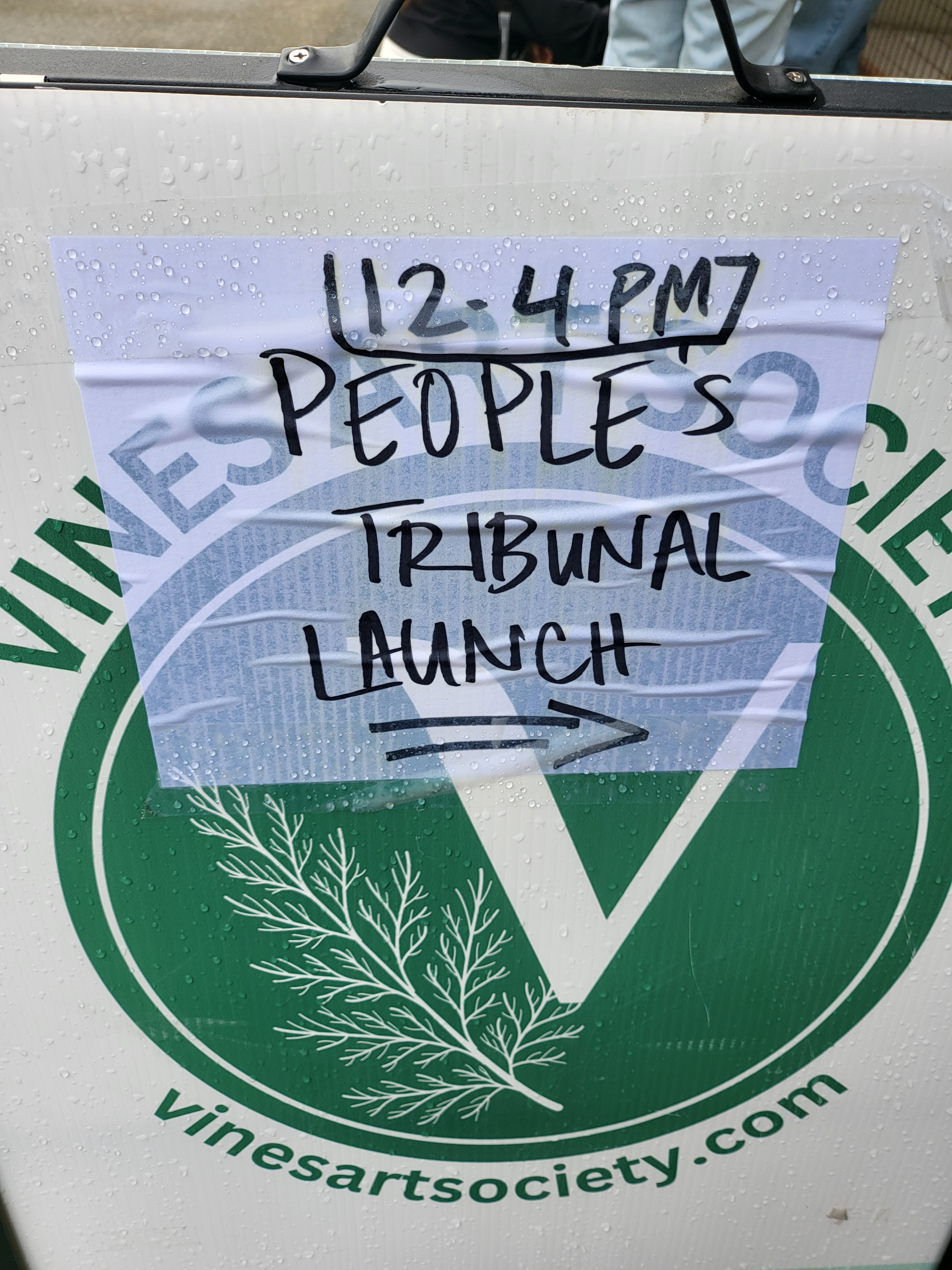 People's Tribunal launch placard.
 Cake in shape of burning cop car.
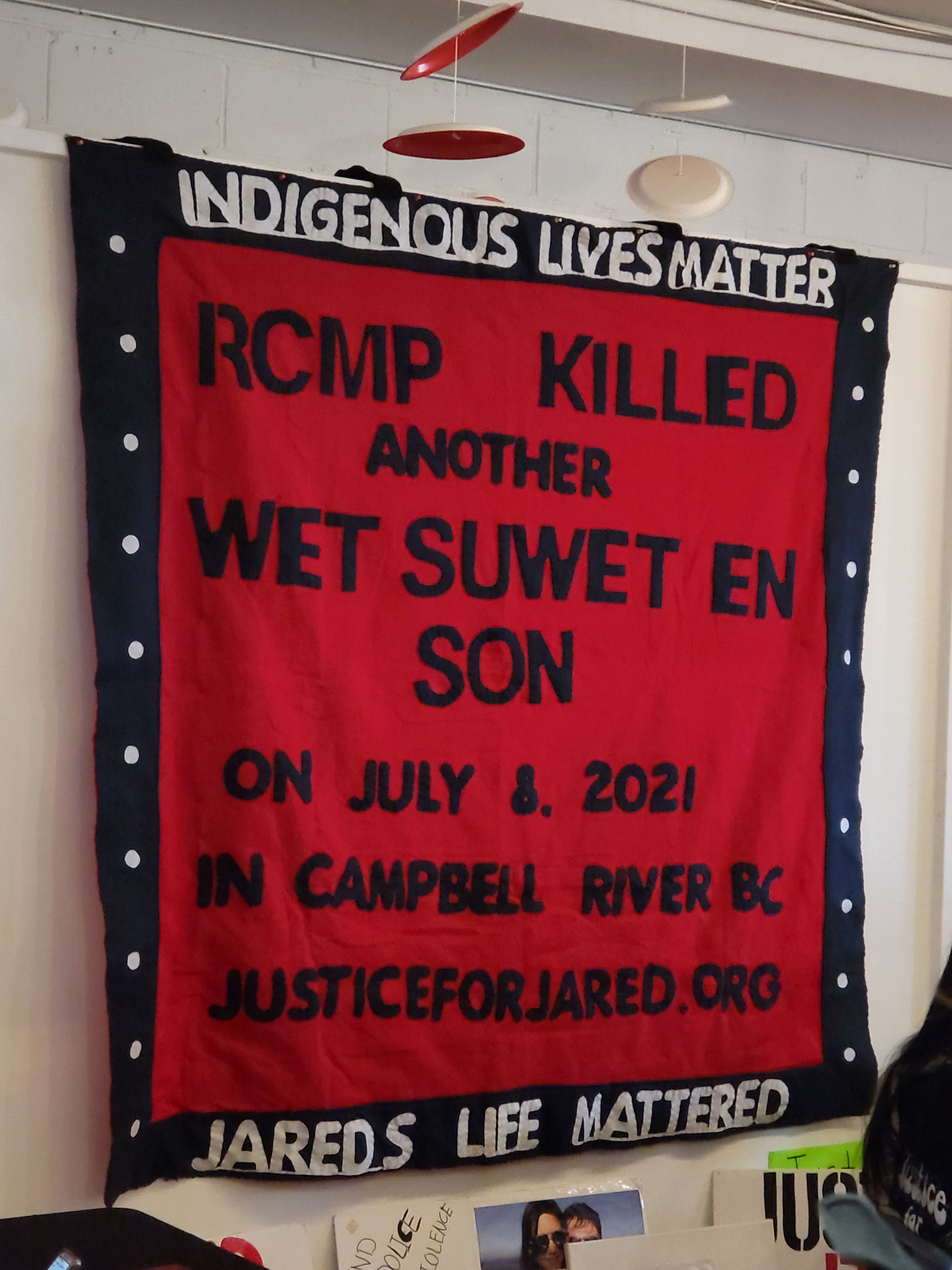 Justice for Jared banner on wall.
On the International Day Against Police Brutality (March 15, 2025) about 60 people gathered to imagine a People’s Tribunal Against Police—not as an act of dreaming but as an act of doing. Participants discussed the need for community-based means for challenging state power and authority on the road to abolition. The why and how of a People’s Tribunal Against Police and its part in moving from resistance to rebellion were considered, with reference to historic and ongoing struggles.
The impetus for the People’s Tribunal comes from Laura Holland, whose son Jared Lowndes, a Wet’suwet’en man, was killed by RCMP in Campbell River, British Columbia, in 2021, and the organization she started, Justice for Jared. After years of investigation, and despite a recommendation by the Independent Investigation Office (IIO) that charges be laid against the killer cops, Crown decided not to pursue charges.
The People’s Tribunal call arises from her work along with other families of people killed by Canadian police, including Laura Manson, the sister of Julian Jones, a Tla-o-qui-aht First Nation man killed by RCMP in 2021. The work was supported by a range of community groups including Defund 604, PIVOT Legal, the BC Civil Liberties Association, and POWER (Police Oversight with Evidence and Research).
Collectively, this is an outcome of decades of struggles by families and allies. Struggles that have left them with no proper or just outcomes in terms of addressing the harms done to their loved ones (and to themselves). Presenters called this the organized abandonment of entire families and communities—overwhelmingly Indigenous and Black communities.
How might a grassroots People’s Tribunal, and the work done towards it, contribute to community wellbeing, while taking on and taking down the state? The March 15 event was a hopeful first step toward pursuing answers.
People’s Tribunals
People’s Tribunals are ways for communities to hold powerful groups to some account, in the face of systems that are inherently unjust and that reproduce their injustices.
The discussion started with a brief overview of historic people’s tribunals. It was noted that people’s tribunals of one type or another have always been part of resistance, wherever exploited and oppressed people have sought redress and reparations.
Examples mentioned included the Jean-Paul Sartre and Bertrand Russell Tribunal on War Crimes in Vietnam (the International War Crimes Tribunal). That tribunal was launched in 1966 to investigate American war crimes in Vietnam. It then expanded its scope to judge a range of acts and structures of power. It presented a moral and ethical justice forum rather than a legalistic one.
That model has been taken up in numerous examples since to respond to laws, policies, and practices that perpetuate structural exploitation and oppression. Presenters noted the Permanent People's Tribunal that was established in the 1970s to examine political repression in Latin America. Other examples include the Russell Tribunal on Palestine and the Monsanto Tribunal on ecological injustices. A World Tribunal on Iraq held sessions between 2003 and 2005.
Closer to the context of the March 15 meeting, presenters noted the Highway of Tears Symposium of 2006. This was organized by Indigenous communities to hear directly from those impacted by violence against Indigenous women and girls (Missing and Murdered Indigenous Women and Girls, MMIWG). This symposium brought together over 500 people and made 33 material recommendations and served as an impetus for the National Inquiry Into Missing and Murdered Indigenous Women and Girls.
There is currently a People’s Tribunal on Police Killings in the UK. It describes itself as “a radical grassroots initiative led by families of those killed by the police in the UK.” They have announced a “launch event escalating our campaigns for justice.”
Why a People’s Tribunal?
One impetus for the current project is to re-frame narratives about police violence away from state portrayals which uniformly justify police violence and typically frame victims of police violence as offenders, threats, or undeserving of sympathy.
It is also important to hear the experiences of those impacted. Victims, families, and loved ones of people subjected to police violence are often silenced, marginalized, and demonized. They are left to fight inaccessible systems and institutions of power without need or adequate resources. Overwhelmingly disadvantaged, marginalized, and oppressed to begin with, they are further victimized by statist “oversight” and “accountability” processes that internalize and prioritize police perspectives, views, and frameworks.
When police kill, they are typically the only ones present at the scene, apart from the victim. They can thus set the scene and manage their stories before any oversight bodies are even involved. Cops control the narrative when they kill. Witnesses that might counter police narratives are often, understandably, afraid to come forward and speak out. A tribunal has the possibility of connecting with and supporting any potential witnesses and providing needed care as they share their experiences.
Many victims, family, members, or witnesses will not speak to state institutions, the courts, or even lawyers. State accountability and oversight bodies can put people in greater danger if they come forward.
And, it must be said, those bodies are as much as useless when it comes to holding police accountable. This is born out by the minuscule number of charges brought by courts against killer cops. Similarly, police forces rarely fire cops who have histories of abuse, violence, or killings, even under the most blatantly horrific circumstances. There is no accountability as communities envision or need it within current oversight processes.
A People’s Tribunal can be an effective way to gather information and evidence of state harms, as mentioned by participants. This can also be educational and help raise awareness about the real nature of policing. Not only can it shape public discourse, it can direct international attention to grave local harms. This was something stressed by the Russell Tribunals.
One participant who showed up in response to the public call was a friend of the sister of Vanessa Renteria Valencia, who was killed by RCMP in Surrey recently. He stressed her frustration with the restricted process laid out by the provincial oversight agency, the Independent Investigation Office (IIO). The IIO told Vanessa’s sister that she has to wait for the IIO investigation to finish before she can take any legal actions against police.
Possible Projects
The Vancouver meeting emphasized the importance of a tribunal that is community led (rather than one of professionals). It must recognize the expertise of those who are directly impacted by police violence. Communities could, of course, choose their own delegates as they see fit. It should provide care for families.
So, what might a People’s Tribunal Against Police look like and what sorts of actions might it pursue. Various strategies and tactics have been put forward and a number of them were raised here. Small break-out groups did some brainstorming.
- Redefining what is meant by “crime” and who defines it. Looking at social harms, the worst of which are committed by states and capital, rather than the selective definition of crime that targets activities of working-class people.
- Overcoming the Canadian exceptionalism that tells people Canadian cops are not violent or less violent than elsewhere.
- Destroying the Dudley Do-Right myth of the Mounties.
- A tribunal could write reports and make recommendations.
- Develop a registry of cop offenders and offences, something I have long advocated.
- Wanted signs for killer cops.
- Make cops unwelcome wherever you see them. In Surrey, we have effectively disrupted Coffee With A Cop copaganda events at coffee shops and restaurants. We frustrated the cops so much they stopped holding such events for years.
- Build alternatives for people to call instead of cops. One such example is carried out in Calgary, the Community Care & Crisis Phone Line.
- Teach histories of colonialism, colonial cultures, and policing.
- Provide community care and resources for those who are fighting. Meet people’s needs with food, for example.
- Be accountable to those directly affected.
- Ensure accessibility for participation.
- Make sure youth and elders are supported and valued.
- Education on how to be safe and keep each other safe when interacting with police.
- Non-hierarchical organizing.
- Shift thinking and practice away from punitive models that dominate.
- Make connections with similar projects elsewhere.
The People’s Tribunal can provide a forum to provide information to communities. It can increase knowledge about police violence and killings and about the true nature of the system that policing upholds and is a central part of.
From a People’s Tribunal to People’s Power
Of course, the real challenge remains to develop the collective power needed to impel structural changes (economic, social, cultural, political) necessary to achieve accountability as communities need it—to disarm, defund, and dismantle police. Right now we lack precisely that.
Many of the actions discussed at the People’s Tribunal event are already being undertaken, some over decades—documentation of police violence, identifying cop offenders and offenses, alternatives to calling police, copwatching, and more. These have not ended police violence let alone ended policing.
How can a People’s Tribunal turn desire into reality? We lack the material means currently to make police do much of anything we would want them to do in terms of reparations. We cannot even get the worst of them fired for the most egregious violence. How does a People’s Tribunal change that?
As Russell himself acknowledged of the Tribunal on War Crimes in Vietnam in 1966:
“[W]e do not represent any State power, nor can we compel the policy makers responsible for crimes against the people of Vietnam to stand accused before us. We lack force majeure. The procedures of a trial are impossible to implement.
I believe that these apparent limitations are, in fact, virtues. We are free to conduct a solemn and historic investigation, uncompelled by reasons of State or other such obligations.”
Any such project will, of course, have to fend off the draws and diversions of reformism. It will have to fight against a turn to NGOism and models of funding. It must also be a project of action not solely study.
Obviously, the need is to develop people’s power, a counterforce that can bring policing (and the state and its capitalist sponsors) to crisis. And a People’s Tribunal can be a useful tool towards that end. Sharing information, strategies and tactics, resources, it can be a venue to bring diverse anti-police movements together and spread those movements through communities of the exploited and oppressed who are subjected to the horror that is policing.
The first gathering for a People’s Tribunal on xʷməθkʷəy̓əm (Musqueam), Sḵwx̱wú7mesh (Squamish), and səlilwətaɬ (Tsleil-Waututh) territories showed this, if in a short, preview form. Bringing together Indigenous people impacted by extremes of police violence, Palestine solidarity activists, union members, LGBTQ2S+ activists, migrants, and members of anti-police power organizations should happen—and often. This is required, ongoing work. The enthusiasm for the People’s Tribunal at the initial meeting shows that it has great potential as a means for ongoing anti-state, anti-capitalist organizing.
Conclusion
Participants recognized full well that Canada itself cannot exist without state violence. That has always been its basis and foundation. It always requires ongoing subjugation—and that is the central function of policing. We must never forget that police were created, and empowered, by the state to kill. It is what they are to their core.
It was recognized too that we cannot ask anything from the state or any of its carceral institutions, whether cops, courts, or corrections. Reconciliation will not happen through inquiries, particularly state ones. It was noted that the MMIWG inquiry showed forcefully that settler populations did not care.
We need to ask ourselves, as we always must, how to move to rebellion—dismantling capitalism, states, colonialism, and imperialism—while sustaining our communities. For participants, a People’s Tribunal holds possibility as a venue for care, support, deep listening, and meeting needs (material, physical, emotional, psychological, intellectual). It can offer spaces for community care and change, where the state only offers violence.
We need to shift where power lies. But we need to collectively figure out the meaning, why and how, of carrying out such work. This is the challenge abolitionists face.
How can we uphold our responsibilities to Indigenous communities on whose lands we live? Laura Holland stressed that the violence has been going on for a long, long time, and its impacts are intergenerational. There is a deep need to take care of people before they can be put in situations of harm (including where they do harm to others).
Someone asked Laura what justice would look like for the cops who killed Jared. Her answer, which she has maintained all along, is for them to walk the land he walked and feel what the land meant to Jared. And to take up the work that Jared had started, such as building homes for people.
For Laura Holland, redress is what is really needed. It is her hope that through a People’s Tribunal we might achieve this.
Jeff Shantz is a long-time anti-authoritarian organizer, researcher, and writer who lives and works on Kwantlen, Katzie, and Semiahmoo territories (Surrey, British Columbia).
Please subscribe to The Media Co-op's newsletter!