
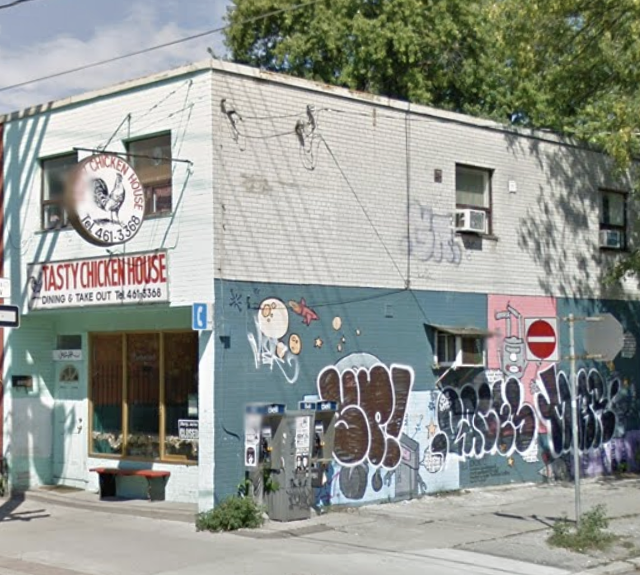
 Google Street view of Tasty Chicken bar
Over the past decade, Toronto’s Queen East has undergone rapid gentrification. Regent Park, Canada’s largest housing project, was torn down and replaced with high-end condos. South Riverdale, which sits between Regent Park to its west and The Beaches -- has always been an affluent neighbourhood -- to its east, became a ‘prime location for an investment property’.
Wealthy people flocked to the once poor neighbourhood and they brought with them their tastes and purchasing power. Demand for upscale restaurants, boutiques and sanitized nightlife went up, while demand for sketchy dive bars went down as longtime tenants were priced out of the neighbourhood. South Riverdale was rebranded by real estate investment interests as “Leslieville.”
While this may seem like a cultural improvement, sketchy dive bars actually played a crucial role in keeping the drug trade contained and controlled. They provided informal yet effective safeguards by spreading dealers out, discouraging violent turf wars, and keeping conflicts behind closed doors. Without them, these disputes have moved out onto the streets, leading to exactly the kind of violence that claimed Karolina Huebner-Makurat’s life on July 7, 2023.
Huebner-Makurat’s death was extremely tragic. She was a mother, a wife, a scholar, a traveller, a kind-hearted person, a Ukrainian, a Canadian, and a “beacon of light” whose death left a hole in my community. She was picking up smoothies for her family when she caught a stray bullet, an out-of-control warning shot fired during an altercation between drug dealers.
In the aftermath, a moral panic narrative has placed the blame for Huebner-Makurat’s death on the South Riverdale Community Health Centre’s safe drug consumption site. However, this narrative ignores a deeper shift in the city’s landscape that contributed to the very conditions that made this kind of violence inevitable. Allow me to explain.
Suppressing violence
So let’s say that one dealer has made the executive decision that another dealer of illegal products is stepping on their turf and that this must be communicated. The dealer doing the communicating has one of two methods to do so — the “easy” or the “hard” way. The “easy way” involves having a conversation in which the other party may or may not agree with the perspective being presented. The “hard way” involves intimidation and robbery.
Taking a man’s shit, performing robbery, is a quality way of communicating: It leaves very few questions to be asked, contributes to one’s long-term brand image goals, solves the immediate problem of securing one’s target market from competition, and contributes to one’s next re-up.
Of course, robbing a drug dealer is easier said than done, but robbing a drug dealer inside a sketchy dive bar brings the added challenge of not pissing off the establishment owner.
Firing a bullet, even just a warning shot, would result in being kicked out of the establishment for life, and even just being seen by other patrons can lead to loose ends and liability.
Sketchy dive bars suppress these entirely predictable moments of the unregulated marketplace that are prone to violently spiraling out of control.
Furthermore, sketchy dive bars suppress violence by providing dealers with the option to casually hang out in one: to buy a beer, play some pool and maybe even ask around if anybody is selling drugs there.
The ability to casually feel out a spot and to notice that it has or has not been taken enables dealers to cautiously, even respectfully, manage territory. I once talked to a dealer who told me that he was tempted to rob another dealer and take his spot, but didn’t because he respected the other dealer as “in the same game as me.”
The most significant way in which a large collection of sketchy dive bars suppresses violence from spilling out on the streets is by physically spreading dealers out. In fact, after dealing out of a sketchy dive bar for a while, a clientele base is established, and then the dealer doesn't even need to hang out in their spot; their phone or to walk around the block would be all they need.
Sketchy dive bars have a way of blending into the urban streets and becoming unnoticed. Sometimes this happens because the bar is physically small, sometimes it is accomplished by seeming like (and even being) a legit establishment, and sometimes it is so painfully obvious that a sketchy dive bar is a place to buy drugs that those few can inoculate you from being able to see the less obvious ones.
Gentrification
Half a decade ago, walking along Queen East, from Logan to Pape, which is just 400 metres, you would have encountered six sketchy dive bars or places where you’d be able to buy/sell hard drugs.
For example, on the corner of Boston and Queen, you had Tasty Chicken House, which did not serve chicken but was a great place to get a warm beer, a bowl of Doritos and, of course, hard drugs.
At The “Dirty” Chicken, it was okay if you didn’t have cash. You could buy your beer using TTC tokens.
West of Tasty Chicken House you had The Cave, which was tiny. I only vaguely remember it, but apparently it served as a great spot to buy/sell hard drugs.
One time, while talking to a lady who moved into the area as a form of real estate investment, she mentioned that she used to sometimes go to Velvet for dinner.
“Oh yea, I remember Velvet,” I told her. Then I asked, “Did you know that you could buy hard drugs there?”
“Oh! Well, I’m not in the business of buying that sort of thing,” she retorted in a judgey kind of way.
“Oh, yeah. Same, same. I’ve always stayed away from hard drugs as well. I grew up going to Morse St. Public School and so I know not to mess around with that stuff,” I agreed with her before adding, “it’s just that I’m childhood friends with the people who used to deal out of there.”
The lady had bought her home in 2010. Her friends told her it was a bad idea because the area was so sketchy, but she told me that she was proud to have made the right decision because, “look at how much better the area has gotten!”
Velvet has been replaced with a place where you can get a Brazilian wax job done for a hot date. Tasty Chicken House is now Wei Bar, which is a #DiveBar, a great place for a good ol’ sloppy drunk-girls’ night out.
This next cultural improvement I really could not make up. If I was writing a fictitious story, I would say, “No, no, that sounds too cliche or unbelievable.” But get this, “The Cave,” the once-sketchy dive bar, is now the office of Julia Dabrusin, my democratically elected federal Member of Parliament (MP).
No Rose-Tinted Glasses
It is important to not wear rose-tinted glasses and be naive about the horror that is the drug trade. As a child I saw my first illegal firearm in front of Tasty Chicken House. My buddy’s older cousin who was working the spot thought it would be cool to show off his piece to the kids. I remember being woken up in the middle of the night by gun shots because Tasty Chicken House had been raided by the police.
A dog was killed in the incident. The dog died nobly protecting his piece-of-shit owner for all the wrong reasons. Years later when my underprivileged childhood friend was drafted into dealing out of the spot to make some money to provide for his daughter, I worried that he too might meet with a terrible fate for all the wrong reasons. Again, please don’t take from this article a simplistic understanding that sketchy dive bars are the answer to everything wrong with the world; they are not.
I celebrated as each of the sketchy dive bars closed, but then on that tragic day when Huebner-Makurat caught a stray bullet, the event shook my understanding of the streets I grew up on. Why was there a gun fight in the middle of the street? Was it a drive-by shooting, a planned act of violence?
I found the video of the incident between the dealers online. It wasn't a drive-by. It wasn't a planned act of gun violence. The incident was one dealer trying to push another dealer off of his turf, and it spun out of control in the middle of the street. This was the type of thing that would have been contained inside of sketchy dive bars, if not suppressed or avoided entirely, but they aren't there anymore.
More Resources
If you’d like to connect what I have said here to a greater body of research, to validate it, please see the following links (and the links contained within them):
https://www.theguardian.com/us-news/2023/dec/08/gun-violence-gentrification-study
However, if I am going to get you to do some additional reading, I’d like for you to specifically become aware of the Woodgreen shooting that happened just four residential blocks away from where Huebner-Makurat caught the stray bullet just a year and a day before. Here’s a link:
Coverage of the Woodgreen shooting is not as authoritative as academic research, but it does suggest that even after completely flooding the South Riverdale Community Health Centre with security guards (which has been the case), we have not learned what we need to learn to ensure such tragedy does not repeat itself.
Acknowledgements
I’d like to end by acknowledging and crediting “Rr” and another anonymous source. I’m just a guy who grew up in the ‘hood. I have no experience selling hard drugs, but my childhood friends do.