
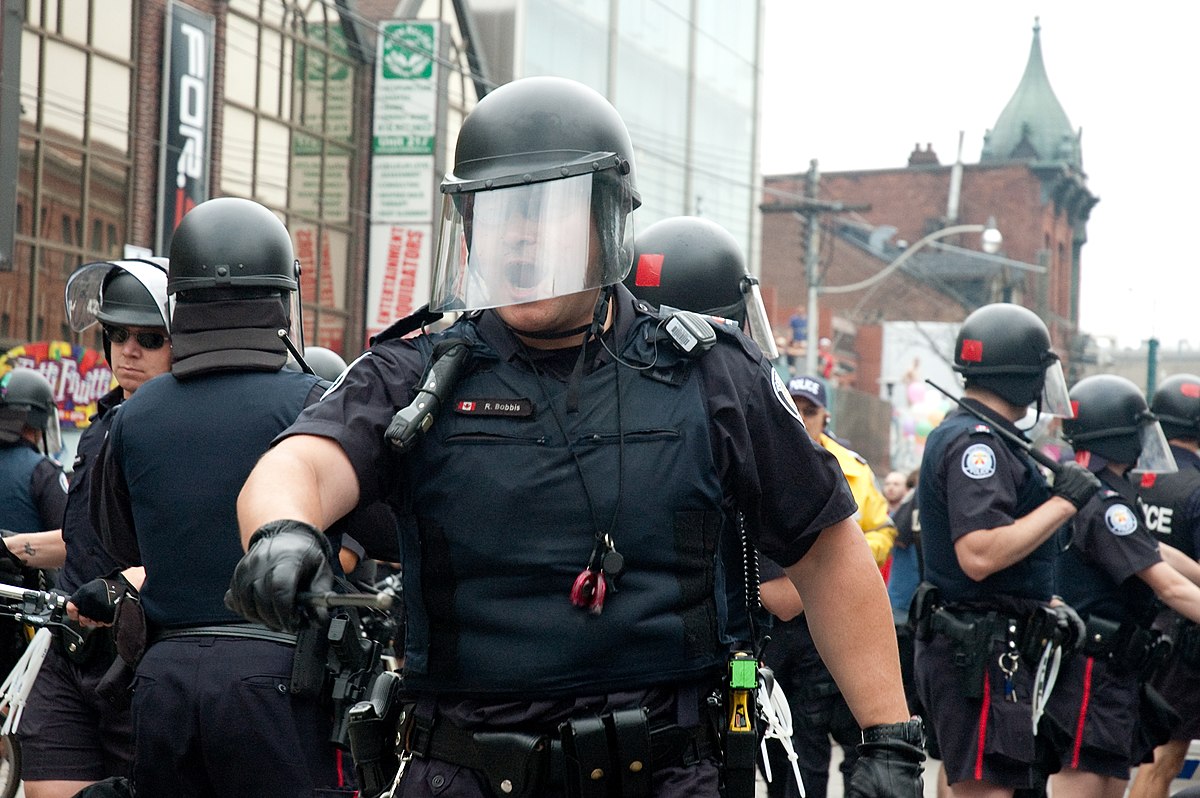
 Toronto police at a protest.
There is a dangerous trend in Canadian politics, one that threatens a key separation of powers that is supposed to be a hallmark of democracy. It is the increased involvement of police in politics—both police officers running for political office and the endorsement of candidates by police associations. Both have happened in elections at all levels—municipal, provincial, and federal—over the last few years.
It has become apparent that direct police involvement in politics has become a regular feature of political life in this country. This should have us worried for a number of reasons. This is ot simply because members of the armed domestic force in society should not be part of the very bodies charged with overseeing policing. More deeply, society should not be organized according to the repressive and violent priorities and interests of police forces.
Police in Politics: A Dangerous Quid Pro Quo
The current federal election shows how extensive police involvement in politics has become. Several active or former police officers are running as candidates in multiple provinces. Policing candidates include Jessy Sahota in Delta BC and Bob Herman, Hugh Stevenson, and Ron Chhinzer in Ontario, all running as Conservatives. Peter Yuen, a former Toronto Deputy Police Chief, is running as a Liberal in Markham.
Additionally troubling is the very public involvement of police associations, which have come out with endorsements for party, leadership, and specific candidates. This has included appearances at political rallies. The Peel Regional Police Association, Durham Regional Police Association, Barrie Police Association, and Sault Sainte Marie Police Association have so far endorsed Pierre Poilievre and the Conservatives.
The Toronto Police Association (TPA) sent letters to Poilievre and Mark Carney to see if police will be “adequately supported” with “appropriate police funding and resources.” A week before election day, the TPA formally endorsed Poilievre and the Conservatives, a decision so predictable it was a foregone conclusion regardless of their inquiry letters.
Where such police endorsements have happened, serious questions have been raised, including concerns that police associations will expect a quid pro quo for their endorsement. In Vancouver, the police association endorsed ruling party cut city funding for a community group (the Vancouver Area Network of Drug Users, VANDU) critical of police—the only group cut. The new government also greenlit increased funding for police and initiated several new policing programs, including ones specifically targeting the city’s Downtown Eastside (DTES), home to many poor and unhoused residents (and to VANDU).
Then, on April 23, news came that a Vancouver Police Department (VPD) whistleblower had made a complaint to the Office of the Police Complaints Commissioner (OPCC) saying that one of the policing projects targeting the DTES, the ominously named Task Force Barrage, was mandating arrest quotas. The complaints commissioner noted that the whistleblower called Task Force Barrage a “politically motivated crackdown” with those in charge “setting quotas.” Notably, Barrage was something of a gift to police from the police association-endorsed council, giving them added resources and a broad mandate to target residents of the DTES.
While Mayor Ken Sim has so far withheld comment, the VPD have used criticism of Barrage to go after community critics of policing—showing the troubling nature of police in politics. VPD spokesperson Sergeant Steve Addison gave a sneering response to media questions about the Barrage whistleblower, saying, “We understand these results, and the support we're receiving throughout the Downtown Eastside may be upsetting to police critics, defunders and people who are ideologically opposed to the work we do.” Are police the voice of the mayor’s office? Or vice versa?
In the 2025 federal election, signs of the cop-Conservative quid pro quo came simultaneously with the TPA endorsement. Poilievre unveiled a broad plan to increase police powers to target unhoused people and dismantle tent encampments across Canada. This, following the wave of endorsements from police associations, is a clear warning of what to expect from police interference in politics. Massive and sweeping expansions of police powers and resources, human and civil rights be damned.
The blurring of boundaries between oversight and overseen is fully on display in British Columbia, where following last year’s provincial election the NDP government named Gary Begg, an RCMP officer with almost 40 years on the force, was appointed Minister of Public Safety and Solicitor General. A police officer is now the person charged with making government decisions about policing.
Even in cases of former officers, there have been some concerning issues. Sault Ste. Marie Police Service Chief Hugh Stevenson retired to run for office but chose to wear a police chief jacket to canvas, which is professionally, and possibly legally, dubious. This worried one resident so much that they reported it. Does this mean he has not separated his identity from the police force even as he runs for public office? Does it suggest he is not able to separate his allegiance from the force as a public office holder and act without prejudice particularly towards community critics of police, representatives of criminalized people, etc.? Voters should not have to guess.
A Disturbing, Growing Trend
For a sense of how recent and expansive this trend of police association endorsements is, we might recall that it became national news in 2022 when the Vancouver Police Association endorsed mayoral candidate Ken Sim and his ABC slate for city council. This is a shift. In Toronto in 2004, a legal opinion requested by the city’s police services board concluded that political endorsements by the Toronto Police Association were illegal under the Police Services Act. The board then passed a policy requiring the police chief to discipline officers who came out for or against political candidates. When the Ottawa Police Association sought to nominate a mayoral candidate in 2006 a legal argument was raised against it.
We should bear this in mind when we see endorsements from Ontario-based police associations like the TPA. Police association executives and members are subject to the Police Services Act, and it prohibits the endorsement of political candidates. So, the self-proclaimed upholders of law and order are once again violating both, as they routinely do.
So, what has changed? My sense is that there is a growing, open, turn by police, especially police associations, to counter community critics of policing. Police have become especially defensive about community opposition, such as calls for defunding or abolition, following the waves of protests after the police killing of George Floyd in 2020. Police have been explicit in saying that this opposition has affected recruitment. They are making a power play to threaten and to silence community movements and stifle opposition to policing.
Police Power Politics
To be clear, this is not a matter of partisanship—its is about the place of police officers, and their associations, in governance. While there may be greater affinity between police and conservatives, given a shared focus on “law and order” or “tough on crime” policies, all major parties have run police officers as candidates recently, including the social democratic NDP.
Police already occupy an exceptional place in society—one with a tremendous amount of power over people’s lives. They are among the few groups allowed to carry weapons openly and to deploy lethal force, which are allowances not provided to civilians.
The ones holding the guns should never be calling the shots, so to speak. Oversight and regulation of police is already limited and inefficient—to a deadly degree. What will this already limited oversight look like, when the very people charged with overseeing police are cops themselves or people beholden to cops for their very political careers?
Even worse, police in government raises the prospect of police driving governance, setting social policies according to police (repressive) priorities, rather than proper social considerations. This stands to bring more violence into society, while making communities less healthy and less safe. It will negatively impact social wellbeing. Direct political influence and favour for the police will be socially harmful.
Sault Ste Marie Police Association President Josh Teresinski justified their endorsement by citing “Pierre Poilievre's approach to public safety—holding repeat offenders accountable and reducing political interference.” We should not overlook the irony there. Police interference in politics is precisely one of the concerns people have about such endorsements.
Priorities for public safety are the responsibility of communities, not police. Community wellbeing means properly supporting essential resources, based on community needs, not vested interests of police. It means ending the repressive domination of social life by police. In the bigger picture, it means abolition.
We must be vigilant to guard against police seeking even more power in society and seeking to do so by formally taking over politics. These dangerous developments must be vigorously opposed.
Jeff Shantz is a long-time anti-authoritarian organizer, researcher, and writer who lives and works on Kwantlen, Katzie, and Semiahmoo territories (Surrey, British Columbia).
Please subscribe to The Media Co-op's newsletter!