
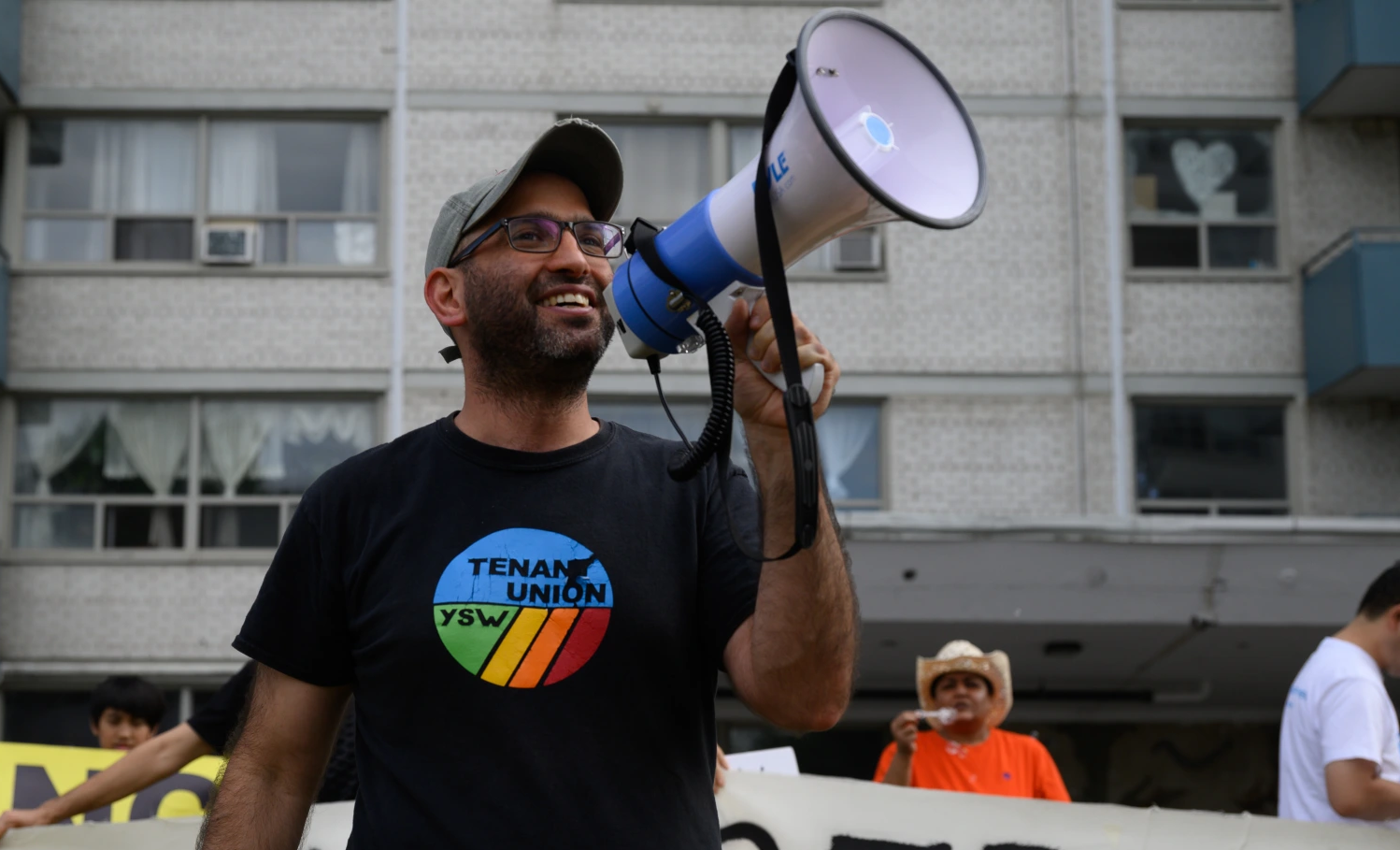
 Tenant organizer Bruno Dubrusin of the York South-Weston Tenant Union. (Photo: Climate Justice TO)
Emma B. didn’t know she had rights until her landlord tried to take them away. When he did, she got together with her neighbours, fought back, and won. And given how bad things are for tenants these days, it made her wonder why more people aren't doing the same.
Emma is a single mother who works two jobs, and she rents in Toronto. She initially assumed that she had no choice but to accept the rent hikes, the ignored repairs, the quiet threats of eviction in her Parkdale high rise. But when the notice arrived—no-fault, legally flimsy, but still terrifying—she found herself in the orbit of a tenant union. That’s when she saw what was possible: tenants organizing, resisting, and forcing landlords to back down. “I used to think struggling alone was just part of renting in this city," she said. "But when we organized, I saw it differently."
Across Canada, tenant unions have won fights that seemed unwinnable—rent rollbacks, eviction bans, public shaming campaigns that have turned slumlords into targets, and more. But these fights remain the exception, not the rule.
One-third of Canada's population are renters and the conditions for change have never been more ripe. Given that organizing clearly works, why is the housing struggle still so fragmented? Why haven't renters everywhere risen up?
Barriers to Organizing
Bruno Dobrusin is a tenant organizer with the York South-Weston Tenant Union. He has been on the frontlines of Toronto’s housing battles—rent strikes, community organizing, building tenant power from the ground up. He sees the current legal framework governing the relationship between landlords and tenants as a key factor limiting the spread of tenant organizing.
The system currently disempowers tenants while protecting the financial interests of landlords. Unlike labour unions, tenant unions have no legally recognized power to negotiate. According to Dobrusin, the absence of legal protections is not an oversight but a deliberate strategy of control. “Although the legislation in Ontario is flexible when it comes to forming tenant associations,” he said, “landlords do not have to meet with tenants or even respond to their demands.”
There is, similarly, no obligation for landlords to reach or recognize a collective agreement, and no way to enforce one. This means that renters are forced into individual negotiations with corporate landlords who control entire city blocks.
While not precisely illegal, withholding rent is not legally protected under most tenancy laws even if you have a legitimate grievance. This is in contrast with the withholding of labour when unions go on strike in the workplace. Rent strikes can still be a powerful tactic, but they’re technically a breach of lease, dismissed in Ontario by the Residential Tenancies Act except in rare circumstances.
Moreover, the law makes it easy for landlords to punish tenants who stand up for their rights.
In the early pandemic months of 2020, as COVID-19 ravaged working-class communities and turned housing insecurity into a crisis, tenants in Toronto’s Crescent Town found themselves squeezed by capitalism at work and at home. Most were immigrants, many were essential workers, and none were insulated from the economic collapse that followed lockdown orders. With incomes slashed, rent became unpayable. And in response, their landlords—Pinedale Properties and Ranee Management Ltd.—did what landlords do and moved to evict.
What followed wasn’t the quiet displacement the system relies on. The tenants organized, they formed the Crescent Town Tenants’ Union, and they fought back. However, even though Ontario law bars evictions that punish tenants for union activity, the Crescent Town tenants argued that’s exactly what they were facing. And the Landlord and Tenant Board—often seen as more landlord-friendly than not—agreed that tenants who organized and proposed repayment plans were being treated worse than other tenants, and many evictions were dismissed.
This ruling was a rare and important victory, but it made clear how easily landlords can weaponize eviction filings to silence dissent. Retaliatory evictions are technically illegal, but tenants bear the burden of proof, which is usually a very difficult standard to meet.
Another key strategy for landlords enabled by the current legal framework is deliberately cycling tenants out of units. High-rise rental towers in working-class neighborhoods like Parkdale have become sites of landlord neglect, rent gouging, and tenant displacement, and corporate landlords have been regularly evicting renters to maximize profits. A 2022 study by the Parkdale Neighbourhood Land Trust found that tenant turnover is, in fact, a business model. Landlords exploit vacancy decontrol, where a unit’s rent can be raised without restriction once a tenant leaves. This results in a system where keeping long-term tenants is less profitable than forcing them out.
Beyond just a source of profit, this cycle of displacement is another key reason tenant organizing hasn’t scaled into a larger movement. If tenants are constantly being pushed out, there is no time to build collective resistance. The landlords count on this. And until tenant unions have the power to force landlords to the negotiating table, this churn of eviction and replacement will continue, keeping renters isolated, precarious, and struggling to fight back.
Fighting Back
One kind of change that tenants need is at the level of government action. Ontario NDP MPP Jessica Bell says that her party “views housing as a fundamental human right,” a position that stands in sharp contrast to the current Conservative government of Premier Doug Ford, which critics say treat housing as an investment vehicle first and a place to live second.
Bell argues that “the government needs to get back to building non-profit housing and co-ops and the tenants act needs to be reshaped to allow tenants associations to be formally recognized." The recognition of tenant unions and of a right to collectively bargain with landlords would not just be symbolic—it would be strategic. A legal mandate to negotiate with tenant unions and the right to strike would change the game.
Dobrusin calls rent strikes “very effective” and believes they’ll only become more common as the crisis deepens. “Rent striking should be made legal and [the government should] force landlords to come to the table to bargain with tenants,” he said. “Whether it becomes legal or not, I think rent strikes will continue to take place, as more tenants organize collectively and realize that striking is the ultimate tool to challenge the economic (and political) power of landlords.”
A key obstacle to realizing that change is, as Dobrusin sees it, the real estate lobby—the developers, landlords, and property managers whose political donations keep them in the driver’s seat. They’ve captured the narrative, convincing lawmakers that any regulation is a threat to supply, even as that “supply” becomes more expensive and more precarious. “Landlords thrive in an environment of generalized precarity,” Dobrusin said. “And they make sure tenant protections are weakened.”
He also argues that the state of the tenant movement is itself a barrier—it's growing, but it is not yet a political force strong enough to make legislators afraid. “As more tenants get organized and connected,” he said, “that’s going to change.”
Dobrusin's policy prescriptions are simple, and radical only to those profiting from the status quo: a rent freeze, universal rent control, a moratorium on evictions, vacancy control, and the return of public housing built not for profit, but for permanence. He believes that the path forward is not top-down reform, but bottom-up revolt. “Keep organizing and growing,” he said, “to become a political force that no one can ignore.”