
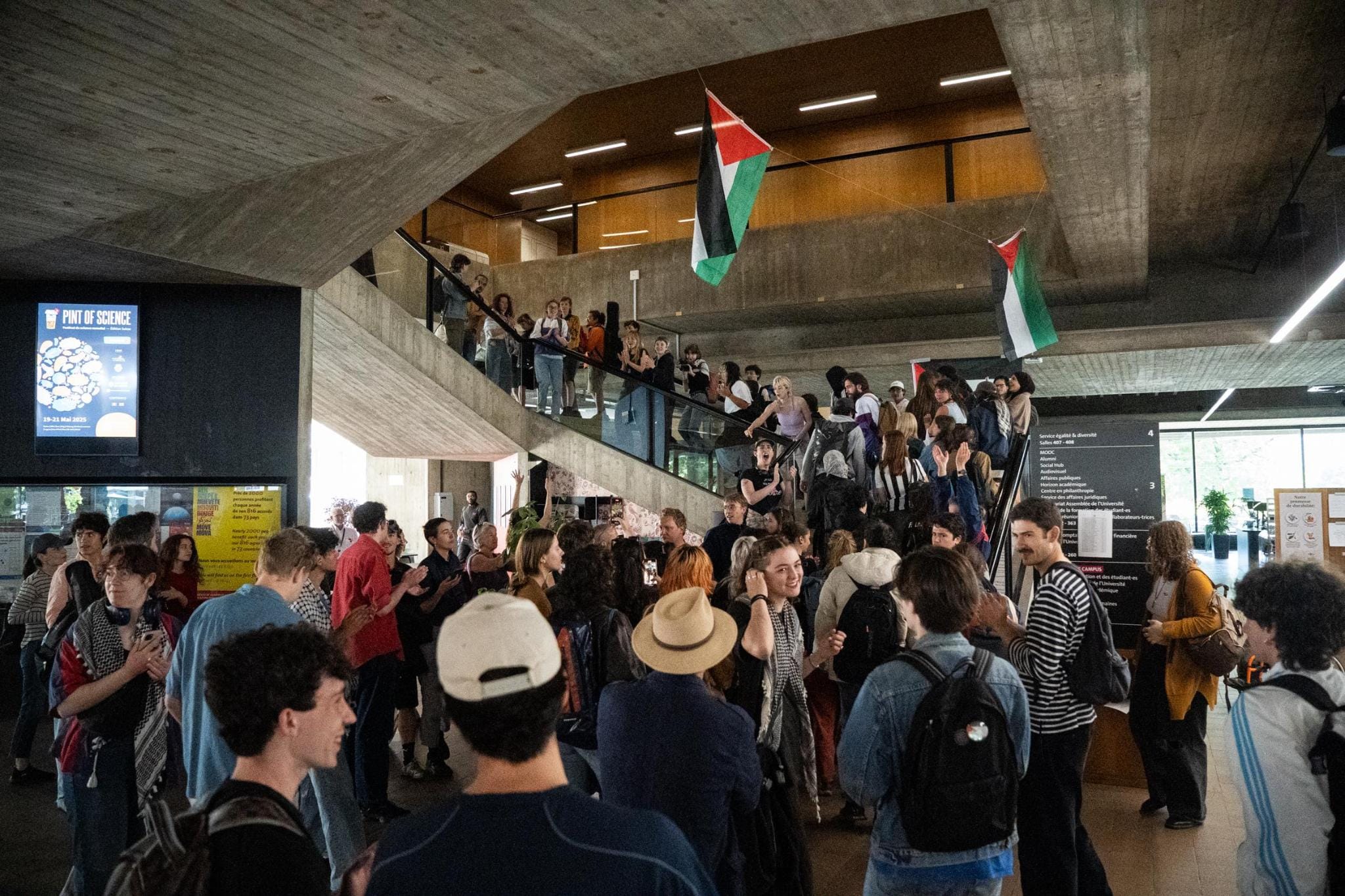
 Photos at Bibliothèque de l'Université de Genève (Uni-Mail) taken by Yousra via Coordination étudiante pour la Palestine in Geneva.
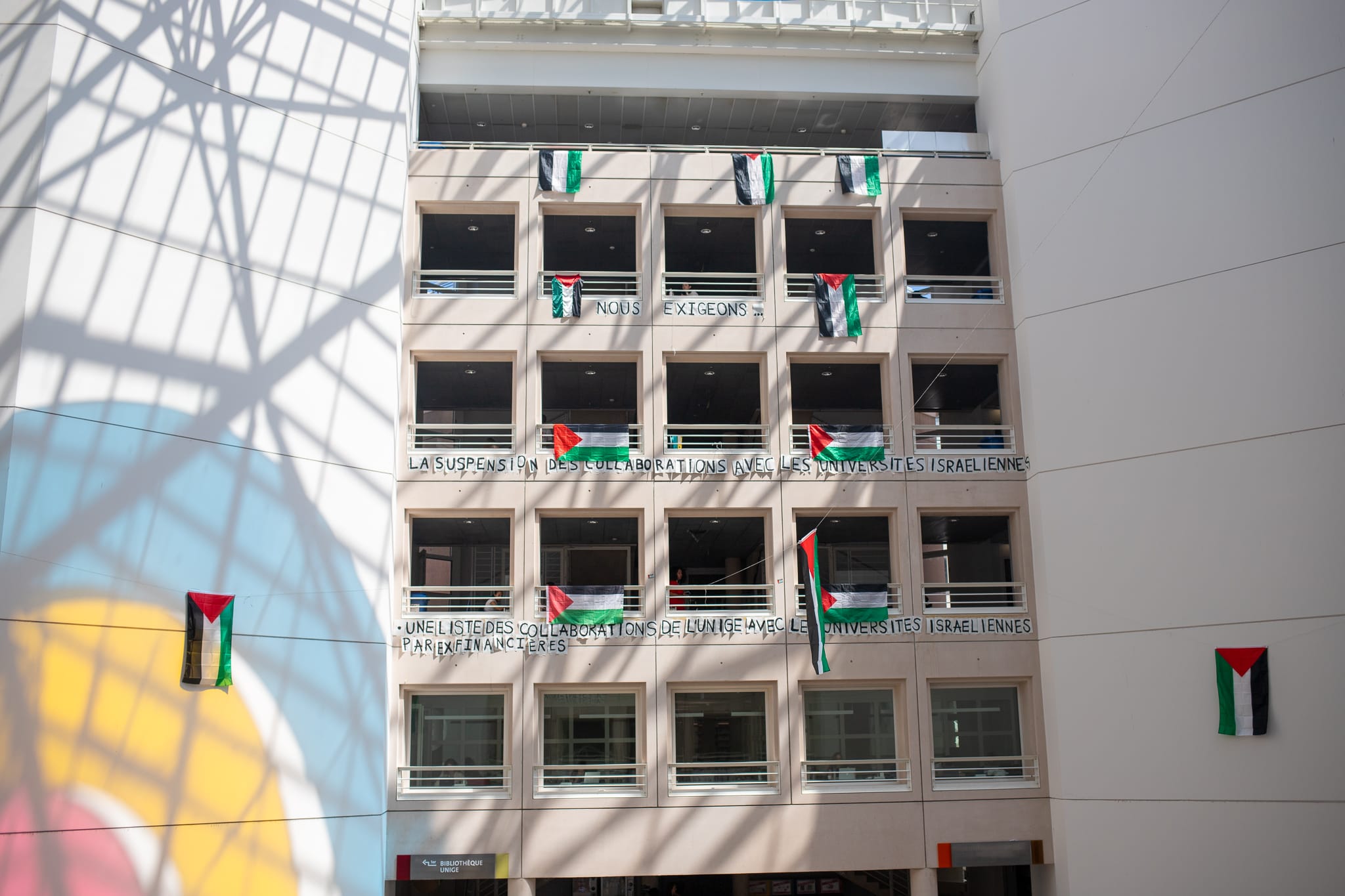 Photos at Bibliothèque de l'Université de Genève (Uni-Mail) taken by Yousra via Coordination étudiante pour la Palestine in Geneva.
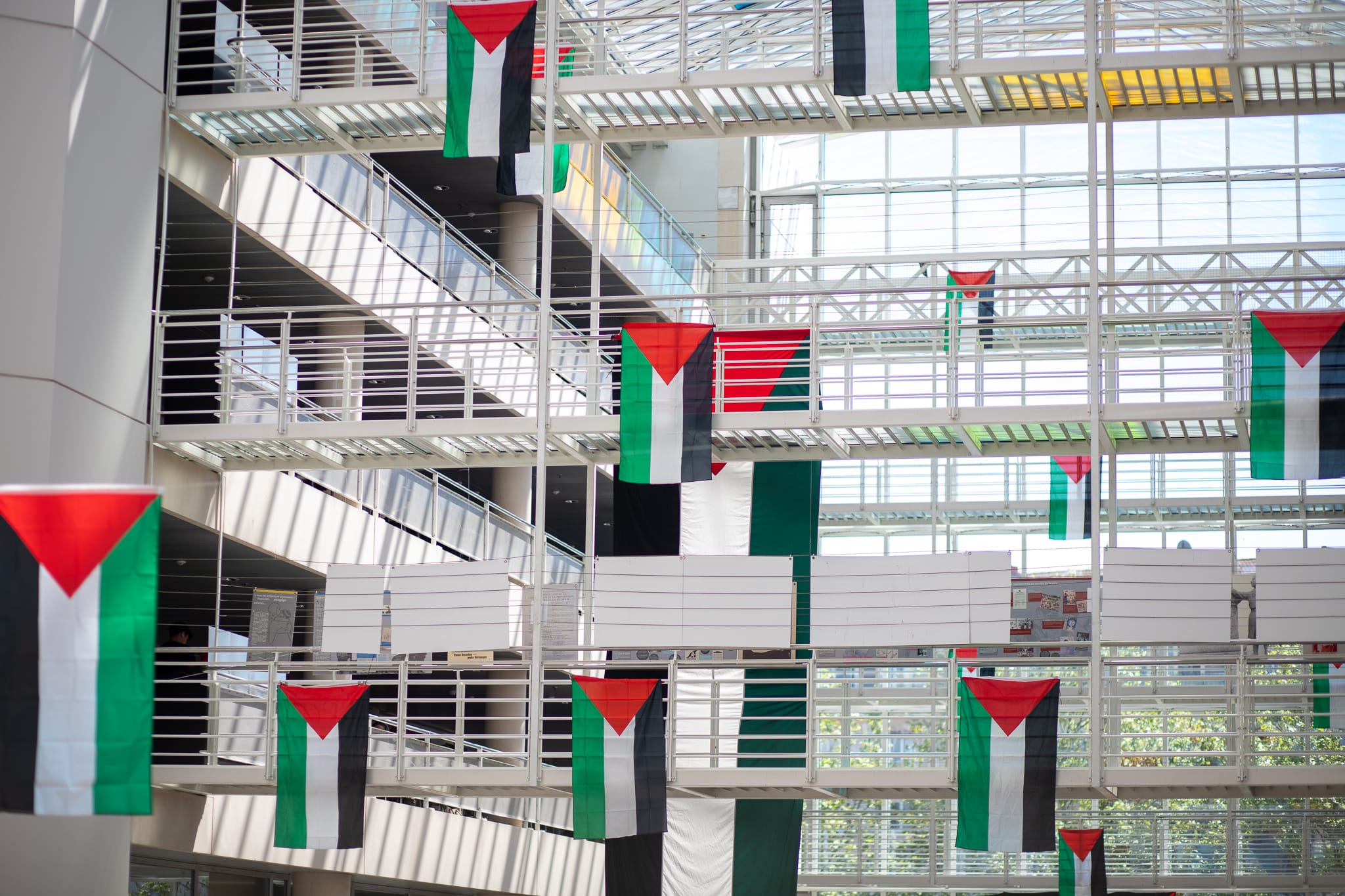 Photos at Bibliothèque de l'Université de Genève (Uni-Mail) taken by Yousra via Coordination étudiante pour la Palestine in Geneva.
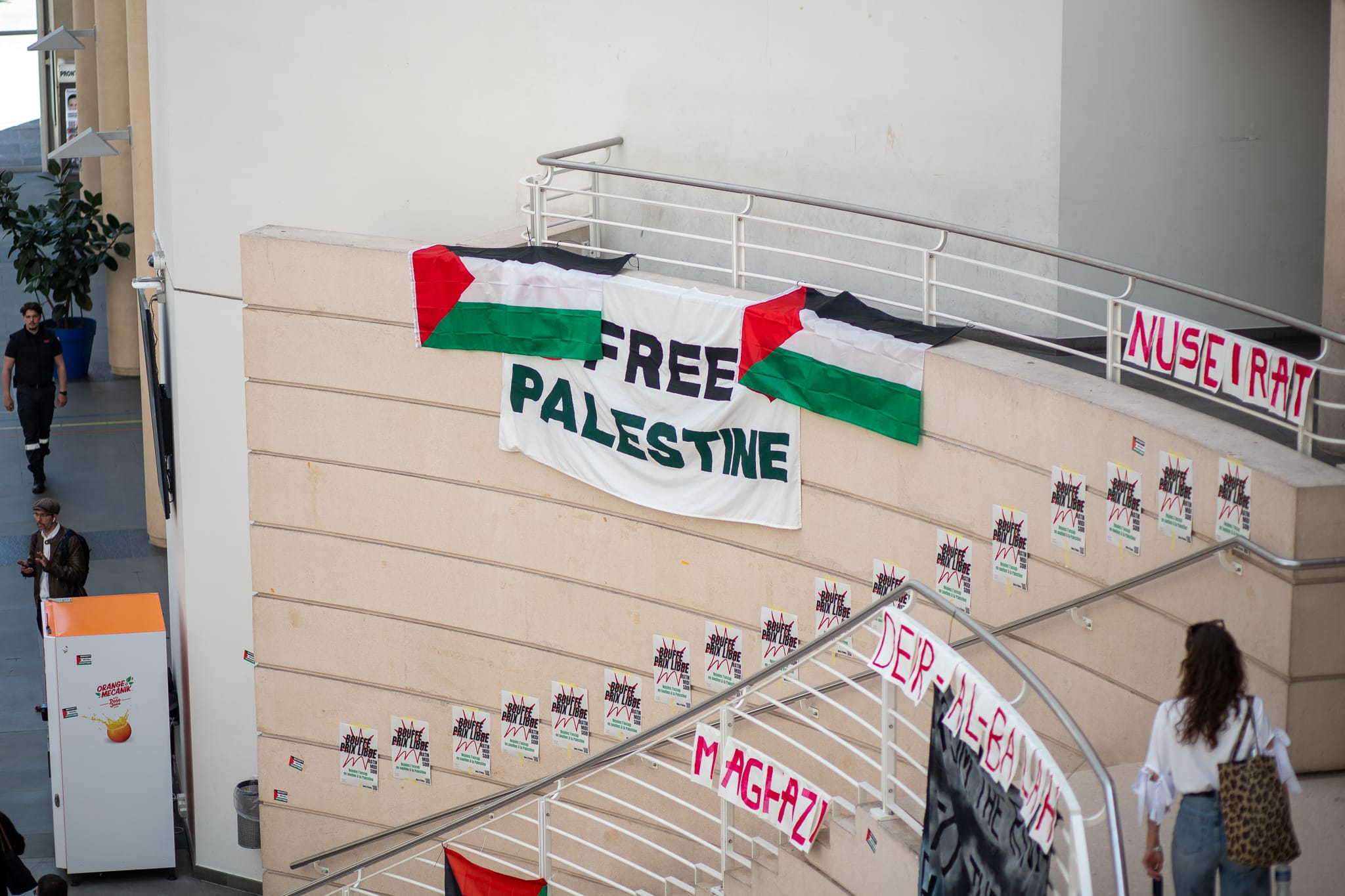 Photos at Bibliothèque de l'Université de Genève (Uni-Mail) taken by Yousra via Coordination étudiante pour la Palestine in Geneva.
Joseph Daher is a Swiss-Syrian scholar and activist who has a long history of involvement in the Palestine solidarity movement in Europe and in struggles for the liberation of the Syrian people. In the context of important ongoing debates about how social change happens, Montreal-based media-maker Stefan Christoff speaks with Daher about Palestine solidarity in the European context and about how that relates to questions that all of us must wrestle with in organizing for social change.
Daher talks about the complexities of the Palestinian struggle in Europe and how it has exposed the racism integral to the majority of mainstream political forces in the European Union, which he links to histories of Western colonialism. He also talks about the importance of building connections between social movements across borders, and about solidarity from below. Moreover, Daher openly challenges the idea that tools of liberation can be shaped by authoritarian states in the non-Western world, like the Russian government of Vladimir Putin, and he challenges the approach to understanding political struggles which reduces them to struggles between different blocks of states – an approach that is often described as "campist."
These questions are active topics of debate within and beyond the Palestine solidarity movement in many different places, including in so-called Canada. Our conversations will only be enriched by listening to the voices of people involved in these struggles on the ground in other contexts around the world.
Stefan Christoff: Can you introduce yourself and your work?
Joseph Daher: Thank you Stefan for this opportunity to exchange and share ideas with you. My name is Joseph Daher, I am Syrian-Swiss academic and socialist. I currently teach in Lausanne University, focusing on contemporary history of the Middle East and also political Islam. I also participated in a research group at the European University Institute on Syria, with other Syrian researchers and academics until 2024.
I also do work in coordination with some grassroots organizations and activist networks, here in Switzerland but also globally, relating to progressives supporting social movements in the Middle East and North Africa. My organizing work really first sparked through efforts to support the Palestinian freedom struggle and to back the Boycott, Divestment and Sanctions (BDS) movement in the mid-end 2000s. For many of us with roots in the region, but also many others, the Palestinian cause is close to the heart, on the basis of collective humanity, always. 
SC: First, let’s focus on the mobilizations that have been taking place to support Palestine in western Europe, in Switzerland particularly, where the protests in Geneva have been very strong. I get the sense that mobilizations in some places, like France, saw street-based power forcing governments to change their political tone and sometimes position in response to Israeli state attacks on the Palestinian people in Gaza. Can you describe the protests that have been taking place where you are, while also offering a perspective on the impacts that these protests have had?
JD: Definitely. I will first address the French speaking parts of Switzerland and then some larger questions. Historically, the left has been more important and, simply put, larger in the French speaking areas of Switzerland, as compared to the German speaking areas for sure. In those areas, the German speaking regions, we saw some specific protests forbidden in different Swiss cities, mirroring other parts of western Europe. Also, in university spaces it has been very difficult even to hold events. Solidarité and other political grassroots formations have been trying to push back and to speak about Palestine in all regions of the country.
It is important to underline that the demonstrations have been composed of a lot of youth, many young women, from non-white communities, but also left groups, the radical left.
So it was only the radical left parties from within the Swiss political scene who extended their solidarity to the Palestinian people. Also some trade unions and, of course, Palestine solidarity groups were active in organizing the protests, but also a lot of non-affiliated community members from diaspora communities have been very active. This must be underlined.
Between all these forces we were able to create a context of protest solidarity with the Palestinian people with multiple demonstrations that included thousands, even with some reaching over 10,000 people in Geneva, also big protests in Lausanne, and smaller cities like Fribourg saw relatively significant protests.
These gatherings include a lot of teenagers, people in their early 20s, including many people from Arab diaspora communities who are really involved in political life for the first time in a public way, helping to organize conferences, protests, and also fundraising efforts for humanitarian support for Gaza, for example. Also, there are many actions that have taken place, actions in markets, in public places, where people have called for BDS, for example.
SC: This can help us to think about the important role that progressive forces have played in terms of creating political space for these protests in solidarity with Palestine. I want to underline here the ways that progressive, long term organizations create a context that holds political space within which new political actors, like the young folks from diaspora communities can then enter and act with autonomy and take collective action.
Also, there is the critical and essential role that diaspora communities have played in creating political space. I would imagine that this is significant in areas where French is more dominant due to the historical lineage of French colonialism in North Africa and West Asia.
I would like to get into the con flict between the more traditional ‘left’ parties in Europe and the more grassroots left and progressive organizations in relation to Palestine – the gap that clearly exists. For example, in Canada we generally see some alignment between grassroots and more institutional left forces around some domestic issues, at least in broad strokes. For example, both are going to be opposed to privatizing healthcare in Canada, at least publically. I think that it is interesting to address this gap between the more institutional political left and activist radical left networks when it comes to Palestine.
JD: The Palestinian issue can create a turning point, [differentiating between left groups with] a more revolutionary understanding of change versus a more institutional left – although this isn’t the best term – or groups who maybe think about change from above, from the parliamentary context. The difference here, the main issue, is how you conceive of change: Does it happen from below or does it happen from above?
Here you can see a point of divergence around Palestine – you can see the difference, both historically and today. Obviously, the Palestinian struggle is a key cause of solidarity for the radical left historically. Today, we are witnessing a key turning point in Europe and beyond, which is that the far right is rising, and societies in the West are moving to the right. You see the traditional socialist, social democratic forces have largely disappeared from the political scene or are being replaced by new political formations, as we see in France with La France Insoumise, or with the movement toward voices like Jeremy Corbyn in the UK, or even with Podemos in Spain.
This is in the background of rising influence of far-right movements in the West. So there is this dichotomy taking place.
Also, there is this forming of alliances between traditional ruling class parties – social liberal, liberal, and centre right – who are trying to save a neoliberal centre that is dead, so this is also happening. These forces in the so-called centre have formed a political alignment with the extremist government in Israel, which shows their bankruptcy, which illustrates an alliance with a society shaped by colonialism and apartheid. This is a dead end and must be underlined. This is rooted in a historical racism that views colonialist Zionism as being an outpost of liberal Westernism in territories that are presented as uncivilized. This is shaped in actuality by an understanding of the world in colonial terms.
Also internally within European society, non-white populations are seen and presented as a threat, so by extension the Palestine solidarity movement is presented as a threat. Also, the Palestinian solidarity movement gathers together European left forces alongside immigrant communities, who together are finding common ground around the question of Palestine, so this is a key reason why the political space of the Palestine solidarity movement is criminalized. The unity across communities that is seen in the Palestine solidarity protests is a threat to the ruling classes on both a cultural and political level.
SC: On the question of power and states…it seems that in the last ten years a major issue that is not, in my opinion, discussed enough within the left globally, on a more cultural level, surrounds the fact that due to the intensity of systemic violence taking place – economic, political, and military violence – a lot of activism revolves around addressing crisis points and builds around that. Over the last year, we have seen that in an inspiring way around Palestine with a mass reaction by grassroots forces. I have noticed that there are some voices that are starting to point toward non-Western state authoritarian actors as representing a potential solution to Western imperialism.
There is a shorthand that we are seeing which claims that the current manifestation of the Russian state, or the political grouping of Brazil, Russia, India, and China through the BRICs bank, are alternatives that social movements should lift up. I feel that also relates to the ways that the protest movements in Syria, when Bashar Al Assad was still in pow er, were addressed. I do feel that this relates to what you are saying because the capacity of the Palestine solidarity movement and the grassroots resistance in Palestine isn’t possible because of these non-Western state forces, it is a process rooted in popular power. What do you think?
JD: Yes, you are right. Now we are touching on an important debate within the radical left. This touches on many points around what society we would like to build, what type of internationalism we want to consider, what are the possibilities around that.
Essentially, this debate is about seeing socialism, or progressive change, as a process that takes place from below, as opposed to change as taking place from above. This is also shaped by a debate about how politics function, some seeing campism as something that is inherent to politics, as opposed to seeing real radical politics as a push for liberation across all borders. This type of campist thinking opposed the Syrian revolution and the validity of Syrian movements that called for change over many years. I oppose understanding change in Syria in that way, of course.
For example, if you claim that BRICs would be in support of the Palestinian cause, well that is wrong, it would be a wrong strategy. If we look today at the opportunism of the Russian state, which has made some gestures toward claiming support for the Palestinian issue, it is obvious this is opportunistic.
This position is linked to the Russian imperialist war in Ukraine, a neo-colonial war. Supporting the self-determination of the Ukrainian people is important, I believe. This does not mean we support the Zelenskyy government. It is a question of principle to support people who are opposed to occupation and colonialism by the Russian empire. Putin was a great friend not long ago to Netanyahu, but problems occurred in relation to the Ukraine war and also due to the rapprochement between the Iranian government and Russia. In this case, Russia isn’t making gestures toward Palestine because it cares about the Palestinian people, it is only geopolitical antics. In this context we can look to India and the current far right, fascistic government of Narendra Modi, which is very close to Netanyahu.
More generally, in the more authoritarian states of the region we can see different situations but also situations with many layers of oppression which takes generations to overcome, like in Syria, but also in Iran, in Turkey, and other contexts. In all these contexts we witnessed popular movements that were oppressed violently [by the state]. It is important for us as leftists to reject this oppression, period.
This interview was originally conducted in winter 2024 and has been updated and edited for the current context. Photos at Bibliothèque de l'Université de Genève (Uni-Mail) taken by Yousra via Coordination étudiante pour la Palestine in Geneva. Thank you to Andreas Koch for coordinating the accompanying photos from Geneva.
Stefan Christoff is a media maker, community activist and artist living in Montréal. Stefan hosts the radio program Free City Radio, broadcasting weekly on nine community stations in Canada and shared globally as a podcast (Spotify + Apple Podcasts). He makes music with many people globally, including Anarchist Mountains, Aidan Baker, Adriana Camancho, Aidan Girt, Lori Goldston, Nicolás Jaar and Sessa. Stefan is on the board of the Immigrant Workers Centre in the Côte-des-Neiges district of Montreal, organizes with Cinema Politica Network and is a regular contributor to Radio AlHara in Palestine. Stefan works with the Social Justice Centre and is also a graduate student in history at Concordia University in Montreal.
Please subscribe to The Media Co-op's newsletter!