
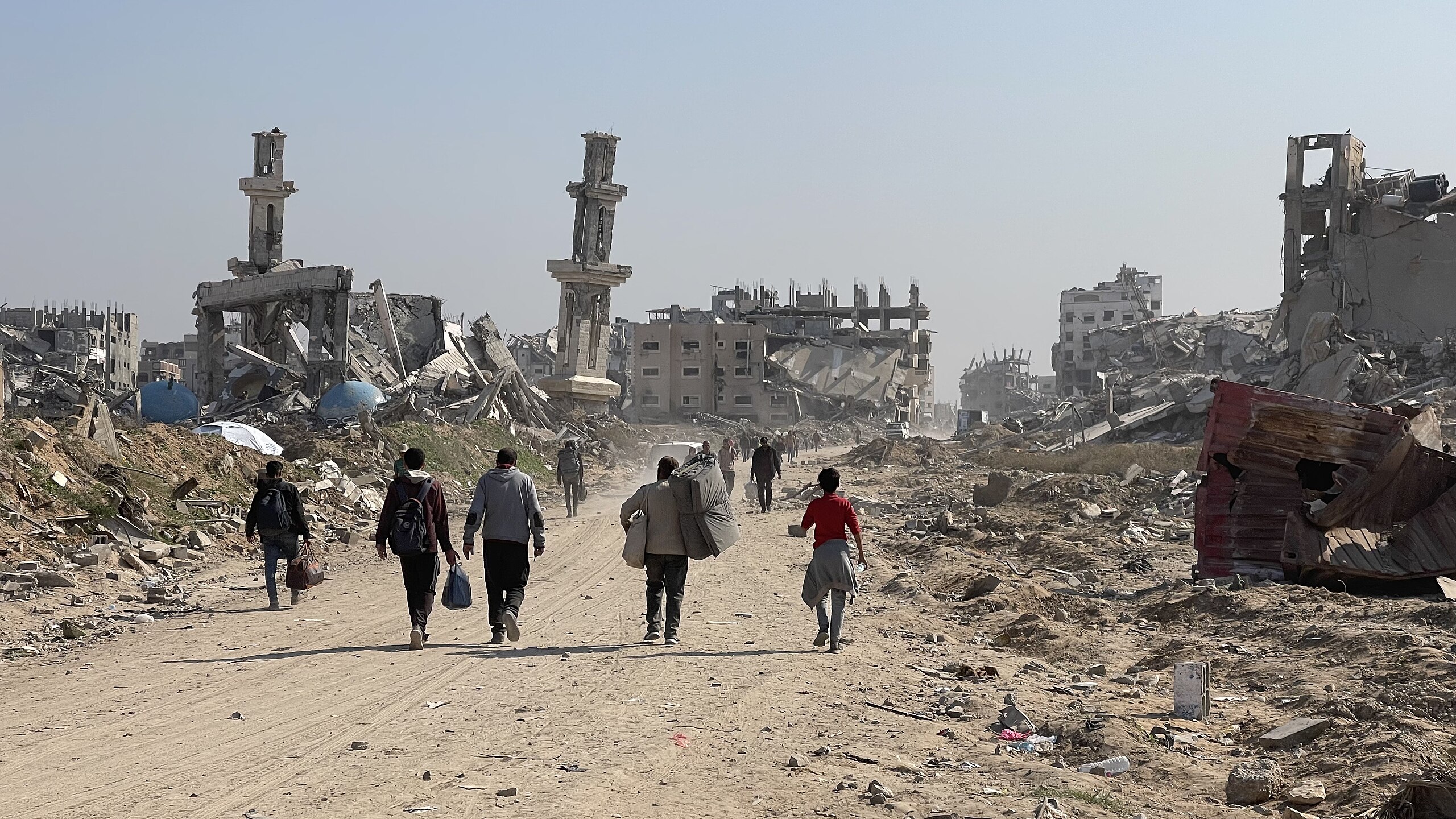
 Displacement of Gaza strip residents during the Israeli assault on Gaza, 2023-2025. (Photo: Jaber Jehad Badwan, Wikimedia)
Palestinian survivors of sexual abuse receive tragically little attention in Western media. This includes Palestinian women, who have been sexually assaulted for decades. In contrast, a lot more mainstream media space was afforded to Israeli victims of sexual abuse from October 7th even though some of that narrative has been problematized.
Indeed, an article from Fairness and Accuracy in Reporting reviewed New York Times coverage of sexual violence in Israel and Palestine over 11 months and noted a disproportionate focus on allegations of sexual assault committed by Palestinians (80%) versus allegations against Israelis (20%). The reporting on Israelis also avoided labelling these acts as sexual violence. Analyses have shown that Canadian media coverage disproportionately humanizes Israelis compared to Palestinians. The lack of coverage contributes to a broader narrative that overlooks Palestinians’ suffering.
The Rape of Palestinian Men
In war, concerns often rightfully focus on the most vulnerable – women and children. But we cannot ignore the men who also face many harms from what various Israeli scholars, academics, and thinkers have called occupation, apartheid, or genocide.
Recently, a UN report stated that Israel has committed genocidal acts and inflicted sexual, reproductive, and gender-based violence. This includes the testimony of a Palestinian man who is a survivor of Israeli sexual abuse.
The sexual abuse of Palestinian men and boys under Israeli authority seems to be a systemic issue. There already exist video testimonials from last year in which Palestinian detainees allege torture and sexual abuse in Israeli detention and prisons. Such testimonies are also reminiscent of male rape and sexual abuse in the Abu Ghraib prison after the U.S. invasion of Iraq.
It takes immense courage for survivors of sexual abuse to come forward. Yet when they do, time and again Palestinian voices are sidelined. This may have to do with the dehumanization of Palestinians, Islamophobic hatred, or the simple fact that such victims are not white.
We are two researchers who have worked on whiteness, albeit from different angles. Long’s work emphasizes white racial identity and racism in Alberta whereas Jahangir’s work sheds light on the lived experience of straight white male students.
Dehumanization
Jahangir’s examination of the economics of Gaza connects the rape of Palestinian men with the conduct of Sodom and Gomorrah. It depicts how capitalist interests perpetuate structural occupation and radicalization. It is important to recognize that systemic sexual violation can emerge with economic exploitation. Thus, the sexual violation of Palestinian men is not something novel that can be blamed on a few bad apples but the result of an oppressive system – something that has long been recognized in the tradition common to the three Abrahamic faiths in Israel and Palestine.
Male rape is a weapon as ancient as Sodom and Gomorrah (in the Jewish and Christian traditions) or the people of Lut (in the Islamic tradition). Based on the exegetical literature, it is the ultimate ignominy inflicted beyond the usurpation of resources when others are systemically dehumanized and subjugated in an asymmetrical power relation.
The dehumanization of Palestinians as “animals” and their children as “little snakes” by high-ranking Israeli officials is evident. This contributes to a context in which human suffering is rationalized and even demanded. Any criticism is deflected through weaponized victimhood or minimized through whataboutery and both-sidesism.
According to Professor Hershey Friedman, the wealthy states of Sodom and Gomorrah were destroyed because of their subjugation of the stranger, the needy, and the poor. This involved torture on a procrustean bed that led to death. Thus, sexual subjugation is intricately tied with economic subjugation.
Similarly, while Muslim think tanks view same-sex relationships as the “emblematic sin” of the people of Lut, the Qur’an situates their conduct in the context of inhospitality and highway robbery.
Even the exegete Abul A’la Maududi, who was a proponent of political Islam, referenced several incidents from the Talmud, stating that the people of Lut robbed poor travellers of their belongings, withheld food, and left the dead naked without shrouds.
This exegetical literature mirrors the situation in Israel with starvation as a weapon of war, the subjugation of naked Palestinian men on display, preventing the UN from offering life-saving support, and rape and torture that have resulted in death.
However, apart from dehumanization, the reason that Palestinian victims are not centred may have to do with whiteness. Indian author Pankaj Mishra quotes George Orwell that Palestine is a “colour issue” and mentions James Baldwin saying that the suffering of Black people is not recognized in the same way as Jewish suffering.
Whiteness
Rachel Schneider and Sophie Bjork-James describe "Whiteness" as a social category used to mark status differences and produce hierarchies within a racial system, and as a cultural marker used to designate individual and collective differences. Scholar Lilach Marom argues that most North American Jewish people self-identify as White and that this ‘whitening’ has led to their complicated incorporation into the White Christian mainstream, despite the continued threat from white supremacists.
The moral authority of Western states, including Canada, is largely built on a racialized hierarchy where White, European lives are centred, while the suffering of racialized peoples – especially those framed as perpetual outsiders – is rendered invisible or secondary. This aligns with Long’s analysis of Whiteness and its cultural norms, showing how racism and White entitlement can shape everyday interactions and institutional practices, particularly when racial privilege, reinforced by Whiteness, is routinely ignored.
This racial logic helps to explain why Israeli Jewish lives are more often framed as vulnerable and in need of protection, while Palestinian lives are treated as expendable. It also explains why pro-Palestinian activism here in Canada, especially when led by Arabs, Muslims, or racialized communities, is policed and criminalized, while pro-Israel advocacy remains politically mainstream and institutionally protected.
Together, these forces create a climate where the Canadian government not only fails to recognize crimes (including sexual violence and genocide) against Palestinians, but also actively suppresses dissenting voices that challenge this status quo. In doing so, Canada reproduces a racialized global order where Whiteness determines who is worthy of protection, which frames Palestinian resistance as illegitimate.
Islamophobia and Collective Guilt
Jasmine Zine documents the steady rise of anti-Muslim hate crimes in Canada since 9/11, including two deadly attacks inspired by White nationalist ideologies in 2017 and 2021. A 2023 report revealed a 1300% increase in Islamophobic and anti-Palestinian hate incidents, particularly on university campuses, and called for urgent government action, including increased security for mosques, anti-Islamophobia education, and public denunciation of anti-Palestinian racism.
While the Federal Government created a Special Representative on Combatting Islamophobia in January 2023, Canada has maintained (until very recently) a pro-Israel stance on the genocide in Gaza, as evinced from its voting patterns at the United Nations, which included abstaining from motions calling for a humanitarian truce in Gaza and opposing resolutions critical of Israeli settlements. Even today, after modest changes in rhetoric from the Canadian government, critics argue that this has not been accompanied by a corresponding change in action.
As a defining moral catastrophe of the 20th century, the Holocaust has created an enduring sense of responsibility in many Western nations to support the Jewish people and, by extension, the state of Israel. In Canada, El-Sherif has argued that this guilt has contributed to a political culture that is highly sensitive to accusations of antisemitism, which has the effect of continuing the racial status quo when it comes to reporting on the violence of Israel.
Overall, multiple factors including dehumanization of Palestinians, Whiteness, Islamophobia, and the West’s guilt for its complicity in the Holocaust all have a role in explaining why Palestinian victims of sexual violence are not given adequate attention in mainstream media discourse.
Dr. Junaid B. Jahangir is an Associate Professor of Economics at MacEwan University in Edmonton, Alberta. He is interested in economic pluralism and renewed perspectives to teaching economics. He has also published in Islamic Studies and co-authored the book - Islamic Law and Muslim Same-Sex Unions. He has developed new courses including Economics of Religion, Economics for Everyone, and Sexual Diversity in Islam.
Dr. Jennifer Long is a cultural anthropologist and an Associate Professor at MacEwan University in Edmonton, Alberta. Her current research focuses on racism and whiteness in Edmonton. Using ethnographic methods, she explores the racial status quo, including the systemic barriers facing various racialized groups. She also integrates design anthropology into her research and teaching, combining community-based research with design thinking. Her book, Abiding Whiteness (Oxford University Press, 2025), examines how cultural conventions allow Whiteness to shape everyday experiences among Albertans.
Please subscribe to The Media Co-op's newsletter!