
June 3, 2025. I can’t breathe. I wake up in an eight-man cube at JCS Correctional Facility in Jackson, Michigan. I pull the air inside my lungs and heave.
“You OK?” An inmate says in the cube, holding a white rag over his mouth.
I tell him I’m fine though I know something is wrong with my breathing, along with having a throbbing headache.
“It’s this air,” he says in a muffled spat. He gestures in front of him.
My eyelids flutter open and shut. He points to his TV on Channel 7: Canada Wildfires. He gives me his tablet with an administration message on it:
Michigan is currently dealing with air quality issues that are resulting from Canadian wildfires. These conditions are being closely monitored at each facility to protect the safety of prisoners and staff. The Air Quality Index is measured using a color-coded system. Facilities in the orange/red or higher categories will have extra precautions to limit stressful activity during times where the air quality is high.
We are bound to this facility and living atop of our graves. The effects of these wildfires, mixed with burning metal deposits, will have a deeper result on the climate, but to what hopeless degree will these burning forests reach?
Canada’s burn is extraordinary because of where these wildfires have happened. The peatlands ecosystems in the north are known for holding onto toxicants like arsenic, according to environmental scientist Colin McCarter at Ontario’s Nipissing University in an interview with Grist.
These particle pollutants we are inhaling contain lead and small metals. Everyone at the JCS facility is experiencing some respiratory problems, if not sinuses difficulties.
Though death can be the end result if the hard breathing isn’t reported, it isn’t worth telling staff that it is difficult to breathe. Most won’t take that chance after their trauma with COVID – reporting symptoms to then die alone in a cell. It was still fresh on our minds.
A few incarcerated find M-95 masks or make themselves a mask to keep from coughing. Some correctional officers wear a mask too.
The yard is eerily silent: no weight pit, exercising, or running. Jobs needed in the facility rank above the message of no activity. Yard crew is still hauling, pulling, and cleaning up the compound. The chow hall bustles with noise of chow chatter. And porters are cleaning their housing unit.

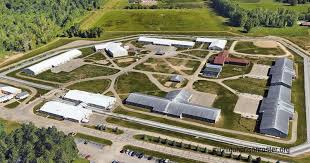
The JCS Correctional Facility in Jackson, Michigan. Photo: Michigan DOC (Facebook)
By night time the prison workers are exhausted from breathing in the pollutants. Showers drag because no one wants to overly exert themselves. There is no rush for phones or the email JPAY system, no loud boisterous laughter that takes gulps of breaths to do so. But there is always that one incarcerated in the day room who tries to crack a joke:
“Aye, remember in Harlem Nights, Eddie Murphy told the crooked cop he tricked into that big-ass safe to take small breaths.” He sips the air. “Take small breaths.” He looks around, does an Eddie Murphy laugh.
The day room full of people crack their necks toward his comical laugh, some holding in their laughs, some shaking their heads. The Eddie Murphy impersonator knows how contagious laughter is, but it doesn’t catch, not enough fire in his delivery. Before he walks out the day room, he coughs.
10:15 p.m., count time, I watch the news. Planetary events make me tune in for an extra 30 minutes to see the happenings. Tomorrow will be worse for air quality. The climate change is real, due to the emissions.
The news reporter advises residents to change their filters and stay inside. I think of the filter at the facility. In prison we have fans. In the units there isn’t a central air conditioning, no filter that sucks in the contaminated air and push out clean breathable air. Or maybe there is and it costs too much to use. For the most part, our irrigation is the outside air, the clouds – I hoped for clouds and rain. I toss and turn until morning.
Fortunately, not too many incarcerated checked in to healthcare after administration announced an air quality index. That week seemed to be a lifetime. I was ready to get back to my workout, my cardio exercise with playing basketball and weightlifting in the pit.
On a Wednesday, a few weeks into June, I ready myself to go hard on my exercises. I brush my teeth, wipe my face and grab my gloves. I head outside steamed up. I get a good sweat in and sit at the blue painted tables on the yard. The green leaves on high rising trees outline the prison’s perimeter. The wispy leaves follow quick gusts in each direction. The blue light sky above hold us all in place. I smile, take a deep enjoying breath. I can breathe. I. Can. Breathe.
A few hours pass. After enjoying the sun, I walk outside the unit again, heading toward the weight pit. In the clear beautiful sky above rolls a cloud afar. It is a dark and ugly evil cloud, but seems to be flanking left. I rush inside the open pit which is just a wooden encampment, black skinny bars gated all around. It gets dark and that hideous cloud grumbles and thunder out in the distance.
“Nope,” an incarcerated said. “I’m gone.” He threw 90-pound dumbbells back into a metal box. With another look at the sky, I throw my Dumbbells back into the box. Stepping out of the pit I see incarcerated folks running into the unit. No one looks back. It rains on one half of the prison complex; it’s coming my way. This is my cue to run for it. One guy stands in the middle of the path cursing God.
“Come on! Get it over with!” he shouts.
I don’t agree to upset the universe but how can I get away from its wrath? That guy damns us all as it gets dark. Inside the unit I turn on the news that reports multiple tornados coming toward Hillsdale, Mason, and Jackson. “Alert: Seek shelter.” The rain comes down against the window, the roof gurgles against the high winds. Wet soil and cement smells wafts into the unit. And thunder rolls and shakes but as soon as the built up in sound, outside the window the sun rays peels through the clouds. Summer is beginning and I am wondering how effective the wildfires will be to the climate.