
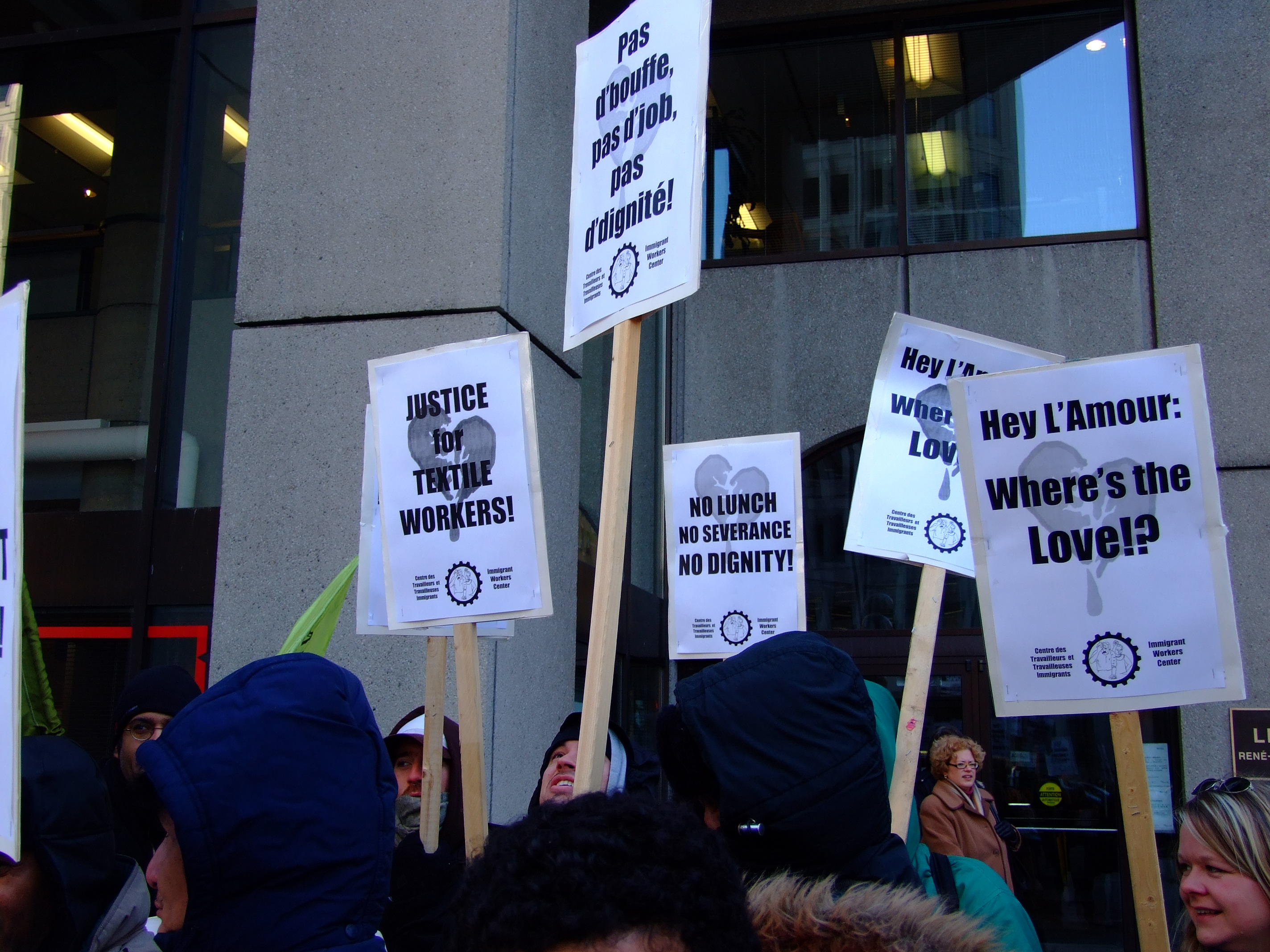
 Photo: Tatiana Gomez, immigrant workers picket Lamour Inc. in support of dismissed textile workers in Quebec
The Immigrant Workers Centre (IWC) in Montreal is one of the most important and dynamic grassroots organizations for migrant workers operating in Québec and Canada today. Its origins and activities illustrate some of the key questions facing the labour movement, including ongoing shortcomings of traditional unions around representation of and leadership from immigrant workers.
Tess Tesalona is one of the founding organizers at the IWC. She arrived in Canada from the Philippines as a domestic worker and became a union organizer in the garment sector and beyond.
In the late 1990s and early 2000s, Tesalona and other labour and community organizers were working with people in Montreal's textile and garment sectors, particularly in immigrant neighbourhoods like Côte-des-Neiges. This community network realized that their efforts would be more effective if they had a community-oriented space directly in the area where many of the workers lived – a space that would be culturally relevant and welcoming for workers facing some of the starkest manifestations of intersectional violence related to workplace injustice. Eventually, they went on to launch the IWC.
Over the last two decades, the centre has been a space where many different workers have gathered to fight for their rights, wage campaigns, and support each other. It has focused on facilitating organizing by and for workers who are often ignored by formal unions and labour-oriented institutions.
Tesalona talks about this context and the difficult grassroots efforts that led to the launching of the IWC. She also explores some of the many challenges faced by organizers, workers, and communities – many of which are just as formidable today as they were back then.
Stefan Christoff: Maybe you could start with an introduction and share a bit about why you and other community organizers felt so motivated to launch the IWC back in 2000.
Tess Tesalona: I am one of the founding members of the IWC. In the three years before the centre came about, I had been working as a union organizer with Union of Needletrades, Industrial, and Textile Employees (UNITE), a union focused on garment and textile workers and the industry surrounding that.
When I became a union organizer, UNITE needed to have organizers from the communities who were represented in the garment sector, including the Filipino community. Many men working in the garment sector were husbands of Filipinas who had come to Canada as domestic workers – like me, I came to Canada as a domestic worker. When the men arrived, often after the women domestic workers, they also needed to find work. Many found work in the garment and textile sector, at companies like Peerless Clothing.
At this time, at the factory of Peerless Clothing, they had 2400 workers.
Stefan: But this number has clearly decreased due to outsourcing by such textile companies.
Tess: Exactly. This was in 1997. So I got into this factory to address the situation. There was an in-house union there, present at the time. I should say that there were around ninety percent migrant workers there in the factory at the time, this was clear, you could see it. It should be noted that most migrant workers don’t have access to being part of a union and if they are represented by a union, then they are mostly never close to the leadership of the union.
On the factory floor, the conditions were of course difficult. It was a factory with quotas. It was group quotas, so your own quotas depended on how your neighbour would work on the assembly line. So at the time I was engaging with this factory, learning about it and learning about the dynamics. There were many communities present and this made things complex. There were also a lot of myths carried by the gossip that took place between the different communities on the work floor. This broke the capacity for people to speak to each other and organize together, so this was something we were trying to address, as union organizers. A lot of stereotypes to break.
Also, the set-up of the factory floor was done in a way to make sure the workers were unlikely to know their neighbours. The company made sure that the neighbour at the work station beside you was somebody who probably didn’t know your language. When we were working on the leaflets to pass out to workers outside the factory, very early on in this campaign, to let workers know what was going on, they were flyers in 10 different languages. Even at the meetings, the assemblies with the workers, the main languages were English and French, but then there would be different language groups – Vietnamese, Thai, Arabic, Tagalog, so many languages present. Mini assemblies would also take place informally in those languages also. Despite all the different cultures and communities, people did come and workers from different backgrounds did attend the meetings. It was really a testament to working-class solidarity. So at the time we made gains for the workers through this process. Bringing people together was and always is a major step.
Stefan: So for people who are reading this who might not know, the in-house union would be a union which was organized by and fully sympathetic to the employer, to the company, not an autonomous union. Also, to underline, we are talking about a process that was taking place in Montreal's Chabanel District, where many garment sector companies were based, and also still where there are many garment companies, despite massive de-industrialization.
Tess: Yes, exactly. Also there is a good documentary about this organizing process called The suit war. I would encourage people to watch the documentary. It was made by Multi Monde. During the organizing process, we were close to the Peerless factory. The UNITE office was nearby. At the time, those of us who were working on the ground to organize the factory proposed to UNITE to open another small office in the community, in the area of the city where a lot of the workers lived, so it was away from the eyes of the supervisors or other workers who were tied to the company management.
Also, the idea of the community office was to have a space for the workers to see each other as people, as community members, as the factory conditions meant that many of the workers didn’t even speak regularly. Creating a space for the workers to spend time in their community was important – for them to go to Filipino church before a weekend meeting, for example, or to easily go to their market spots late after weekday meetings.
Stefan: This was in the Côte-des-Neiges district in Montreal.
Tess: Yes, but it could have been in another area also, like in Parc Ex for example, but yes, we were meeting a lot of workers in Côte-des-Neiges, so we started in that area. When we proposed the idea to UNITE, where I was working, the local supervisors liked the idea, but people higher up in the union weren’t supportive, while we thought it was important. So for a while the idea of the centre was just a project in our minds, but we kept talking about it and talking with workers about it. For the Filipino community particularly, it was clearly important.
For us in the Filipino community, we didn’t want to wait, so we started with the Filipino workers support group because there were a lot of Filipinos who were ready to organize. We were meeting weekly on Fridays. The first meetings were dinners at different people’s houses. So first we formed the Filipino workers support group, which was a model also for other communities, to create a process for other communities to also get organized. Also within the UNITE union there were good elements. There were Haitian organizers and also a Latino organizer. We invited these community members to be some of the first board members of the Immigrant Workers Centre when we were first getting started, so different communities were present.
Also internally within UNITE there were issues for our own conditions as workers, so we were working on forming our own union within the union, to have better working conditions. So after we unionized as UNITE organizers, the larger union just closed our entire department, which was working on the campaign to support Peerless factory workers (and also working on other situations, of course). This was despite the fact that we organized 15 different work places in the city and 11 got union certified.
Stefan: I imagine there were many other strike actions that were taking place during this time and other actions that built up toward the need for the formation of the IWC to become even more clear.
Tess: Yes, of course. I always remember the fact that most of the workers were migrant workers and there were actions where we got locked out of the factories. It was winter, most of the folks were very cold, some were newly arrived and not used to winter in Montreal yet.
There was a strike at a company making socks, for example. They were called Iris Manufacturier. Now they are closed in Montreal. I remember this strike was major, many families came out to picket lines. It was cold. I was working night shifts at the time to organize with the workers who were on strike. I recall being with the workers talking about the strike, but also talking about what was happening in the Philippines, what was happening in Peru. Also, it was before the invasion of Afghanistan, I remember talking with textile workers about Afghanistan. A lot of these conversations during the strike at Iris Manufacturier I remember having in the UNITE organizing van, around the factory, when we were transporting materials and going to the actions, or coming from the actions.
It became clear to me that having a physical space for the workers to gather and have conversations, political conversations about their workplaces but also what was happening in the world, was very important.
Stefan: You are talking about trying to build solidarity between different communities, across languages during this time at UNITE. These experiences made it clear that the need for the IWC was clear. I really appreciate the conversations that you are describing, with textile workers, which were facing major cuts due to deindustrialization in the garment sector in Montreal. At the same time, these companies were making false promises of keeping jobs in Montreal and were getting a lot of public subsidies that were not reaching the workers and that were being used to prepare for shipping jobs to the Global South, where workers could be even more exploited. The IWC’s Mostafa Henaway writes about this in Essential Work, Disposable Workers: Migration, Capitalism and Class.
At this time, you were pushing for there to be an autonomous workers space, the Immigrant Workers Centre, to create a context for the workers to organize. Can you speak a bit more about why building this alternative institution was important? You were taking a big risk in launching a physical centre with no funding laid out. You weren’t working with a map, going step by step. You were improvising, I would imagine.
Tess: In a way, I was building on my experiences working within both the Philippines and also within the Filipino community in Montreal. This experience helped me a lot. There were ideas on how to organize even if each context is different. It was also clear that we needed to have allies from outside of specific industries, from universities – progressive professors like Eric Shragge and Jill Hanley, for example.
A challenge that we did face was the fact that we were relatively low level union workers in UNITE so our contact with other unions was limited, so we needed to reach other people in the union world to get support for our efforts to make a centre. I remember attending a meeting with other unions in Canada and I made comments during the forums, also others from the IWC did. The Canadian Autoworkers at the time, which is now UNIFOR, picked up what we said and came to speak with us. Also, we had allies like filmmaker Malcolm Guy from the documentary film project Productions Multi-Monde, which I mentioned, and people like Roger Rachi, who was very active in the union sector at the time.
Stefan: Building relationships was important.
Tess: Exactly, building relationships was important but also revisiting relationships and following up with people. Also I had worked with Jill Hanley at the community organization Project Genesis in Côte-des-Neiges, so we had both been active in the community. These relationships were important in creating the IWC and making up the first boards at the centre also.
Stefan: The labour movement has shifted a bit toward addressing, at least in discourse, the connection between immigration status and workplace justice. Can you talk about the role of such spaces like the IWC in creating the conditions for a broader shift in the politics of the labour movement?
Also, you talked about making the connection between the reasons why people migrate, the situation in their home countries, the context for migration, and their arrival in Canada. Maybe we can underline a bit more the connection between migrant justice struggles and workplace justice struggles.
Tess: We can address this issue in relation to the recent past – the pandemic, for example. Yes, the Immigrant Workers Centre did start with the garment and textile workers. We also did work with the healthcare sector, with workers in this field. During the pandemic there were a lot of migrant and immigrant workers in the healthcare sector. Many died in this recent context.
When I was doing work with healthcare workers, there were the realities of workers being shipped between different workplaces, being forced to work in multiple locations. Remember the case of Mamadou Konaté for example. This has for years destabilized both the workplaces but also the possibilities for organizing. During the pandemic, this had devastating results with the spread of illness taking place more quickly between the workers and the people they were serving. This has been an issue for a long time. I recall this being a key concern expressed by healthcare sector workers 20 years ago when I was working in this field.
Until today, also the same issues remain – that private companies working in healthcare and also in agricultural industries rely on this precarious work model, either to ensure that there isn’t direct employment, with a reliance on temporary workers, or to be able to hire workers on short term contracts, which works to block capacity for workers to unionize. Also, this applies to hospitality sectors.
This all underlines the key necessity of there needing to be an understanding of class at play. This is for workers who are migrants but also workers who are born here. This connects different communities. The IWC has always been about building unity and connection between working-class people. A main goal of the centre has been to educate people about class conditions, to work together to a more fair society, to challenge class injustice.
In a way, we are trying to always link the community sector organizations with labour organizing. There are connections between the two and building links between community groups and the union movement has always been a key focus at the IWC. For example, how can we understand and speak about the question of housing, which is a community issue and also a question of workers’ rights, because if you don’t have decent wages you can’t afford decent housing. Also, this underlines why affordable good quality housing is a workers’ issue also. [Ed. – The Immigrant Workers Centre participated in a major gathering for housing justice in 2025 in Montreal.]
How do we fight for the rights of workers without seeing all the interconnected issues? This understanding and the political conversations that happen around these points is important.
I want to share a story from the time of organizing even before we had a physical centre. Our first funding came from a solidarity fund from the Canadian Auto Workers Union, a small fund of twenty-five thousand. During this time, I was the first employee. It was Black History Month. During this time we had a conference called “The Changing Face of the Labour Movement.” It was about bringing in and highlighting immigrant voices in labour organizing. We had this event because at this time we were finding that the union leadership didn’t reflect the members, there were a lot of experiences that weren’t represented in the union leadership. How can we address this issue? This conference took place to address these concerns and many major labour unions were present, it was successful and underlined at the time the importance of a space like the IWC.
The struggle to highlight the specifics of struggles of immigrant workers continues, but having a space like the Immigrant Workers Centre does assist in creating political space for this.
To listen to other interviews with organizers from the Immigrant Workers Center, check out the “Voices of the IWC” project.
Please subscribe to The Media Co-op's newsletter!