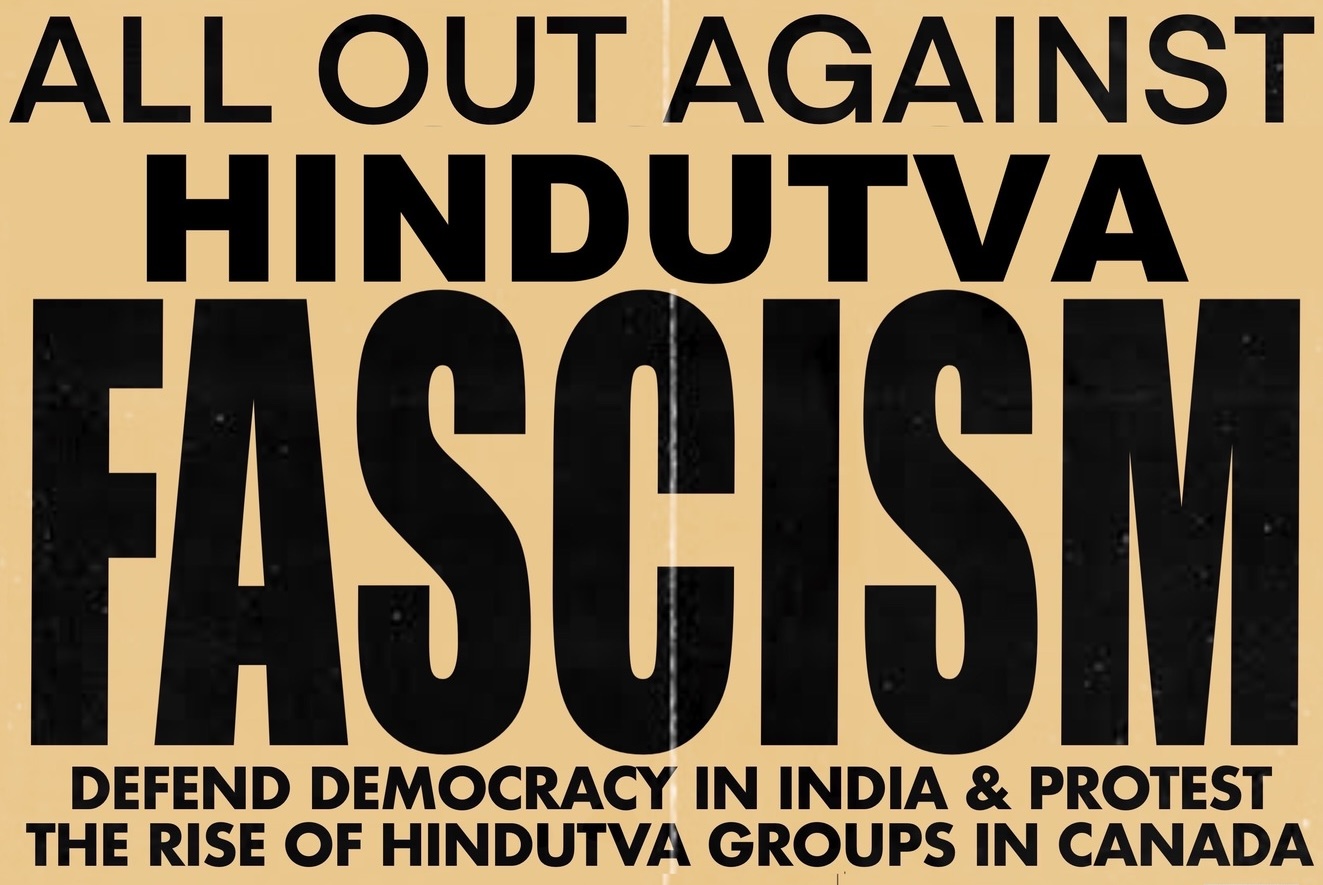
Those of us in South Asian Diaspora Action Collective (SADAC) and the Centre d’étude et de recherche sur l’asie du sud (CERAS), both based in Montreal, recognize the growing reach of far-right extremist and fascist forces, including in circles of power, and the way that more and more world leaders are positioning themselves in alignment with or openly as part of those forces. Along with our movement allies, we have been opposing Hindutva – the ethno-nationalist Hindu far right, that is led by a century-old fascist movement called the Rashtriya Swayamsevak Sangh (RSS) and its political arm, the Bharatiya Janata Party (BJP). This ideology has had a presence in Canada and North America for at least a couple of decades.
At the G7 summit in Kananaskis, Alberta, this June, a warm welcome was extended to Indian Prime Minister Narendra Modi of the BJP, despite protests from many civil society groups in Canada. In contrast, before becoming Prime Minister of India, as a result of successful organizing and education, for ten years Modi was effectively banned in the US when he was denied a visa in 2005 for his complicity in “severe violations of religious freedom” in the 2002 Gujarat genocide in which over 2000 people were killed and thousands displaced. Modi was invited to the G7 this year despite the fact that late last year Canadian security agencies indicated that agents of the Government of India had been involved in serious criminal activity in Canada. They charged a “significant number of individuals for their direct involvement in homicides, extortions and other criminal acts of violence,” including the assassination of Canadian Sikh leader Hardeep Singh Nijjar. Canada expelled six Indian diplomats following the assassination. Most recently, Canada has listed the Bishnoi organization of India, which operates transnationally and has been linked to these criminal acts, a "terrorist organization".
We have experienced the dangers of the growing power and presence of Hindutva in our own organizing. At our event last year called "The Struggle Must Continue: Hindutva fascism in India and in the Diaspora, and its impacts on minorities," a mob of over 70 people harassed and intimidated the participants at our event door. Earlier, Concordia University had caved to pressure from the Hindu far-right and cancelled our room booking.
More on Hindutva
Hindutva is a modern political ideology that advocates for Hindu supremacy and seeks to transform India, constitutionally a secular state, into an ethno-religious nation referred to as the Hindu Rashtra (Hindu nation). Over the last ten years, under the ruling Hindu nationalist BJP, India has seen escalating human rights abuses and exacting systemic violence on its minorities including lynchings, house demolitions, and structural discrimination against the country's 200 million Muslims, as well as Dalits, Adivasis (Indigenous peoples), Christians, and Sikhs.
The RSS is the fountain-head of the Hindutva movement. It was founded in 1925 and is also the world’s largest and most enduring violent fascist paramilitary organization. Its leaders were directly inspired by European fascism and established direct contact with fascist Mussolini and cite Nazi Germany as an aspirational example.
The fascist movement that started a century ago gradually advanced towards its political ambitions. In 1992, hundreds of thousands of karsevaks (religious volunteers) associated with RSS destroyed the 16th-century Babri mosque. In 2002, as discussed earlier, a massacre of Muslims took place in Gujarat under then-Premier Modi’s watch. In 2019, under Modi and BJP's second mandate at the federal level in India, we saw clear signs of fascism in the everyday functioning of the country. Parallels to 1930s Germany are stark. The Citizenship Amendment Act (CAA) & National Register of Citizens (NRC) discriminate against Muslims when it comes to their sheer existence in the country. Other laws also designed to make Muslims second-class citizens mimic Nuremberg laws and exhibit the Nazification of India. (It should be noted that these comparisons are not hyperbolic.).
Over the past decades, an increasingly strong relationship has developed between India and Israel, at the expense of the Palestinian people and the many minority groups of India, particularly Muslims. Since the BJP came to power in 2014, the ruling establishments of both countries have signed numerous defense contracts worth billions of dollars. Additionally, Israeli tactics of house demolitions and land encroachment, among others, can be seen in India and notably in Kashmir. India has become an active partner of Israel through the exchange of arms and tactics, while here in Canada and in the US, the ties between Hindu supremacist organizations and Zionist groups are growing at an alarming rate. Hindutva forces have supported the creation of a Jewish state from the beginning, while Hindutva ideologue Gowalkar, in his 1939 book We Or Our Nationhood Defined, states that India’s minorities should be treated like the Jews were by the Nazis. Similar sentiments can be found in his other works. This same ideology and vision is at work today in India via the third term of the BJP government, as analyzed in a recent book.
Far-right alignment
Over the last decades, a strong alignment can be observed between the global far-right and Hindutva – e.g., in 2011 when Norwegian Anders Behring Breivik massacred over 70 people, his manifesto included how he was influenced by the Hindutva movement, and he pledged support for the deportation of all Muslims from India. This anti-Muslim view was mirrored by the far-right in Norway and reflected in the US and elsewhere in Europe.
Such ideological alignment among far-right tendencies can be seen in various geographies globally, including in the USA (including an alliance between MAGA and Hindu far right) and the UK. The far-right movement that surfaced in the form of the “Freedom Convoy” in Ottawa during the pandemic was composed of well-known and established far-right individuals and groups, including white supremacists, Islamophobes, and people with anti-immigrant and anti-Indigenous mindsets. Riding off of this wave, we increasingly see open discourse between Hindutva and the far-right/white supremacists in Canada.
The growing nexus of extremist ideologies and the rise of a blend of far-right movements underscores the urgency of working locally while strategizing with a global perspective. In today’s context, building strong, inclusive coalitions and strategic alliances is essential to bolstering grassroots organizing and resistance to Hindutva and other interlinked forms of organized hatred.
*The header Image is drawn from a demonstration in Ottawa to Parliament Hill in 2023 where activists converged from Montreal, Ottawa and Toronto to denounce the presence of Hindutva fascism in Canada. event info; event details and analysis.
Please subscribe to The Media Co-op's newsletter!