
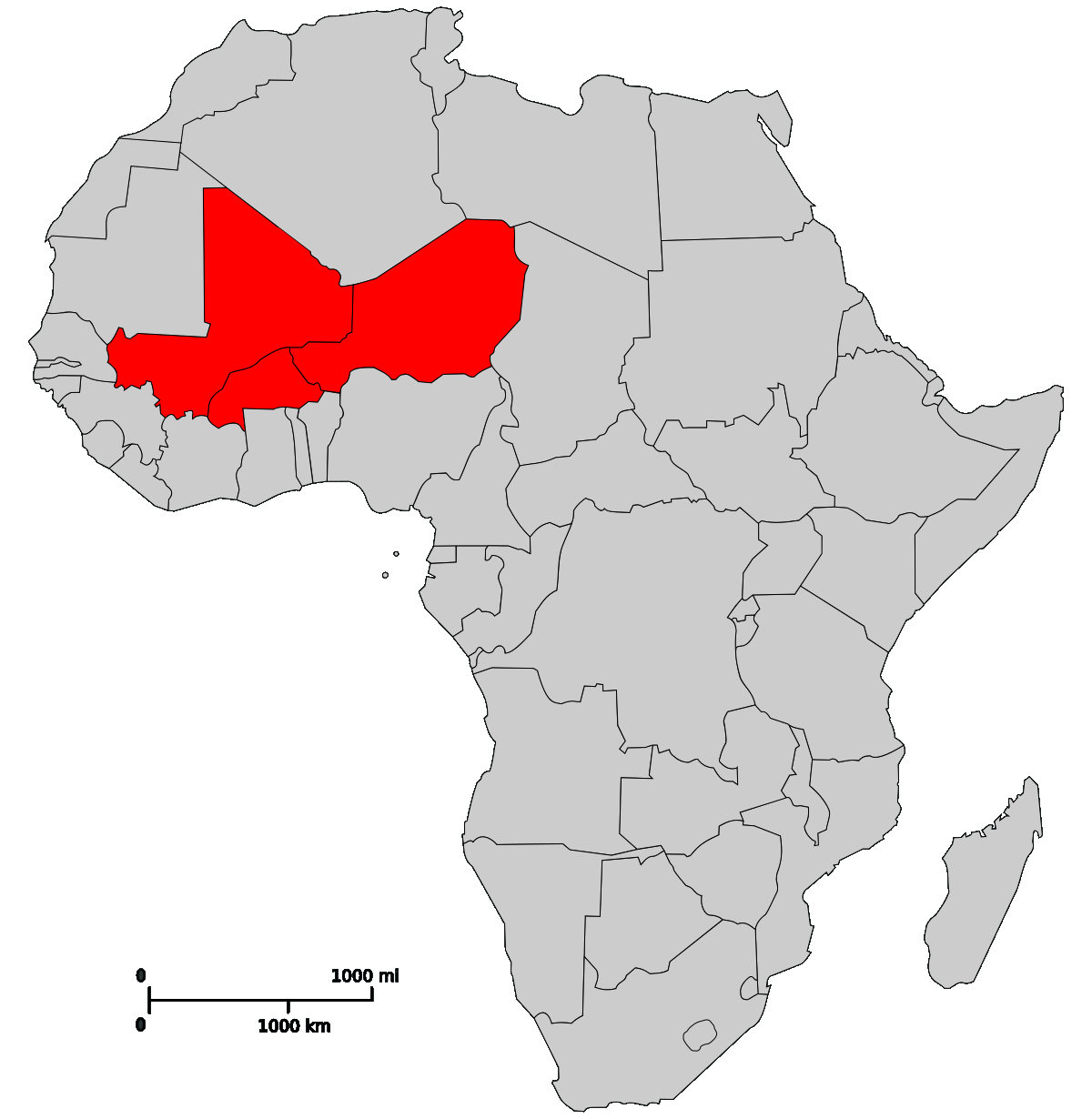
 Map of the Alliance of Sahel States (Image: Lukt64, Wikimedia)
The Sahel is standing up, and people in Canada are taking notice. Through workshops, rallies, public education initiatives, and material support, grassroots organizations across Canada are showing solidarity with the recently founded Alliance of Sahel States (AES) confederation, formed in July 2024 by the former French colonies of Burkina Faso, Mali, and Niger.
The AES is a modern Pan-Africanist alliance that aims to integrate the military and economic infrastructures of its three member nations, industrialize under a sovereign and united development plan, and definitively break with neocolonial influence in the region. AES member states have expelled French and US troops, and anti-imperialist governments coming to power in West Africa also led Canada to withdraw its soldiers from the area. Burkina Faso, Mali, and Niger have increased the state role in key resources like water and gold, and challenged neocolonial influence at the cultural level by abandoning French as an official language and renaming public spaces for Pan-Africanist heroes. In its push for sovereign development and African integration – a demand of the continent’s grassroots for many years – the AES seeks to transform the entirety of the economic and social relations in member countries.
The idea of a West African “coup belt” is popular in Western media, but it is a faulty lens through which to view the AES because it equates the AES states with reactionary military governments that took power on the continent in earlier years. The AES governments are genuinely popular across Africa and in the diaspora because they have channelled the long-time demands of the grassroots, namely sovereignty over land and resources, into national and regional policy that aspires toward African liberation. As director of Pan Africa Today Jonis Ghedi-Alasow said in a recent interview with BreakThrough News, “What we are seeing there…is a shift away from being the stooges of neocolonialism and imperialism to a reality where, for better or for worse, the decisions about what directions these countries are going is being made by those countries…We cannot understand that by looking at coups, we can only understand that by [looking at] the thousands and thousands of people in the streets.”
Many people in Canada hope to support this process. Prudence Iticka is one of them. She is a Cameroonian Pan-African organizer based in Calgary and a member of United African Diaspora and the Coalition for the Elimination of Imperialism in Africa, organizations which provide material support to grassroots movements in the AES. Iticka, who spoke with The Media Co-op from the Cameroonian capital of Yaoundé, stated, “We personally believe that there are two core things that we in the diaspora should be doing if we claim to be in solidarity with any revolutionary struggle in the Global South. We try to produce truth about the AES, to speak to people about what’s really going on. It still shocks me in Canada when I meet people who have no idea what the AES stands for, and these are Africans. But we know it’s very hard. You don’t get positive news about the AES on the six o’clock news.”
In addition to “producing positive propaganda” about the AES, Iticka and the organizations in which she is a member aim to “support the frontlines” of the struggle. This includes fundraising – they recently sent a generator to the Thomas Sankara Centre for African Liberation and Unity, a Pan-Africanist school with branches in Ouagadougou and Niamey – and supporting workshops with grassroots movements such as Niger’s Movement of Women Committed to the Safeguarding of the Homeland (FESPa).
In his classic 1972 work How Europe Underdeveloped Africa, Guyanese historian Walter Rodney wrote about how European powers drained Africa of its resource wealth: “The mining that went on in Africa left holes in the ground, and the pattern of agricultural production left African soils impoverished; but, in Europe, agricultural and mineral imports built a massive industrial complex.” The AES is working to overturn this legacy, to ensure that member states’ resources bring wealth and development to their people rather than foreign countries. In this way, the AES hopes to challenge the system of unequal exchange that undergirds Western imperialism in Africa.
At the first summit of the AES in July 2024, Burkina Faso’s President Ibrahim Traoré stated that “imperialists see Africa as an empire of slaves,” and that they think “Africans belong to them.” Traoré noted, “From Ottawa to Paris, the streets are illuminated; it is the light, but in Niger, it is the darkness…When you go to our states, our soils are full of precious metals such as gold, but often there is not even the slightest road accessible to reach the areas where they exploit gold, even less certain basic social services. This is why we have decided to revolt and take the fate of our countries into our own hands.”
Such speeches have been accompanied by meaningful assertions of sovereignty against international capital. In September 2024, the Traoré government nationalized two UK-owned gold mines. Additionally, Traoré announced that his government would not shirk from withdrawing mining permits from some foreign companies as a way to increase the country’s share of gold ownership. “We know how to mine our gold,” he said, “and I don’t understand why we’re going to let multinationals come and mine it.”
In Mali’s case, the assertion of state power brought the central government into bitter conflict with Canadian mining giant Barrick Gold, which has resisted Mali’s efforts to secure greater benefits from its mineral wealth. In this conflict, the Malian government has imprisoned several Barrick employees and issued an arrest warrant for Barrick CEO Mark Bristow.
Iticka praised the “clarity” of the AES countries’ analysis, in which imperialism is understood as the main obstacle to African development. “To me that is why the struggle has advanced so rapidly. They are struggling to get their land back. These are countries that are extremely rich in resources but live incredibly poor. The struggle now is to get back control of their land, and the way to do this is by uniting all their capacities to move the struggle forward, but with an understanding that this is just the beginning. The AES is clear that they want to add more African countries until they reach their goal, which is to unite the entire African continent.”
On August 30 of this year, the Coalition for the Elimination of Imperialism in Africa released a declaration of support for the AES. The declaration was signed by 51 organizations in Latin America, Europe, the US, and Canada. Canada’s seven signatory organizations were United African Diaspora, Daraja Press, 1919, Popular Front Canada, Global Afrikan Congress (Canadian Chapter), Peace Alliance Winnipeg, and United 4 Change. Several of these organizations have worked to spread information about the AES to Canadians: earlier this year, Daraja Press hosted a discussion on the AES titled “Alliance of Sahel States Forges Ahead,” while Peace Alliance Winnipeg hosted a panel on “Africa’s New Revolutions” featuring Iticka and Dr. Amina Mire as speakers.
Kg Banjoko of United 4 Change, a Black-led grassroots non-profit based in Fort McMurray, spoke to The Media Co-op about her organization’s decision to sign the declaration. “We fully support the work happening in the AES,” said Banjoko. “It’s something that can instill hope in a lot of African diaspora members.” United 4 Change has supported grassroots organizations in the AES through fundraising and donations; on the information front, they focused their African Liberation Day celebrations in 2024 and 2025 on “highlighting key milestones of the AES.” Banjoko, who is Nigerian, explained that many people in Nigeria view the AES as a source of inspiration, even though their own government imposed sanctions on Niger following its anti-imperialist coup in July 2023.
Banjoko urged Africans in the diaspora to support the AES. “That’s the start of the journey, saying ‘I’m going to fund the people that have the capacity and want to liberate their people.’ As diasporic Africans, we have that responsibility.”
The AES enjoys wide popular support on the continent and in the diaspora, but it faces many challenges. Burkina Faso’s leadership claims to have thwarted four coup attempts since Ibrahim Traoré took power in September 2022, while Malian authorities scuttled a coup attempt this August, the leader of which they accused of working “on behalf of the French intelligence service.” On top of this, Islamist insurgencies occupy territory in all three countries. These groups have carried out devastating attacks against civilians and soldiers.
Earlier this year, Michael Langley, the head of US military operations on the continent, took direct aim at Ibrahim Traoré, accusing the Burkinabé leader of misusing his country’s gold reserves and failing to counter the terrorist threat, a statement that appeared to portend growing US aggression against Burkina Faso. Solidarity protests erupted across the region and around the world, including in Toronto, rejecting foreign intervention against the AES.
AES leaders and supporters emphasize that Western interventions are not the solution to violence in the region. They argue that Western interventions have played a significant role in exacerbating insurgent violence in West Africa. They point, for example, to how NATO’s 2011 destruction of Libya supercharged the Islamist insurgencies and to the failure of French interventions in West Africa, such as Operation Barkhane, to stem the violence. Terrorist violence in the Sahel increased by 2000 percent from 2007 to 2023. The AES has identified the role of the West in fuelling insurgent violence as one factor contributing to their decision to break with France and the US and move toward security collaboration with the Russian Federation.
Staying up to date with the AES can be difficult, but resources do exist, including a Substack focused on news from the AES published by the Coalition for the Elimination of Imperialism in Africa. On Instagram, the Thomas Sankara Centre runs the Burkina Books page, which offers updates on the AES. Iticka urged readers to follow the national TV networks of Burkina Faso, Mali, and Niger, as well as the official Facebook and X pages of the AES presidents, which release regular communiques. Banjoko also noted the Tricontinental Institute’s recent coverage of the Sahel, which is grounded in a deep historical understanding of regional socialists and Pan-Africanists like Djibo Bakary, Modibo Keita, and Sankara.
Despite the challenges, people in Canada remain determined to learn about the AES and show their solidarity with the alternative vision of the Sahelian alliance. As Banjoko put it, “If you care about the future of Africa, you need to care about the future of the AES.”