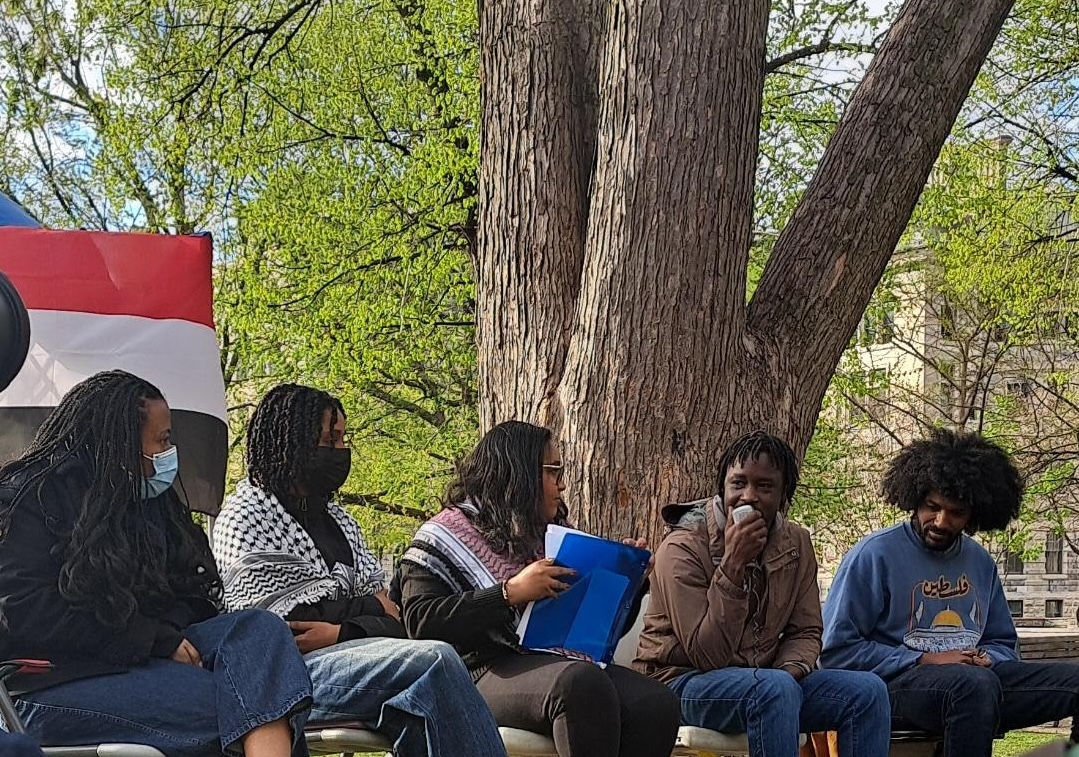
 'Sudan & Black-Palestinian solidarity' event at the encampment for Gaza at McGill University, May 2024
This text is a lightly edited version of a speech delivered at the Draw The Line rally in Tiohtià:ke (Montreal) on Sept. 20, 2025.
Hi everyone. I want to thank all the organizers of this beautiful event. Thanks for organizing and bringing us together. It's good to be here with all of you
My name is Duha and I am with Sudan Solidarity Collective. We are an anti-war volunteer collective, providing mutual aid and political education about what’s happening in Sudan. With a shortage of nuanced coverage and information about Sudan, it becomes all the more important for us to keep doing this work.
I don’t need to recount the statistics again. The war in Sudan, which began in April 2023 between the Rapid Support Forces (RSF) and the Sudanese Armed Forces (SAF), has repeatedly been referred to as the worst humanitarian crisis, the largest displacement crisis, and the “forgotten” war, among other descriptions. But descriptions is as far as the international support goes. We don’t need more descriptions, we need urgent action, active solidarity and support.
In the third year of this war, Sudanese people continue to carry the burden of this counter-revolutionary war. Those inside Sudan are confronted with disablement and death every day in many forms. From the bombings, or from the constant fleeing, or the sexual violence, or the deliberate starvation, or from the spread of diseases like Dengue, cholera and others, with barely any medical infrastructure still available.
As I speak to you now, my parents in Khartoum, along with most of their neighbours, are bed ridden from these diseases. And as I speak you now, residents in Alfashir, the capital of North Darfur state, are still besieged for the 15th month, with aid blocked entirely from entering. Alfashir, along with other parts of Sudan, has already been declared as a Phase 5 famine by the IPC standards.
Just yesterday, an RSF drone strike targeted a mosque in Alfashir, killing 40 people who were praying, including 11 children. Journalists, volunteers and aid workers are targeted, arrested and killed on a daily basis. Landslides and floods also take away lives in Sudan.
Those who managed to flee the country are mostly living in dire conditions as refugees in Egypt, South Sudan, Chad, Uganda and other places, under the mercy and exploitation of governments that have decided to benefit from the suffering of Sudanese people.
I, like many, have lost family members and friends who died from the things I mentioned earlier, or simply from the crushing weight of grief. We have had to bury our loved ones in places we can’t even return to, or recognize.
Just a few days ago, a boat carrying Sudanese refugees, caught fire and sank off the Libyan coast, on its way to Greece. Fifty Sudanese people died in it.
We may hear about the deaths of refugees at sea, but we don’t hear as much about those who die crossing desserts. Last year, my young relative was one of those. He died out of dehydration after being stranded in the desert by a smuggler on the way to Egypt. This is the reality for millions of people, not just Sudanese, forced to flee their homes due to instabilities imposed on us.
To quote the brilliant Somali-British poet Warsan Shire, from her poem titled home:
you have to understand,
that no one puts their children in a boat
unless the water is safer than the land
no one burns their palms
under trains
beneath carriages
no one spends days and nights in the stomach of a truck
feeding on newspaper unless the miles travelled
means something more than journey.
Make no mistake, these instabilities are a direct result of colonial legacies and capitalist and imperial tendencies and actions. What is happening in Sudan is not in isolation from what’s happening across the world: in Palestine to Indigenous and racialized peoples on Turtle Island and beyond, in the Democratic Republic of the Congo (DRC), in Haiti and elsewhere.
The war in Sudan is not a civil war. It is best described as a counter-revolutionary war between the people along with their demands in the 2018-2019 revolution on one side and countries and corporations, like the United Arab Emirates, the United States, Israel, Egypt, Saudi Arabia and others, and the militarized factions in Sudan on the other, supported by these states and corporations. Land, gold and other resources are at the heart of what’s happening in Sudan.
With all this, Sudanese people in Canada have continued to speak up and advocate for adequate immigration measures from the Canadian government in response to the horrors. However, as expected, the response has been extremely limited and highly discriminatory. The family reunification program for Sudanese Canadian residents and citizens only had 4,950 applications, with 500 of them for those of us in Quebec after being initially excluded. The program comes with financial requirements inaccessible to many members of our community (including depositing $9,900 per person, in addition to the $635 application fee). The government only committed to bringing in 4,000 government-assisted refugees. Despite their efforts and the danger they face, most in both programs have not made it here yet. Some applicants have been killed or died while waiting for Immigration, Refugees and Citizenship Canada (IRCC) to process their paperwork.
Regarding this, your support is needed in demanding your MPs accelerate the process for Sudanese applicants and refugees and reopen the programs with more accessibility measures.
The Sudanese diaspora all over the world have been the ones financing the humanitarian aid of the whole country, while the international aid community engaged in what Ruth Wilson Gilmore calls, “organized abandonment”. This is why your solidarity is important and life-saving. As I mentioned, I am here representing the SSC. We formed in response to the outbreak of the war in 2023. We are a volunteer group of students, scholars, artists, creatives, professionals, activists, and community members who have come together to resource grassroots Sudanese civilian-led groups at the frontlines of radical resistance and relief efforts in Sudan. These civilian-led groups include emergency response rooms, resistance committees, independent tea and farmer unions, and internally displaced camps (IDPS), which are supported through our Sudan Solidarity Fund.
In our two years as a collective, we have raised close to a million dollars, going to groups that we support in the Darfur states, Khartoum state, South Kordofan, Sennar, Gadarif, Port Sudan, Kassala, Jazira state and the Northern state of Sudan. These civilian-led groups are those on the frontlines creating the conditions for life in a context in which the warring parties and their colluders only bring about death and destruction. They provide clean water, medication and medical supplies, communication infrastructure, shelter, education for school-aged children, community kitchens, reproductive health services, and evacuation assistance to those affected by the war, among many other things.
To support and follow our work, you can go to our website, SudanSolidarity.com or on social media, Sudan Solidarity Collective. Our Montreal chapter page on IG is called MTL4Sudan. We also invite you to attend the workshops we host through our workshops4sudan series. You can find more information about it and our workshops series on our website as well. Proceeds from the workshops go toward our Sudan Solidarity Fund.
Thank you so much.