
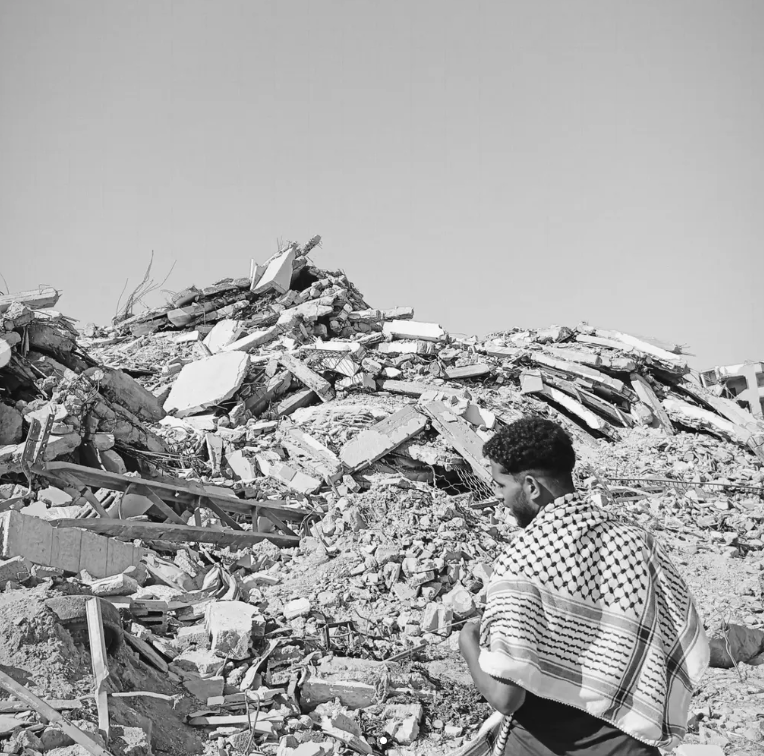
 Photo: Naem Abu Al-Qumbuz
Since October 7, 2023, Israel has enacted what its former minister of defense Yoav Gallant has called “a complete siege on Gaza.” Its actions are widely regarded as amounting to genocide. Under this “complete siege,” no aspect of Palestinian society has been exempt – including Gaza’s education system and the lives of many Palestinian students.
While many students in Gaza have been forced to discontinue their studies due to the destruction of schools or through the acquisition of a life-changing disability, others continue to pursue education against all odds. Some have been accepted into Canadian universities. Yet more than 100 of these Palestinian students remain stuck in uncertainty and unable to attend the institutions that chose them amidst visa delays that advocates argue the Canadian government should be doing far more to solve.
Documenting Scholasticide
On April 18, 2024, the United Nations Office of the Humans Rights Commissioner released a statement expressing “grave concern over the pattern of attacks on schools, universities, teachers and students in the Gaza Strip.” According to the statement, an estimated 80% of schools in Gaza were damaged or destroyed, and upwards of 5,479 students, 261 teachers, and 95 university professors had been killed. Further estimates suggested that at least 60% of educational facilities (including libraries) had been destroyed, which left 625,000 students without educational access. These numbers are anticipated to have risen in the time since.
According to UN experts, “these attacks are not isolated incidents. They present a systematic pattern of violence aimed at dismantling the very foundation of Palestinian society.” Critics argue that targeting the Palestinian educational systems has been a longstanding project under Zionist colonization. In 2009, Dr. Karma Nabulsi, a Palestinian scholar, coined the term “scholasticide” to describe the Israeli Occupation Force's (IOF) systematic destruction of educational institutions. (“IOF” is the designation preferred by anti-imperialist critics when referring to the Israeli military, due to its long-term involvement in what the UN has determined to be the unlawful occupation of Palestinian lands.) Nabulsi explains that “the systematic destruction of Palestinian education by Israel” has been ongoing “since the occupation of 1967,” as seen, for instance, in the “calculated, wholesale looting of the Palestinian Research Centre in Beirut during the 1982 war and the destruction of all those manuscripts and archived history.”
Since October 7, 2023, the destruction of Palestinian educational systems has only intensified. Human rights organizations have documented targeted attacks by the IOF against academics, scientists, and other intellectuals in the Gaza strip, sometimes through deadly air raids on their homes without prior warning.
Despite the historical and ongoing occupation, Palestinians have consistently emphasized the importance of education and scholarship. According to the Palestinian Central Bureau of Statistics, Palestinians in the Occupied West Bank had a literacy rate of 97% in 2020 – one indication of the significance of education and scholarship in national, cultural, and political identity.
Hend Salma Abo Helow, a medical student in Gaza, has written on the generational value of scholarship in Palestinian society. “Our mother had instilled in us a passionate love for books. Reading wasn’t just a hobby; it was a way of living.” According to Sewar Elejla, a former doctor at the al-Shifa hospital in Gaza and now a researcher based in Canada, this is why the Zionist state has placed concentrated effort in destroying the education system. In a 2024 article, she wrote, “the Israelis know the pivotal role that education plays in society. That is why they have continuously attacked our schools and colleges.”
Naem’s Lens
Before October 7, 2023, Naem Abu Al-Qumbuz was pursuing his passion for photography through post-secondary studies. The 22-year-old and his family of nine were living near the border of the Gaza region when they were forced from their home due to bombardment and violent attacks from the IOF.
Naem’s experiences over the last couple of years provide a window to the ongoing genocide and scholasticide. “I stopped studying because of the Israeli war on Gaza. I lost my home, my school supplies, and everything else.” He explains that since the start of the genocide most of his friends and classmates have been martyred and “most of the others were injured as a result of the bombing and destruction.” 
One day while seeking humanitarian aid from an American station, Naem was caught in IOF gunfire. He recalls waking up disoriented in a hospital only to find his right hand missing after an emergency amputation.
“I didn't know what to do with one hand; after losing my right hand, I couldn't help my family”, says Naem. “Photography was a part of my life … but after I lost my hand, everything changed.”
In 2012, Israel voted to ratify the UN Convention on the Rights of Persons with Disabilities (CRPD), which obligates “all necessary measures” be taken in accordance with international law to ensure the protection and safety of persons with disabilities during armed conflict. Yet, prominent scholars have discussed the intentional maiming of Palestinians as an ongoing practice of the IOF. Today, Gaza has the highest global rate of child amputees and 15% of Gazans who have been displaced are believed to be people with disabilities.
Following the amputation, Naem created a fundraising campaign to cover daily living expenses. He is one of many Gazans who have lost their occupations due to the genocide and who have no source of income. “Everyone depends on charitable donations.”
Naem also faces ongoing challenges in figuring out how to live with the loss of his right hand. He recently underwent a second surgery to remove excess bones, and is hoping to receive a prosthetic limb. But given the regularity of Israeli attacks despite the supposed “ceasefire,” it is unclear what the future holds for him and his family.
Naem is far from alone in the challenges he has to navigate. Students across Gaza continue to experience immense barriers, from the destruction of educational infrastructure to widespread trauma and the lack of basic supplies.
While under “complete siege,” many necessities, including fuel, ran out in Gaza due to Israeli blockades. Hend recalls how, for her family, burning their few remaining books became a last resort. “My nephews … sacrificed their academic future: they burned their freshly printed schoolbooks ... so their family could prepare a meal.” Ahmed, her 11-year-old nephew, told her, “Either we starve to death, or we fall into illiteracy. I choose to live. Education will be resumed later.”
Canadian Complicity
One path forward for some students in Gaza is studying abroad. However, some countries – including Canada – are not making it easy.
Since the start of the genocide, Canada, like other countries, has seen a sustained movement in solidarity with the Palestinian people. As a result of this organized political action, Canada has officially recognized a Palestinian state and claims to have halted all arms shipments to Israel as of January 2024. However, a report from World Beyond War examined Israeli import data and public shipping records which suggest otherwise. A subsequent report found additional arms moving from Canada to Israel through the United States. Ongoing civil society mobilization in 2025 successfully pressured entities as diverse as city councils, major labour unions, and churches to call on Canada to institute a full, two-way arms embargo.
While its arms trade with Israel has been the focus of sustained criticism, Canada’s complicity in Israel’s scholasticide has received much less attention. Primarily, the complicity has manifested through a demonstrated lack of political motivation to assist Palestinian students who, by virtue of their merit, have been accepted to Canadian universities.
Currently, according to the Palestinian Students and Scholars at Risk network (PSSAR), there are 130 Palestinian students who have received official acceptance to Canadian graduate programs and are experiencing severe visa delays. As a result, these students remain stranded in Gaza or neighbouring countries such as Egypt or Lebanon, and they face the possibility of losing their scholarships and other funding. The Canadian government claims that the primary barrier for Palestinians leaving Gaza is obtaining the proper security clearance through the submission of required photos, fingerprints, and biometric data. To further complicate the situation, Immigration, Refugees and Citizenship Canada (IRCC) is unable to administer tests and complete paperwork on site due to the ongoing conflict.
Meera, a 25-year-old Palestinian living in Gaza city, was offered admittance and full scholarship to the University of Regina to pursue a master's degree in industrial systems engineering. However, Meera has been unable to attend classes due to the delay in her visa application. She told University Affairs, “we are not only at risk of losing our opportunity but are also at risk of losing our lives.” This was tragically demonstrated in 2024 when twin sisters Sally and Dalia Ghazi Ibaid, who had been accepted to PhD programs at the University of Waterloo, were killed in an Israeli bombing while attempting to leave Gaza to fulfill their visa requirements.
Canadian academics and advocates from PSSAR have criticized the government's response, claiming other countries like France have worked with the Israeli government to ensure the passage of Palestinian students for attending their academic programs. While they have called on the immigration minister Lena Diab to expedite the approvals of student visas, Diab told The Canadian Press that all international students must adhere to the same processes despite what country they are from.
In September 2025, the Middle East Studies Association’s Committee of Academic Freedom drafted a letter to Prime Minister Mark Carney, detailing the risk to student lives while also warning him of the potential “long-term damage to Canada’s research ecosystem” if the students are unable to enter Canada. “These students are critical to collaborative projects with time-sensitive goals and deliverables.”
Other Canadian politicians have also spoken openly against the federal government's approach. During a recent media conference, Heather McPherson, the Edmonton Strathcona MP running for the leadership of the NDP, called the federal government’s unwillingness to support Palestinian students an act of “political cowardice.”
Image credits: Naeem Abu Al-Qumbuz
Naeem Abu Al-Qumbuz: is a former photography student currently living in the Gaza strip.
Maren Savarese Knopf: is an emerging interdisciplinary scholar and PhD student in Sociology at the University of New Brunswick. Maren's community-based research focuses on issues of disability justice, marginality, health, settler colonialism and interspecies relationships. Maren is a settler originally from Treaty 4 and uses embodied and arts-based methods to understand the ongoing impacts of colonialism on the environment.
Please subscribe to The Media Co-op's newsletter!