
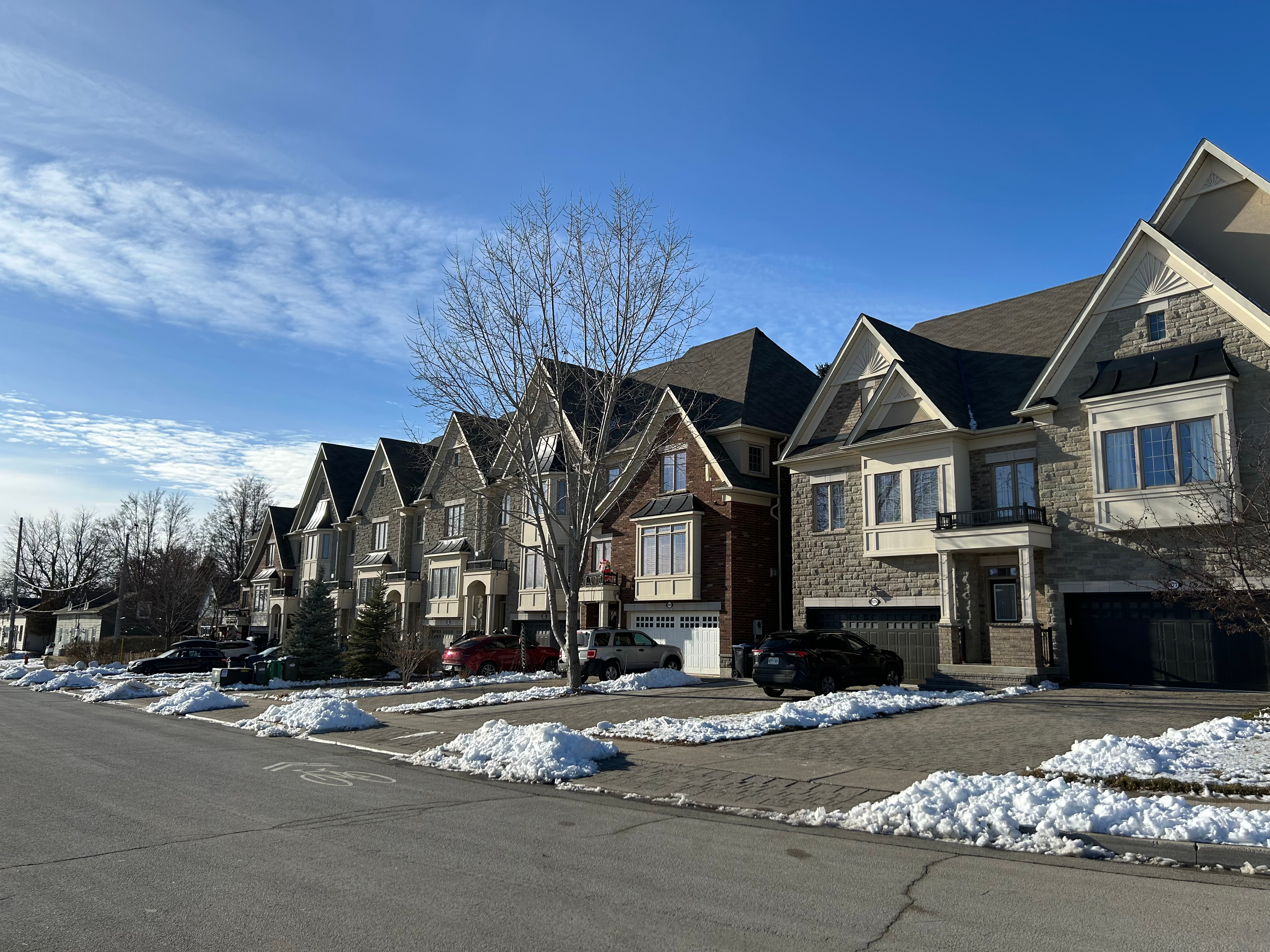
 Photo: Tarek Yousef Tahan
Canada's housing crisis is severe, and recent years have seen an endless stream of proposals for what we should do about it. Far too often, however, these analyses, policy measures, and advocacy efforts fail to address the needs of more than two million people in this country who live in multigenerational households.
For Maher El-Youssef, a resident of Windsor, Ontario, the appeal of living in a multigenerational household showed up in a million little ways. “When I came back from work, I saw my mom, dad, wife, and kids, and felt joy. We sat together for dinner, played cards, laughed at my dad's jokes with the kids, had fun, and made a plan for the day." It meant more people to share the work of running a household, and more people to share the pleasures of life.
For many families, cultural values play an important role in the choice to organize living in this way. El-Youssef, who has Palestinian-Lebanese roots, notes that multigenerational households have existed in the Middle East for centuries, as his culture emphasizes the importance of taking care of parents and elders.
"Financially, we feel it is a duty," he says. "We came to Canada, and this sense of responsibility still lives on within us."
Murtaza Haider, a professor of Data Science and Real Estate Management at Toronto Metropolitan University, agrees. He says, "There are certain cultures that are more likely to adopt this type of lifestyle," such as South Asians, especially Punjabis. StatCan data reveal that over half of Canadians living in a multigenerational household are racialized people.
Although it is not mainstream in Canada today, the practice has deep roots on this continent. Many First Nations — for example, the Haudenosaunee, Wendat, and Pacific Northwestern Nations — lived this way prior to colonization. Even today, the proportion of Indigenous people living in multigenerational households is higher than non-Indigenous people.
The same census also revealed geographical discrepancies throughout Canada. For example, around 25 per cent of people in Nunavut, which is majority Inuit, live in a multigenerational household — more than triple the national average. In the urban context, cities like Brampton, Ontario, and Surrey, British Columbia, have more multigenerational households than other cities due to higher South Asian populations.
Culture is only part of the story; there are also perceived practical advantages.
A Harvard University study focused on Germany found, for example, that multigenerational households allow for informal care of young children and older adults and improve overall well-being. Another study published in a medical journal in British Columbia found these households decrease loneliness — a significant factor in depression, which costs the Canadian health care system $32 billion annually — and social isolation.
David Amborski, a Professor Emeritus at TMU’s School of Urban and Regional Planning, agrees, saying, "Multigenerational housing often has a built-in daycare, because sometimes the elderly people are retired and can take care of the kids." El-Youssef says this is a feature of his household.
Haider also points out that multigenerational housing units allow for the pooling of financial resources and "improve the affordability of households that do not have to purchase or rent multiple dwellings."
Despite the advantages of multigenerational living and its importance for many people in the Canadian context, however, families and experts alike agree that current government policies create barriers for such households.
Challenges for Multigenerational Households
The dire state of Canada’s housing market is well known. Advocates point out that the cost of housing has risen more than 300 per cent since 2000, compared to overall inflation of 48 per cent in the same time period. The gap between housing prices and income doubled from 1987 to 2024, the worst deterioration out of all G7 countries. Approximately three million households in Canada are in core housing need (which is defined as living in a dwelling that is unsuitable, inadequate, or unaffordable). Of this number, there is a significantly higher prevalence among renters than owners. The number of unhoused people also continues to increase — in Toronto, for instance, homelessness more than doubled between 2021 and 2024.
Multigenerational households face specific affordability challenges in the context of this crisis. For example, larger housing units are more expensive than smaller ones, which puts additional financial strain on families. El-Youssef attests to this, and says, "My wife and I do not want to cheat on our parents [and] children by not buying enough food, care, and maintenance for the house." For this reason, he feels that governments should do more to address the cost of living.
At the same time, the overall lack of affordable housing means more people are having to live multigenerationally out of necessity rather than by choice, which increases the demand for the limited number of suitable units.
Expanding the pool of units that allow multigenerational living is also difficult. Amborski says restrictive zoning policies are one factor that contributes to this. Data Sciences, a Canadian marketing and analytics firm, found that zoning bylaws in many cities limit the type of housing that can be built on a plot of land to include only single-family homes, excluding other types of housing like duplexes, townhouses, and apartments. This, alongside height, parking-zone, and other restrictions, may limit the availability of adequate housing stock for multigenerational living.
This likely means that some people who want to live multigenerationally are unable to do so comfortably. StatCan data indicates that 28 per cent of multigenerational household units are considered crowded, or too small for their needs. In comparison, only about five per cent of non-multigenerational households belong to this category. El-Youssef affirms this, saying now that his children are older, "I need more space, because we've become more crowded."
Some federal and provincial housing measures in recent years touch on aspects of this problem, though it remains uncertain what impact these measures are actually having on the supply of suitable units, and advocates are clear that no governments are currently doing enough to address questions of affordability.
For example, on November 28, 2022, the Ontario government passed the More Homes Built Faster Act, which contains measures that some argue might benefit multigenerational households. The law amended zoning policies to permit up to three residential units on most lots without a by-law amendment. It will exempt new units fro, additional development and parkland dedication fees. It will also prohibit municipalities from imposing minimum unit sizes for additional residential units (ARUs) or parking spaces per unit. The British Columbia provincial government has made similar reforms. However, critics like Environmental Defence Canada argue that the bill is "counterproductive for housing affordability" and "environmentally disastrous."
Also in 2022, the federal government introduced the Multigenerational Home Renovation Tax Credit (MHRTC). The MHRTC is a refundable tax credit that can be claimed to offset some of the costs of certain kinds of home renovations that could enable multigenerational living.
Tanya Burkart, a tenant leader in Brampton, Ontario, with anti-poverty organization ACORN, suggests one solution to the problem could include larger subsidized units in co-operative housing projects. Another would be a ban on above guideline rent increases in Ontario. She also believes Canada should scale-up non-market housing from the current three and a half per cent of the housing system to at least the OECD average of seven per cent.
However, she says a recently passed law in Ontario, Bill 60 (the Fighting Delays, Building Faster Act), "pushes us closer to having no rent control in Ontario," making things worse for all tenants.
While the number of multigenerational households increased from 2011 to 2021, it is unclear how demand will shift over the longer term. For example, Burkart notes that most people ACORN represents do not live in multigenerational households. Haider also says, "I do not think there is a big demand for it," particularly among younger people. This may be because younger generations are more assimilated than their elders, making them less likely to adopt the practice as adults.
"I do not know if my kids will raise their kids this way, as they have lived in this country for a long period of time," says El-Youssef. He also says it was sometimes difficult to raise their children without their grandparents’ intervention, something younger generations may tolerate even less than their parents.