
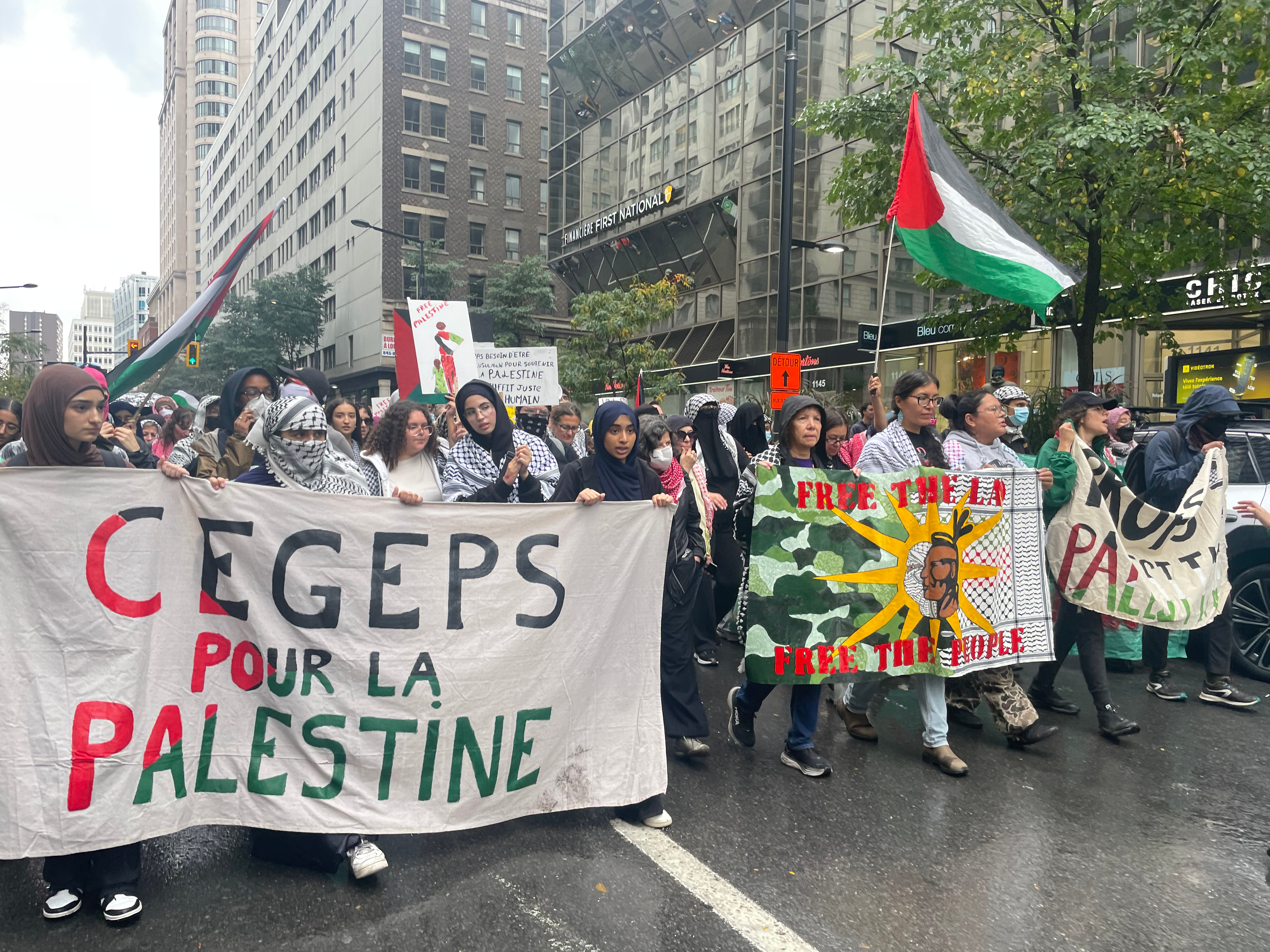
 A march during the October 2025 Montreal student strike for Palestine.
In October 2025, more than 81,000 students went on strike at colleges and universities in Montreal. In response to a call for broad popular mobilization by Divest for Palestine (D4P) and the Convergence des luttes anticapitalistes (CLAC), 63 student associations from at least 14 different institutions chose to act in solidarity with the Palestinian resistance and voted to strike for one or two days.
Although student organizations throughout Canada participated in protests in solidarity with Palestine on October 7 this year, the events held in Montreal remained unique because of their size, the breadth of student groups involved, and the fact that their action took the form of a strike.
Despite growing public sympathy with the Palestinian cause in Canada and globally, and quite substantive and positive coverage of October's actions in Quebec media, universities in Montreal continue to respond to pro-Palestinian activism with sharper repression than they do when it comes to most other issues.
A Clear Message
Over the course of the weeks that preceded October 7, students voted to adopt strike mandates in their respective associations. They were responding to calls for action from the CLAC and D4P, two organizations based in Montreal. The CLAC is an anti-capitalist organization that has been active in the city for two and a half decades, while D4P is a collective of individuals and civil society groups committed to the Palestinian struggle that emerged in the context of the solidarity movement of the last few years. According to a communiqué released by both organizations a few days prior, the October 7 date was chosen to reaffirm solidarity with the Palestinian people and denounce an “imposed narrative” in which “the settlers are the victims.”
The overarching demands of the strike called for Canada and Quebec to immediately cease all complicity with the ongoing genocide in Gaza - immediate sanctions, a bilateral embargo on arms and military equipment, and the termination of all military, economic, commercial, political, diplomatic, and cultural ties with Israel. The demands also included ending the Canada-Israel Free Trade Agreement and closing the Quebec government's newly opened office in Tel Aviv.
Student unions had more specific demands related to their own institutions. For example, the Student Society of McGill University (SSMU), representing 27,000 students, voted for a one-day strike on October 7th, demanding their university divest from companies linked to military actions in Gaza, such as Lockheed Martin, Airbus, Textron, BAE Systems, Safran, and Thales.
Starting October 6, 2025, strike mandates were carried out on campuses across the city. Concordia University's students had, for instance, voted for a two-day strike, and hundreds of protesters gathered at its downtown campus. Tactics to enforce the strike, such as picketing – a practice commonly used during student strikes – were met with a brutal response by university security personnel, who arrested two protesters. The following day, Concordia administrators closed its downtown campus to all in-person classes, citing “the threat of extreme disruption.”
On October 7, thousands of students from several institutions protested in front of Concordia, where they denounced the university’s campus shutdown before moving to the McGill campus. Later, the students joined a rally organized at Victoria Square in downtown Montreal by D4P, where students from francophone universities and junior colleges also gathered. The event was followed by a protest organized by a Palestinian group in which thousands of people marched down René-Levesque Boulevard. This was the biggest pro-Palestinian rally in the city in months. Consequently, most streets of downtown Montreal were paralyzed for almost 12 hours.
Student Activism in the History of the City
This level of mobilization can only be understood in the context of a long history of student activism in Montreal. The recent surge in solidarity with the Palestinian people, including the October 7 strike, brings together the histories of pro-Palestinian activism, varied initiatives promoting boycott, divestment, and sanctions (BDS) against Israel, and groundbreaking strikes on a range of issues in universities across the province.
In 1985, under pressure from student organizations, McGill became the first Canadian university to divest from South Africa in response to apartheid. This happened only a dozen years after students occupied a building on the downtown campus of Sir George William University (now named Concordia) for two weeks to protest racism in the school’s administration.
Concordia also has a long history of staunch pro-Palestinian activism. On September 9, 2002, student activist groups successfully blocked Israeli Prime Minister Benyamin Netanyahu from entering and giving a speech on campus. Student leaders were arrested, riot police were deployed, and a window was broken in one of the downtown buildings. The event is discussed at length in an NFB documentary released the following year.
In 2012, over 300,000 students in Quebec went on strike to protest tuition hikes, including most students in Montreal’s institutions. Although the degree to which the strike was carried out varied in different parts of the province, it lasted over six months and faced a range of repressive measures from the provincial government. The strike only ended when a provincial election was called.
Most recently, both at Concordia and McGill, divestment initiatives have succeeded in restraining direct investments in fossil fuels. At McGill, in March 2022, a 12-day occupation of the Arts building played a crucial role in pushing the university to adopt these measures.
In 2024, McGill and Concordia students also held one of Canada’s longest standing encampments for Palestine, lasting from April 27 to July 10.
A Different Media Response
The student strikes on October 6 and 7 were widely reported in Quebec media. LaPresse, Le Devoir, and Le journal de Montréal, the city’s main periodicals, published articles both on the student strikes and the protests in downtown Montreal, as well as the CBC followed protesters on the Concordia and McGill campuses. This level and nature of coverage strongly contrasted with that of other pro-Palestinian protests throughout Canada that day, which were largely overshadowed by Zionist narratives of the October 7 attacks.
“In a lot of ways, the protests worked,” explained Benoît Allard, spokesperson for D4P, in an interview conducted last December.
“We wanted to change the narrative that the genocide had started in October 2023 … We wanted to speak out against the Isreal’s instrumentalization of the attacks. I was solicited by all sorts of platforms… For the first time, I was recognized in the streets, people wanted to talk to me, ask me questions. I really think it [the protests on October 7] broke some kind of wall of silence around the genocide.”
“This acceptance by the media,” Allard added, “is a sign that the position that Israel is the victim is no longer tenable… Public perception is changing, and it’s largely due to grassroot initiatives and student action like we saw in October.”
Allard’s observation echoes a change in the perception of the situation in Gaza that can be seen in many contexts around the world. Just a few days after a UN commission confirmed last September that Isreal’s actions correspond to four out of the five acts that constitute genocide, countries such as Canada, France, and the United Kingdom attempted to nuance their position on the matter, claiming, for example, they “recognize” the State of Palestine. While critics question the sincerity and substance of this recognition for many of these countries, it still marks a change in discourse regarding Israel and the justifiability of their actions in the Middle East.
University Repression
Notwithstanding these broader shifts, the responses by universities in Montreal to Palestinian activism on campus have remained largely unchanged.
Since 2023, students and professors across universities have faced increasingly policed campuses. A video taken on October 6, 2026, and released online showed private security in Concordia’s downtown campus violently taking down two protesters inside a campus building. At McGill, riot police were dispatched the following day to try to prevent protesters from entering the campus. For many, responses by Montreal universities to Palestinian activism in the last few years has been different than for other issues in the past.
According to an undergraduate student who has been involved in campus activism, “We’ve been going on strike regularly for a few years, but [in previous strikes] security didn’t hate student activists ... Most people understand what it’s like to be on strike. When we’d get caught, they would ask for our IDs, tell us we’re in violation of some rule, we’d refuse, and that’d be everything. Things aren’t like that anymore…”
Wishing to remain anonymous, he explained that participating in strikes for Palestine has provoked a different response by the university than other initiatives led by students.
In March 2024, for example, over 20,000 students from Concordia and McGill went on strike to protest tuition hikes imposed by the provincial government for Canadian students coming from outside of Quebec. On the same occasion, picket lines were formed in front of classrooms to bar students from going in – something which, at the time, didn’t provoke the intervention of campus security.
This time, however, not only were activists arrested, but full-time employee of Concordia Student Union Juliana Smith was also barred from campus after being accused of “participating in preparing and equipping persons” who were involved in “disrupting classes.” Though these claims remain mere allegations, she is still unable to enter campus and is pursuing legal action against the CSPS, Concordia’s campus security.
Concordia’s public relations team did not respond to requests to be interviewed on the matter.
Although she acknowledges the disruptive behaviour of some students, Dr. Norma Rantisi, a geography professor at Concordia, is also alarmed at the policing and silencing of Palestinian activism on campus.
She said, “A lot of the messaging coming from administration can be very problematic and insensitive. And sometimes in ways that imply that it’s the strikers that are enacting violence. And, again, these risks feeding into a broader climate of intimidation… There are two dimensions to it. One is that the administration’s stance is that students cannot be disrupting classes. Okay, yes, that's their stance. But you know, there's this kind of fine line because the students are voting in their democratic assemblies and there's a lack of respect for that process… and so students are responding to that, and they're responding, yes, in a disruptive way, but not in a violent way.”
In September 2024, it was revealed that Concordia had hired the private security company Perceptage on four different occasions, totalling 14 workdays. The company is owned by Adam Cohen, a former Israeli Defense Force (IDF) solider who frequently hired other individuals tied to Israel.
Although the company was not rehired in 2025, the university has continued investing significantly in private security. These measures have shown to be controversial given that lowering enrollment has forced massive budget cuts, among others, leading to the non-renewal of 63 short-term contracts amongst faculty.
Ushering in Change
Universities are far from the only institutions in Canada that have thus far refused to follow the changes in public sentiment on the issue. Arms manufactures still export to Israel, for instance, and Canadian pension plans still invest in Isreal-friendly companies. The Quebec office in Tel-Aviv remains open.
Nevertheless, Dr. Rantisi highlights the admiration she has for student movements. In an era where many feel shackled by a sense of powerlessness and ineluctability, student activism has offered a model for taking action against a system that feels impenetrable. She parallels the current mobilisation to 2012.
“In the process of mobilizing, they had to conduct a lot of research. They had to learn to organize. They had learned to be leaders. They had to learn and teach at the same time. And they never had such a phenomenal educational experience as that moment ... I mention this because I think it's the same with the student mobilization and the student movement we're seeing today. I think they are leading. And this awakening amongst the profs is at least in part by being inspired and directed by the movement that the students have ushered in.”
Recently, student activism seems to be driving other sorts of changes.
On October 27, three weeks after the student strikes, the McGill Association of University Teachers (MAUT) passed a resolution for an “academic and cultural boycott of Israel.” More precisely, the resolution was aimed at boycotting institutional partnerships with Israeli universities, such as exchange programs, while remaining within Quebec’s guideline of academic rights and freedoms in universities. It is still uncertain if McGill’s administration will respect the MAUT resolution, but, if the resolution is enacted, the boycott could last two full years before having to be voted on again.
This gap between universities’ response to Palestinian activism and public perception on the genocide is slowly widening. Soon enough, the views of these institutions will no longer be compatible with those of society at large. And as history shows the true horror of the atrocities committed in Palestine, many will have to confront the harm they have directed at their students and staff.
Xavier Gransden is an anthropologist, independent journalist, and average fisherman from Tiohtià:ke/Montreal. He presently lives in Mistissini, Quebec.
Please subscribe to The Media Co-op's newsletter!