
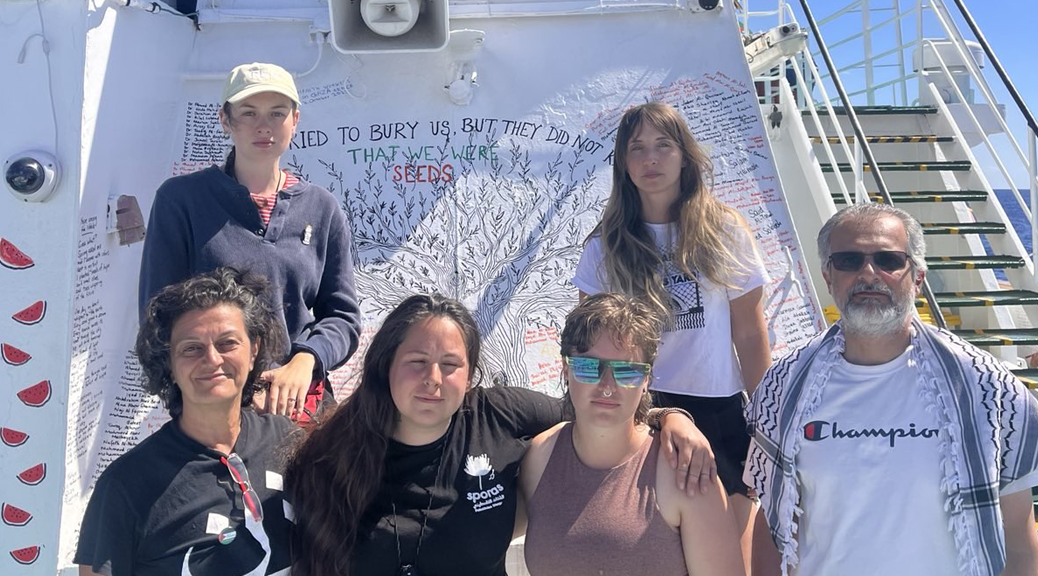
 Photo of 6 members of the Canadian Boat to Gaza, part of the Freedom Flotilla Coaltion.
She made a pre-recorded video to be posted if she got kidnapped. She stood in front of the Palestinian flag and spoke into the microphone on the cable of her earbuds.
“My name is Mskwaasin Agnew, I am a Canadian citizen, and if you are seeing this video, it is because we have been intercepted at sea, and I have been kidnapped by the Israeli Occupation Forces. I am asking that my comrades, friends and family put pressure on the Canadian government to demand my immediate release, to sanction Israel, and to demand a full two-way arms embargo. I come peacefully, I am unarmed, only carrying humanitarian aid.”
Her colleagues at Toronto Indigenous Harm Reduction posted the video on Oct. 8, 2025. Later that day, a few hundred people rallied downtown in support of her, demanding her release. The crowd blocked the intersection at Queen and University, while chanting, singing, dancing, and listening to speeches from Mskwaasin’s friends and family.
People waved the Palestinian flag, the Mohawk warrior flag, and a cardboard sign resembling a red dress—the symbol for missing and murdered Indigenous women. People banged on hand drums that had the words “Land Back” spray painted on the drum skin. One person burned sage in a small metal bowl, and paced around in the crowd, giving people a chance to smell it. One person brought their hairless cat in a “Land Back” tote bag.
They had the crowd sing a song called Wave After Wave. Mskwaasin taught the song to some of the other volunteers she sailed with. They were going to sing it as they sailed, and as they were being abducted.
MPP Alexa Gilmour addressed the crowd on behalf of Sue, Mskwaasin’s mom.
“She wants everyone here to know that Mskwaasin’s mission was not just about bringing aid, it was about bringing awareness. She wants you to know that this is not about her.”
“This is about the people of Palestine. Those tens of thousands of people who have lost their lives while all of us in Canada have stood by and done far too little. Nothing at all. We must continue to call for a two-way arms embargo. We must continue to call for sanctions on Netanyahu and his cabinet. We must continue to call for immediate humanitarian aid to those in Gaza. And we must stop trade with Israel until the genocide in Gaza stops.”
“Sue said to me, I want her to know that I love her, that I'm proud of her. She is a warrior. She would do anything for anybody, and those of you who are here. Now the world knows that. So people of conscience, rise up. Rise up. Demand her freedom. Demand an end to this war in Gaza and an end to genocide. People of conscience, rise up. Thank you.“
Since 2007, Israel has imposed a blockade on the Gaza Strip, and controlled nearly all movement of goods and civilians in and out of it. The terms of the blockade have changed multiple times over the years. At times, they’ve closed checkpoints to all fuel and goods. At other times, checkpoints have been open, or partially open. The list of restricted items has at times included broad categories such as “communication equipment,” and made it difficult for Gazans to know what they were allowed. Documents have shown the Israeli military trying to calculate the minimum number of calories Gazans needed to avoid malnutrition, with Israeli human rights groups arguing that these numbers were used to limit food during the blockade.
Since 2023, the blockade has intensified. In the wake of Oct. 7, the Israeli defense minister ordered a “complete siege” on Gaza, cutting off electricity, food, and fuel. Mass starvation has spread across the Gaza Strip. There are shortages of critical medicine and medical supplies, including antibiotics, wound care, and sterilization equipment. People are receiving amputations without anesthesia, and surgeries without scalpels. Despite the announcement of a ceasefire, Israel has continued to block aid from entering the strip.
The Freedom Flotilla Coalition is a grassroots campaign to break Israel’s blockade of Gaza. It consists of multiple campaigns and initiatives from all over the world, with member organizations in Canada, Italy, Spain, Malaysia, Ireland, and more. They aim to end the blockade by challenging it in courts, raising awareness of the blockade and occupation, and by directly sailing to Gaza.
The flotilla’s boat, the Conscience, departed from Italy on Sept. 30, 2025 — Truth and Reconciliation Day. They brought food and medicine, including first aid, bandages, inhalers, ointment for burns, pain relief medication, and antibiotics.
The volunteers on board all wore pieces of orange cloth in solidarity. Among them were six Canadians: Mskwaasin Agnew, an Indigenous woman from Toronto, Nimâ Machouf, a doctor from Montreal, Khurram Musti Khan, a humanitarian and activist, Sadie Mees, Devoney Ellis, and Nikita Stapleton, all activists from St John’s.
The Conscience is a passenger ship built in 1972, 68 metres long and ten metres wide at its widest point. The word “CONSCIENCE” was written on the side of the white boat, with a banner above it saying “FROM THE RIVER TO THE SEA.” Dozens of Palestinian flags flew on strings tied between the poles and handrails of the ship, hanging just low enough to get in the way of their group picture among the benches on the upper deck. Additional Palestinian flags hung off the side of the boat, and were displayed in some of the boat’s windows.
A large crowd saw them off at the port. Among the crowd was a marching band playing Bella Ciao, an Italian folk song whose name literally translates to “hello beautiful” or “goodbye beautiful.” Bella Ciao is commonly associated with the anti-fascist resistance in Italy during the second world war, and is sung on the anniversary of Italy’s liberation from fascism in 1945.
Life on the boat was difficult.
For the first two days, the Mediterranean shook the boat. People were nauseous. A team of medics onboard took care of them, and they applied scopolamine patches for motion sickness. Cooking was difficult, and even dangerous. If a pot fell, people could get covered in boiling oil.
Because so many people were on board, and because the air conditioning wasn’t working, the sleeping quarters were crowded and hot. People could choose to sleep on a seat, or on the floor. Khurram often had trouble sleeping.
There were four toilets on both the men and women’s side, but they were instructed not to flush unless it was absolutely necessary to preserve the boat’s limited supply of fresh water. There were designated times where people could bathe in seawater on the lower deck. They were served just two meals a day, at 10:00 AM and 7:00 PM. Participants volunteered to cook, and they made a variety of meals including veggies, chicken, and boiled eggs.
People were assigned various chores like garbage collection, cleaning the bathrooms, washing the dishes, and watching for drones. One of the main goals of the flotilla was to raise awareness, and so they spent a lot of time filming, taking photos, and doing interviews.
In their free time they would chat, or look up news on Palestine. They wrote and drew on the walls of the Conscience in marker and spray paint. Some were poems, in English and in other languages. Devoney wrote in yellow spray paint “ARMS ARE FOR HUGGING.” On one wall, they drew a tree. Above it they wrote: “They tried to bury us, but they did not know that we were seeds.” Around it, they wrote down some of the names of healthcare workers killed in Gaza.
On the boat, they held some events to commemorate the journalists and medics in Gaza. One night, they had a Zoom call with some doctors working in Gaza. Another night, they had a memorial for some journalists and doctors who had been killed. Many on the boat had lost friends and colleagues in Gaza.
The grief on the boat was palpable, and many on board were anxious about what Israel may do to them. Despite that, they felt strong being together. They had all been active at home advocating for Palestine, but been ignored by people in power, and so taking direct action together on an international stage felt powerful.
“I think we all felt hope and power and grief all at the same time. And some fear, but I think altogether it was beautiful and it was strong,“ Sadie Mees said.
They did drills every day in preparation.
They knew who would sit where, and how to quickly put on their life jackets. They packed small bags with some essentials, such as their medication, warm clothes, water, and something to eat.
The night before, an article came out where Israel announced their plans to attack the Conscience. Someone on the boat knew Hebrew, and translated it. They said they were looking at it as a military objective, and said they were worried it’d be as violent as the Mavi Marmara. The Mavi Marmara was part of a 2010 flotilla to Gaza, and the site of a massacre. Israeli commandos attacked the Mavi Marmara, and killed ten of the volunteers on board.
They were intercepted at 4:30 in the morning on Oct. 8. The captain got on the loudspeakers and told everyone it was really happening. They all rushed to the main deck, put on their lifejackets, and threw their phones into the water so that the Israeli army wouldn’t get ahold of their personal information. Naval boats and helicopters closed in on the Conscience.
The wind from the helicopters shook everything on the boat. The sound of the helicopter was so loud they couldn’t talk to each other. Soldiers descended by rope, wearing infrared goggles and bodycams, and armed with submachine guns, tear gas, and more. They roamed the boat, and destroyed every camera with their batons.
In just a few minutes, there were 30-40 soldiers onboard, shouting orders at the flotilla members. “Do this, do that, quiet, shut up, don’t run, don’t walk, don’t talk, don’t chant, don’t look.”
The flotilla members sat on benches on the deck, chanted that they were journalists and medics, and raised their hands so the soldiers would know they weren’t armed. The soldiers separated some of the men on board who were Tunisian and Turkish, as well as some of the racialized women.
Mskwaasin sat in the front row of benches. She held her breath while a soldier aimed the red dot of a laser sight at her chest. All the while she was trying to anticipate what else they could do. She knew that in the past they used skunk water, a weapon that smells of raw sewage or corpses, and whose smell can linger for days or longer. They were also known to use water cannons, which shoot water at high enough pressure to blast the eyes out of someone’s skull. Above all else though, Mskwaasin was worried about her comrades. After a week at sea, many of them were in rough shape.
Khurram was next to a flotilla member who suffered a panic attack. He held Khurram’s arm, and took off his keffiyeh. Khurram took it. He looked up and saw a gun pointed in his face. He looked at the muzzle of the gun, then at the soldier, and then tried to keep calm and ignore him. A group of soldiers called for him. “Somebody threw something in the water. Did you see? What was it?” the soldier said. Khurram replied “I don’t know.” The soldier raised his voice and said “No, I'm asking you, somebody threw something in the water. What was it?” Khurram replied “I told you, I don't know.” The third time he asked, the soldier told his colleague to tase Khurram. Khurram remained silent. Then they sent him back, without tasing him.
Despite the fear and stress of the situation, some found the experience empowering. “There is something so ridiculous about over 20 soldiers with these weapons, fully kitted out, coming onto this boat of doctors and journalists who have just been trying to bring medication and food. They look ridiculous. They are ridiculous. They're shameful. And there's so much strength that comes from knowing that you are on the right side,” Devoney said.
It took around 12 hours for them to reach the port of Ashdod, Israel.
The soldiers didn’t like what Devoney was wearing when they got off the boat. They told Devoney to take off their keffiyeh, and they did, revealing a shirt that said From Turtle Island to Palestine. The soldiers didn’t like that either, and took Devoney to their bag to find something to change into. Devoney pulled out an orange shirt that says Every Child Matters, which they wore on the day they set sail—Truth and Reconciliation Day. The soldiers read the shirt, and said “Every child matters? No, you can’t wear that.” Devoney replied, “You don't think children should live?” The soldier answered, “No, you can't wear that shirt.”
When they reached the port, the soldiers zip-tied the Conscience members’ hands behind their backs, and made them kneel on a hard rocky surface. Not all of them received the same treatment. Sadie Mees saw a hijabi woman in front of her get zip-tied and thrown to the ground.
Khurram estimates they were kneeling for an hour. This is a stress position, and leaving someone in a stress position is considered a form of torture. The soldiers insulted them while they knelt there.
One by one, they were taken inside. Devoney was one of the last to be called. A soldier grouped up the small group of people remaining and took a photo of them. “So there's a picture of me kneeling in this group somewhere, probably several in their Telegram channels, I'm sure,” Devoney said.
Inside, the soldiers cut their zip ties, and they were frisked and checked. They were given two forms in Hebrew which the flotilla’s lawyers warned them not to sign—a custody order and a deportation order.
They were taken to another table where their bags were checked for items related to Palestine. The soldiers threw out Khurram’s scarf and took a book out of his bag called “Gaza in Crisis.” They spoke to each other in Hebrew, and returned it to the bag.
As they left the port of Ashdod they were zip-tied again, blindfolded, moved into prison trucks, and taken to Ktziot Prison. Mskwaasin later smuggled her blindfold out of Israel, and later came to realize that these were the same blindfolds found on Palestinians murdered in Israel’s custody. “It really puts it in perspective how close you are to such gross inhumanity,” Mskwaasin said. “We were witnessing a small, small piece of what Palestinian prisoners go through.”
When the flotilla members reached the prison, they were all placed in a big cage. Then they were called one by one. They were taken aside to change into prison clothes, and then brought to their cell.
The jail smelled like urine. There were seven people in one cell, measuring around 10ft by 12ft. They had bunk beds and an attached toilet.
Nimâ Machouf’s cell was covered in writing, scraped into the walls by previous occupants. Some of it was a tally, showing that someone was there for over a month. Some of it was in Arabic, which she couldn’t read. Some of it came from earlier flotilla participants, who wrote things like “flotilla” or “break the siege.” Outside the window, she could see a mural of the Israeli flag. Above it was an aerial view of Gaza, destroyed, with Arabic written on it. Nimâ’s cellmate translated it. It said “New Gaza.”
Nimâ Machouf says she gets goosebumps thinking about the mural. She added “This jail was not destined for tourists. It was destined for Palestinians who resist the Israeli regime. And this picture, I found it terrible. It shows to the people ‘Look what I have done with your life, with your country, and with you, and I’m proud of it.’”
Most of them went on hunger strike during their stay, while others refused both food and water. They didn’t trust that the guards wouldn’t put something in the food. Nimâ and her cellmates asked for bottled water, but were denied. The tap water in their cell seemed to be good, but their colleagues in the neighbouring cell said that their tap water was brown, so they opted not to drink it.
At night, dogs would bark and keep the prisoners up. If that failed, the guards would wake them up themselves by playing loud music, or flashing bright lights.
The five Canadian women met with the consular official for 20 minutes. They told them that they would talk to their emergency contacts, but made no effort to document the abuses they suffered. The official told them that the foreign affairs minister had tweeted. As far as they know, that tweet was the only work that the Canadian government did on their behalf.
When Sadie, Devoney, and Nikita were released, the consular official met them at the border of Jordan and loaned them $300 each. The three haven’t heard from the consulate since.
Mskwaasin returned to Toronto on Oct. 11. She stepped into the lobby, clad in a gray shirt, gray sweatpants, and green slippers provided to her by her captors—the same outfit many of her colleagues were wearing on release.
She had a suitcase, a satchel, and a tote bag with a watermelon on it. The crowd erupted into applause. She turned right down a ramp, and embraced her mom who was holding a bouquet. Four people start singing and beating a large drum.
She let go of her suitcase and hugged her other friends and comrades. One person draped her in an indigenous blanket made by Mini Tipi. Another draped her in a keffiyeh.
She was given an eagle feather. “For your bravery, your courage, your selflessness, and for showing us what humanity is.” The feather had been on an “eagle staff” for 10years, used by the Walking With Our Sisters art installation commemorating missing and murdered indigenous women. “I know it will help you in your work to continue to advocate for a liberated Palestine and in your work here in harm reduction.”
The drumming resumed, and the drummers began singing a victory song—sung for prisoners of war and warriors that escape captivity.
When the song ended, CTV came forward with a microphone. Flanked by her mom and Dr. Shoush, Mskwaasin addressed them.
“There’s still a genocide happening in Palestine and my comrades are still in prison. We need to tell Canada to sanction Israel. Israel is committing a genocide and an ethnic cleansing of the Palestinian people, and there needs to be a full two ways arms embargo… Open the humanitarian corridor, stop starving these people, this is a manufactured famine. People are starving to death, children are starving to death.”
Mskwaasin began crying. Her mother rested her head on Mskwaasin’s shoulder. “People are dying senselessly and needlessly. There’s no reason why you shouldn’t let in doctors and journalists. If you don’t let in journalists it’s because you don’t want the world to know the truth.”
She wiped away tears, said “Free Palestine,” and turned away from the camera while the crowd cheered.