
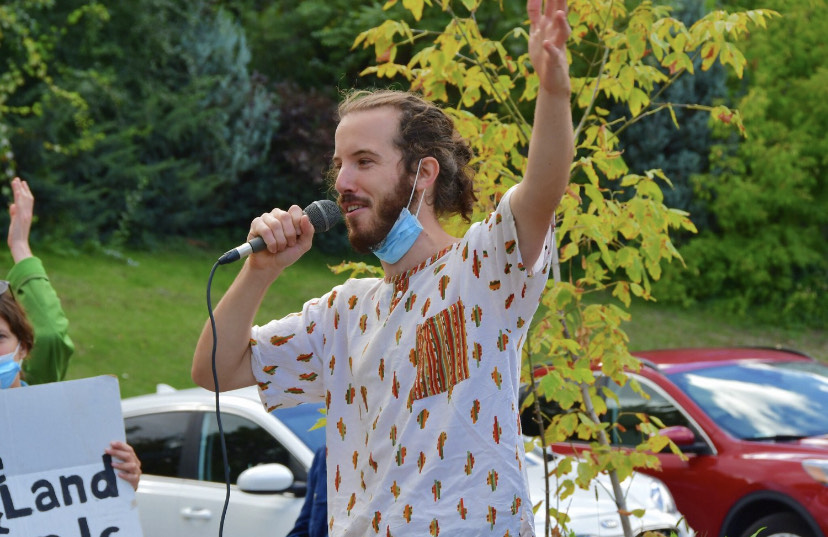
 Nathan McDonnell
 is a community organizer who grew up in Australia and currently lives Montreal. He organizes with the Milton Parc Citizens Committee, a grassroots community organization that emerged out of a successful 1968 struggle against a property developer's efforts to demolish much of Montreal's Milton-Parc neighbourhood. The MPCC's website describes it as "a membership-based, non-partisan organization, which strives to encourage and help create grassroots democracy and collective autonomy. Our projects are based on mutual aid, urban ecology, popular education, housing justice, and direct democracy." McDonnell is also a publisher with the radical press Black Rose Books.
The Media Co-op: Give a brief overview of your past and present involvement in grassroots political work.
Nathan McDonnell: I started being involved in grassroots activism when I was a student at university. I was involved in climate activism, in student activism, in refugee solidarity, and in solidarity with Indigenous struggles. This was in Sydney, in Australia. That's also where I discovered anti-capitalist politics. And I found that really helpful in understanding the interconnectedness and the systemic nature of the different crises that we face.
Then it was when I came to Montreal that I discovered community organizing – so, like, organizing in a community context, especially at a neighbourhood scale. That was through my neighbourhood in Milton-Parc in Montreal, which is a neighbourhood with a long history of community organizing. And I also discovered anarchist politics. That, I found really helpful and really consistent, both ethically and practically, as both a critique of all kinds of authoritarianism and as a practice of alternative ways of organizing society based on direct democracy. And then, at some point, I came across the ideas of social ecology, which was pioneered by Murray Bookchin, and I really appreciated its emphasis on de-centralism and direct democracy.
I'm especially active with a community organizing group in my neighbourhood called the Milton-Parc Citizens Committee. Something I really love about Montreal is that there's a very strong culture of neighbourhood organizing. And Milton-Parc in particular has a long history of this, especially since the '60s, when people organized to save a big part of their neighbourhood from demolition by a big luxury condo and hotel project. They were able to successfully save most of the housing and then acquire that housing into community hands to make a big community housing project of 16 housing nonprofits and six housing co-ops. At the time, it was the largest project of its kind in North America. So it's where, like, 1,200 people live without landlords, self-managing their housing for much cheaper than market rents. That was history that really inspired me.
I've been involved there for 11 years now, or maybe 12, half of that time as a volunteer and then half as a paid community organizer. We do mobilization, popular education, and we incubate citizen projects. We do those things in themes like housing, homelessness, food security, the environment, participatory democracy, and the solidarity economy. I've been really grateful to be able to do that kind of organizing, and in a neighbourhood that has a very established tradition and culture. I've really learned a lot from the process and really enjoyed being part of starting lots of different projects, and being involved in lots of different campaigns.
Two other things I’m currently involved in are the Verdun Community Land Trust, which is trying to take housing off the private market to make it permanently affordable and democratically controlled, and Prenons la Ville, which is a network of citizen mobilizations in different neighbourhoods of Montreal.
TMC: What are a couple of important things that you have learned from collective grassroots struggles that you have never been personally involved in, and why are those things important to you?
NM: Something that I've learned from this experience is the power of autonomous collective decision making – people discovering and developing their power to build autonomy collectively and make decisions collectively. I think that in our society, we're so used to having authority, whether it's at school or with the government or in the workplace. We're so used to other people making decisions for us and telling us what to do. So for me, it's really empowering and really revelatory to realize that we can govern ourselves. Like, when I first learned about Milton-Parc and the big scale of this self-managed project, that really inspired me about the power of communities to self-organize, to build autonomy beyond capitalism.
So, yeah – on a very practical level, when I'm involved in organizing, something I've learned is the importance of giving the space and time, and the transparency and openness, for people to get involved, and then also to plug into the decision making. And in terms of my role as an organizer, it's to encourage people to get involved and to facilitate that process, but also not to too much impose myself on the decision making and the planning, but to try to really facilitate for groups to collectively decide what they want to do and how. That's always an interesting balancing act, to be there in support while not directing the process.
TMC: Given the importance that you see in autonomous decision making and collectively governing ourselves, what resources would you recommend to people who are interested in learning, in a practical sense, how to build their capacities to do those things?
NM: That's a great question. I don't have a fully fleshed out answer for that, but one that comes to mind is a book edited by Cindy Milstein called Deciding For Ourselves: The Promise of Direct Democracy. In it, she looks at lots of different movements for direct democracy around the around the world.
Another film that inspired me in terms of housing is a documentary about PAH, which is a housing movement in Barcelona. It's called SÍ SE PUEDE Seven days at PAH Barcelona. It's really interesting how they do tenant organizing. They prioritize mutual aid and solidarity for tenants who are being exploited by their landlords. They involve tenants to support other tenants to do direct action and to figure out what are some actions that people are comfortable to do, including things like blocking evictions and doing occupations of the offices of landlords.
TMC: What are a couple of other sources related to grassroots struggles that you've never been involved in yourself that you've found to be particularly useful or important?
NM: Before, I mentioned social ecology and Murray Bookchin. I'm really inspired by the philosophical approach that he developed and how he shows the history of struggles for freedom, even going back into ancient history. Something else I'm inspired by is the ideas of Saul Alinsky, like in his book, Rules for Radicals.
Two other movements that really inspired me: the Zapatistas in the state of Chiapas in Mexico, as well as the revolution in Rojava, in the Kurdish majority area in northeast Syria. Because both the Zapatistas and the revolution in Rojava are kind of libertarian socialist revolutions where society is collectively organized through direct democracy. And they have a very strong emphasis on women's empowerment. And both of those also emerge out of Indigenous movements, with a strong anti-colonial and anti-state politics. Those are two examples that really inspire me, as examples of revolutionary societies today that are very established and well functioning and successful, as much as they have their challenges.
I am also very inspired by different tenant organizing movements in Montreal in different neighbourhoods. One organization in particular that is at the cutting edge of more radical, tenant-led organizing, is the Syndicat des Locataires Autonome de Montréal (SLAM), or the Montreal Autonomous Tenants Union (MATU). Without any paid staff, they work on organizing tenants to support each other, to fight evictions, resist rent raises, and generally build collective tenant power against landlords. They have a website and a killer Instagram.
One other thing I'm inspired by is liberation theology. It's basically a Christian, especially Catholic, leftist movement that was very strong throughout Latin America since the '60s. I'm very inspired by how they organize, how they try to re-discover in religion a kind of radical politics and social justice.
TMC: What are a couple of key things about struggles that you are or have been involved in, or about your approach to activism and organizing more generally, that you would like other people to know more about?
NM: Beyond all the theory and philosophy and strategy, for me a big thing that animates my organizing is a sense of love, and just really being interested in people and in collective care, and a commitment to service – even just down to making people feel welcome. Something I really care about is trying to make it as easy as possible for people. Like, when people come to our meetings, come to our spaces or projects, trying to make that person feel welcome, cared for, and introducing them to other people to make them feel at home. I think that sense of hospitality is really, really important to me, because beyond the politics and beyond the element of social change, I think that people also get involved in organizing because they seek community. And I think that having strong communities that care for each other is really important for changing society.
TMC: Anyone who's been around in movements for a while has probably experienced some spaces that are really good at doing those things – love, collective care, hospitality, and so on – but has also probably experienced spaces that are really not good at them and that don't feel welcoming or caring at all. So what's your sense of why it is, sadly, relatively common to have movement spaces that don't do a good job of that? And what do we need to do to make sure more of our spaces get better at it?
NM: I think we live in a society of individualism. It's in the air that we breathe. So it's something I think we need to actively work on. I think we need to actively change our culture to try to challenge this individualism.
I also think having multiple generations is really important. I think it really helps bring a broader perspective. I really enjoy organizing with seniors, because I think they bring a lot of maturity and groundedness. At the same time, I think youth bring a lot of energy and dynamism.
I think also at times, in some aspects of our movements, I think there can sometimes be some paranoia – maybe because of security culture (i.e. practices used in some activist groups to avoid or mitigate the impacts of state repression) or because of trauma. And I think it's all things that we have to be conscious of, but also try to not forget our collective need for community and inclusion.
TMC: What are a couple of sources related to, again, either concrete struggles that you're involved in, or to your approach to activism and organizing more generally that you would want other people to read, or watch, or listen to, or otherwise learn from?
NM: There's lots. I think that studying history is extremely important for activists, both to be inspired by what's possible and what's been achieved, and also to understand the challenges and the contradictions that we face. In particular, I'm really inspired by the moment of the revolution in Spain in the 1930s, which was a time when huge parts of Spain were basically taken over by workers and farmers and they were self-managed without bosses for several years, before it was crushed by the fascist Franco regime. So, yes, that's one moment that really inspires me. And there's lots of other moments.
For example, in Sydney, in the '60s or the '70s, there was a construction union called the Builders Labourer Federation, and they went on strike to save a whole big neighbourhood, right in downtown Sydney, of heritage houses. They went on strike to save them from being knocked down. And they successfully saved them. This movement was really interesting in terms of bringing together labour organizing, heritage protection, and also environmental protection.
Before, I mentioned Murray Bookchin. One book that really inspires me – it's known as his most important political work – is called Urbanization Without Cities: The Rise and Decline of Citizenship. In it, he goes through a history of struggles for freedom.
One of the first films that really politicized me is Manufacturing Consent, by Noam Chomsky. Although it doesn't really necessarily show us how to organize – it's just very good as a critique of the media.
To get in touch with Nathan, you can email him at nathanpmcd@gmail.com.
Scott Neigh is a writer, media producer, and activist based in Hamilton, Ontario. His latest book is Listen! Knowing the World and Fighting to Change It from Fernwood Publishing.
Please subscribe to The Media Co-op's newsletter!