
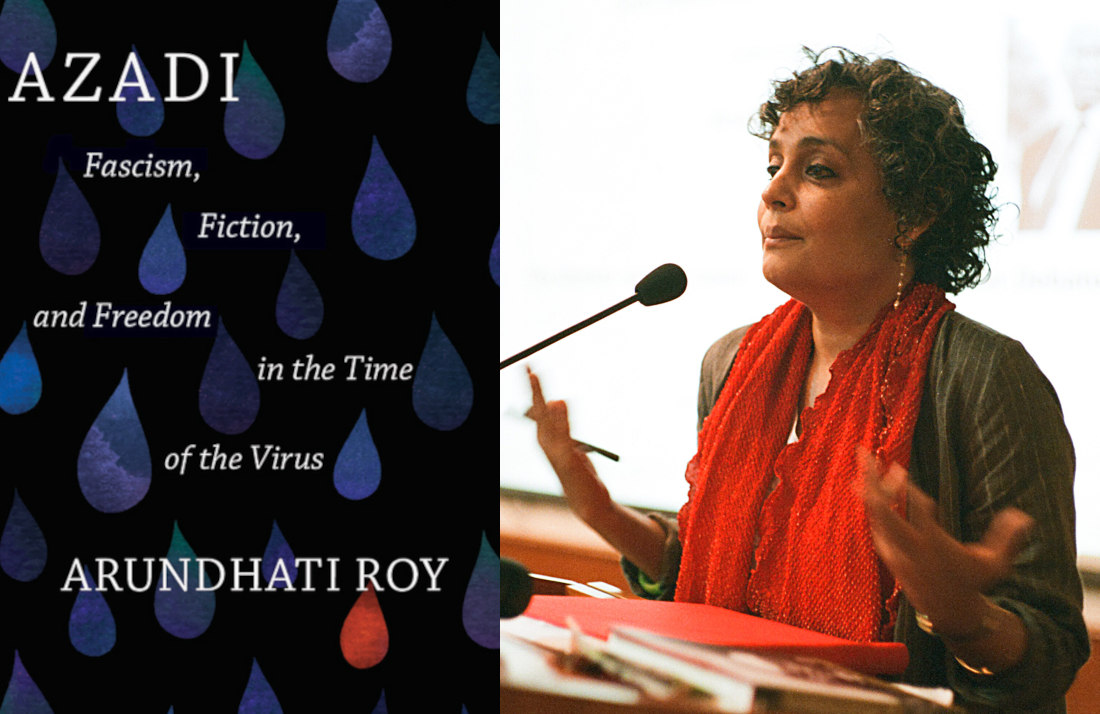
 The cover of *Azadi* and Roy. (The forher is taken from the Haymarket Books website, the latter is from user Payasam (Mukul Dube) on Wikimedia)
Arundhati Roy has won many prestigious literary awards, most prominently the 1997 Man Booker Prize for The God of Small Things, but because of her politics, among many Indians she is a target of scorn. This includes seasoned uncles with an axe to grind but also some young, educated, privileged, upper-caste, English-speaking people. There is misogyny involved in this hatred when it comes from young men who nurse their identity issues by lashing out at highly qualified women with sexually crass language and expletives. Others hide their bigotry by weaponizing patriotism, which Samuel Johnson aptly deemed the last refuge of a scoundrel.
Harassment of intellectuals is not unique to Roy, of course. Academics like historian Audrey Truschke have faced similar treatment from Hindu nationalists, as has 94-year-old Romila Thapar in India. Academics in Canada have been threatened by local Hindu nationalists as well. CBC shed light on how Chinnaiah Jangam at Carleton University in Ottawa and others have received hate mail and threats. This harassment by Hindu nationalists, who characterize themselves as victims of “Hinduphobia,” has led Canadian academics to seek help from the police for their own safety and wellbeing.
Roy is well known in the West, including in Canada. Her latest book is a memoir, Mother Mary Comes to Me (2025), which is widely available. Many of her other books can also be readily found on the shelves of Canadian bookstores, and her shorter pieces of nonfiction circulate broadly online.
To better understand the venom directed at her, I decided to read some of her work. I had recently finished books by another Indian writer with critical politics, Pankaj Mishra – his Bland Fanatics (2020) and The World After Gaza (2025) – and I decided that Roy's essay collection Azadi (2020) would be a good place to start digging into what irks her detractors.
In addition, having watched Homebound (2025) on Netflix allowed me to connect with her views on the handling of the pandemic and systemic discrimination against both Dalits and Muslims in India. The latter now form the most disenfranchised group in India, based on a whole array of socio-economic factors. It reminds me of Jason Stanley’s argument from How Fascism Works (2018) that state policy marginalizes an out-group, which results in segregation and ghettoization, which in turn feeds into negative stereotypes of the out-group and eventually more state repression. As Roy notes in her book, which has been banned in Indian-administered Kashmir, social and economic boycotts push Muslims to ghettos and then stereotypical Maulana (traditional Islamic clergy) voices are projected on television to perpetuate crass generalizations.
False Flag Attacks and RSS Fascism
After her win at the Booker Prize brought her to international prominence, Roy turned a great deal of her attention to writing nonfiction. Much of that work has focused on important struggles for justice in India as well as criticism of right-wing political forces working to exacerbate inequality and oppression.
In Azadi, for instance, she writes about Hindu nationalism in the context of the 2019 Indian elections. Many in India were anticipating a “false-flag attack” as the elections approached. This would not have been the first time that Hindu nationalists have used such tactics – YouTube educationist Dhruv Rathee has exposed multiple false flag attacks used by them to stoke communal tensions. Such attacks are possible when the state is complicit and the police turn a blind eye or actively abet violence. Additionally, criticism of such attacks is suppressed when countervailing institutions like the media and judiciary are co-opted, and when universities are gutted by targeting “secular” or “left-wing” academics and students.
There is ongoing debate about whether Hindu majoritarianism (Hindus form roughly 80% of India's population) should be referred to as “fascism” or not, but Roy argues that whatever the outcome of such academic quibbling, “fascism is staring us in the face.” She lists the characteristics of fascism as dehumanization and ghettoization of the internal enemy, relentless propaganda, false flag attacks, fawning celebrities and business leaders, attacks on universities, fear of intellectuals, infighting within the left, dawdling liberals, and a hate-infested “zombie population.”
Roy is clear in her assessment that the RSS (the Hindu nationalist paramilitary organization, a member of which assassinated Gandhi, and the ideological progenitor of India's ruling party, the BJP) is far better resourced and more deeply entrenched within state institutions than white nationalists in North America. She writes that none of the white supremacist, neo-Nazi groups have the mass membership or infrastructure of the RSS. Additionally, she notes that foreign diplomats, including the German ambassador, have hobnobbed with the RSS leadership. While much is made of Islamist groups like al-Qaeda and ISIS, Roy highlights the “full blown terrorist network” of Hindutva organizations that have “hit lists, hideouts, and safe houses” replete with arms and ammunition to “bomb, kill, and poison people.” She uses the phrase “typical RSS chameleon speak” to indicate that the RSS wears the “mask of reason and inclusiveness” when it is needed. Both Hindu and white nationalists, however, are similar in how they threaten Muslims, subject them to violence, and stoke misogyny with sexually crass language, even as they claim to “liberate” them from conservative Muslim norms.
The Majority with a Minority Complex
In Azadi, Roy highlights that ruling party members, their social media trolls, and the co-opted media in India blame Muslims for provoking violence, attacking themselves, and burning their own shops and homes. This narrative is seemingly borrowed from Israel, which ruthlessly culls Palestinians and holds the oppressed responsible for the violence inflicted upon them. This practice of the oppressors blaming their victims is well documented. For instance, Arturo Hermann (2021) writes that a psychological explanation of this dastardly phenomenon is “projecting into other persons/peoples/countries the negative aspects of our personality.” It helps the perpetrator of horrific crimes to cope with the moral vacuum they have become, as they deflect any responsibility for their actions. This is starkly evident when, according to Roy, the RSS rejects the “lynching epidemic” against Muslims as a “conspiracy to defame India” and deflects it as a “western concept.”
Roy writes that such repeated and systemic attacks on Indian Muslims should not be called riots but should instead be understood as fascist pogroms. The use of the word “pogroms” is resisted by Indian liberals, who celebrate Indian Prime Minister Narendra Modi's neoliberal economic policies and sideline horrific violence like the 2002 Gujarat genocide of Muslims (which meets all ten stages of genocide laid out by Genocide Watch and is deemed to be one of India’s worst pogroms). More than two thousand people, mostly Muslims, were murdered, and many more were tortured or raped, all with the full complicity of the state government – which at the time was led by Modi. She notes that Modi won three consecutive terms after the Gujarat genocide not despite it but because of it, as he was hailed as the hriday samrat (Emperor of the Hindu heart).
Far too often, Hindu nationalists use expletives like “madrassachap” (which pejoratively refers to Muslims educated in Islamic education centres), “bhikari” (beggar), or “jihadi” to dehumanize Muslims, even as the nationalists behave as hate mongering social trolls, celebrate the death of children in Gaza, and rejoice in the ignominy inflicted upon vulnerable minorities. As Sriya Iyer (2018) writes, they remain an overwhelming majority with a minority complex.
Immigration of Hindutva Hatred
Just as writers in Canada have begun to explore the relationship between Hindu nationalists and right-wing forces in this country, Roy has discussed some elements of this phenomenon in the US context, both in the Introduction and Chapter 6. For example, she delves into the relationship between Trump and Modi. In 2019, Trump and his allies gave the BJP prime minister an enthusiastic welcome in Houston – the "Howdy Modi" event – which was attended by 50,000 American Hindus. Many supporters of Hindu nationalism in the US also form a strong base that supports Israel taking a hardline approach against Muslims, who according to them only understand the language of force. She highlights that such folks were cheering the wickedness of the RSS, which in the words of their ideologue Golwalkar aims to subordinate Muslims such that they can claim nothing, not even citizenship rights. Roy adds in Chapter 6 that this India shaped by the RSS is what the Israelis wish to partner with and the Saudis wish to fund.
The specifics of these relationships among reactionary forces shift with the political winds, of course. Where once Trump was worshipped, now he is denigrated. Where once the Taliban were deemed terrorists, they are now welcomed. These changes only show how far-right ideology is influenced by changing political interests. As well, the terrorism label is often weaponized by the powers that be. It is foisted and it is relinquished, as in the case of the Syrian President and al-Qaeda leader Abu Mohammad al-Julani, who is now welcomed by Washington.
Roy notes that, as of 2018, India was the fifth most dangerous place for journalists, a place where “doubters and dissenters” are terrorized by Hindutva trolls, who label them as “anti-nationals.” It is a place where people are asked to sideline their joblessness, hunger, and eviction to solely focus on “national pride.” It is therefore not surprising that Hindu nationalists – both those in India and those abroad, who brought their hatred of Muslims with them – post snide remarks directed at Roy. They feel she defames India. Hindu nationalists in the diaspora regularly demand activists go to India if they are so brave, just as white nationalists ask Palestinian activists to go to Gaza.
The Occupation of Kashmir
Roy asserts that it is not possible to speak of Kashmir in India without risking bodily harm. She is clear that what India has done over the last 30 years in Kashmir is unforgivable. Like Pankaj Mishra, she writes that many Indians who celebrate their own independence reject the same for Kashmiris who live under Indian occupation/colonization.
The conventional narrative is that when the British Empire withdrew from the subcontinent in 1947, it split a unified whole into two countries, India and Pakistan. Roy writes, however, that there was no singular India that was partitioned but rather hundreds of sovereign principalities that were forced towards a merger, like the Princely State of Hyderabad. In this context, the situation of Jammu & Kashmir was distinct and complex, in ways beyond what can be fully explored here. Briefly, as a Muslim majority Princely State, it could technically have become part of Pakistan, given its contiguous boundary with the latter; however, it was ruled by a Hindu Maharaja, who had the power to decide the state's fate. Kashmiri Muslims rebelled, in vain, against a “discredited monarch,” whom they had been actively attempting to overturn for decades in favour of a representative parliament. The partition of the subcontinent and the communal frenzy along the partition line seeped into Kashmir too, and Kashmiri Muslims succumbed to the violence, which continued for several months and culminated in a genocide of Muslims by Hindu nationalists. Subsequently, the Maharaja sought support from the Indian government and ceded sovereignty to India. Two years later, Kashmir was granted special status under the Indian constitution's Article 370, which lasted until the Modi government revoked it in 2019, during its second term.
Roy goes on to say that since 1990, Indian forces have killed more than 70,000 Kashmiris, “disappeared” thousands, tortured tens of thousands, and used pellet guns to maim and blind hundreds of youths. She writes that Kashmiri youth that have seen the horror of multiple Abu Ghraib torture centres across their valley are willing to sacrifice their lives for freedom. As Salman Rushdie states:
“The phrase of "crackdown" that the Indian army uses really is a euphemism of mass destruction. And rape. And brutalisation. … The decision to treat all Kashmiris as if they're potential terrorists is what has unleashed this, the kind of "holocaust" against the Kashmiri people. … And the level of brutality is quite spectacular. And, frankly, without that the jihadists would have had very little response from the Kashmiri people who were not really traditionally interested in radical Islam.”
Roy reminds us that “Kashmir is the most densely militarized zone in the world,” with over half a million soldiers, and people there live in perpetual fear of being labelled as “informers, double agents, and triple agents.” She writes that Kashmiri Muslims who do not wish to belong to India and Indian Muslims who do, both find India to be an “extremely unmotherly mother,” given the violence unleashed in her name. In this context, Canadian academic Farhan Chak’s assessment of India’s coercive patriotism is instructive. Chak asks us to “imagine someone insisting that you must love them, carry their flag, sing their songs, and chant their anthem” and that “if you refuse … they threaten your life. Love me, or else.” Roy rejects the Indian smear campaign that depicts Kashmiris as “murderous fundamentalists” and rejects conflating the democratic aspirations of a people living under occupation with Pakistan’s actions. She is adamant that “if freedom is what they want, then freedom is what they should have.”
Given all of this, the Indian government's decision to ban Azadi in Jammu and Kashmir is hardly surprising.
The Façade of Secularism has Fallen
Roy is an equal opportunity offender and does not restrict herself to naming the injustices perpetrated by Hindu nationalists. She also criticizes the casteism and racism of Gandhi for labelling Black Africans as “kaffirs” and “savages.” She critiques Manmohan Singh (former Congress Party prime minister of India) for labelling the indigenous Adivasis (original inhabitants) who fight corporate mining projects as the “single largest internal security challenge.” She highlights the plight of the Kashmiri Hindu Pandits, whose tragedy is often used to hide the “rest of the horror” in Kashmir. She also refers to the “cunning” statecraft under the Congress and its co-opted Kashmiri Muslim allies who provided intelligence to the occupation and obeyed the “brutal bidding of their masters.” Moreover, she notes the “pin-drop silence” of Indian Muslims on Kashmir even as they protested the introduction of anti-Muslim citizenship laws, which plays into the good Muslim-bad Muslim binary. Perhaps it is this critique of all sides that has kept her safe so far, even though a high-profile Bollywood actor like Paresh Rawal openly suggested that the Indian army tie her to a jeep and use her as a human shield, Israeli-style. Most likely, however, it is her grand international stature that is doing the trick, a privilege not enjoyed by others that speak truth to power – like, for instance, journalist Gauri Lankesh, whose murder was celebrated on X.
Lankesh, who was shot dead in front of her house, reflects how the street vigilantes have been greatly emboldened and the extent to which Indian media is complacent in the face of Hindu nationalism. Eight years later, her killers have still not been brought to justice. Even when journalists are murdered, justice is often systemically denied. Roy writes that Israeli spyware is used in the BJP’s India against human rights activists, students, academics, or anyone deemed “anti-national,” and lynching happens with the complicity of the government, the police, and people “who wouldn’t hurt a fly” themselves but are “friends of the mob.”
Roy notes that India has never really been secular or socialist but rather has always been an upper caste Hindu state with the façade of secularism. That façade has now fallen, with the rise of Hindu nationalism and its use of fake history to exaggerate victimhood and cast Muslims as treacherous outsiders. However, Roy points out that a good proportion of India’s Muslims are erstwhile Hindus who converted to Islam to escape the brutality of the cruel caste system. It is only a few years ago that two Dalit children were murdered for defecating in the open. The situation of Dalits continues to be alarming, and every week a death or a casualty resulting from caste-based assault is common. She also says that the BJP is five times richer than the Congress Party and elections are increasingly about money that is used to feed “frenzied bigotry” through WhatsApp groups for electoral gains. Overall, her assessment of India under fascism remains bleak.
In Azadi and far beyond, Roy shows a consistent willingness to speak truth to power. This is why right-leaning individuals, especially those with the privilege of education and status, lash out against her, both in India and in the diaspora abroad. She brings critical light to stories like the genocide in Jammu and the occupation of Kashmir that many in a hyper-nationalist state like India prefer to ignore. As India descends further into anti-Muslim bigotry and hate, Roy's example shows that a single candle threatens the darkness. And that, for me, is the purpose of literature – to cast light in the dark.
Dr. Junaid B. Jahangir is an Associate Professor of Economics at MacEwan University in Edmonton, Alberta. He is interested in economic pluralism and renewed perspectives to teaching economics. He has also published in Islamic Studies and co-authored the book Islamic Law and Muslim Same-Sex Unions. He has developed new courses including Economics of Religion, Economics for Everyone, and Sexual Diversity in Islam.
Please subscribe to The Media Co-op's newsletter!