
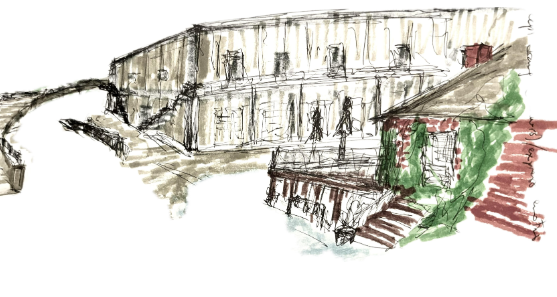
 Sketch of Orange Gallery on the right, another older building behind.
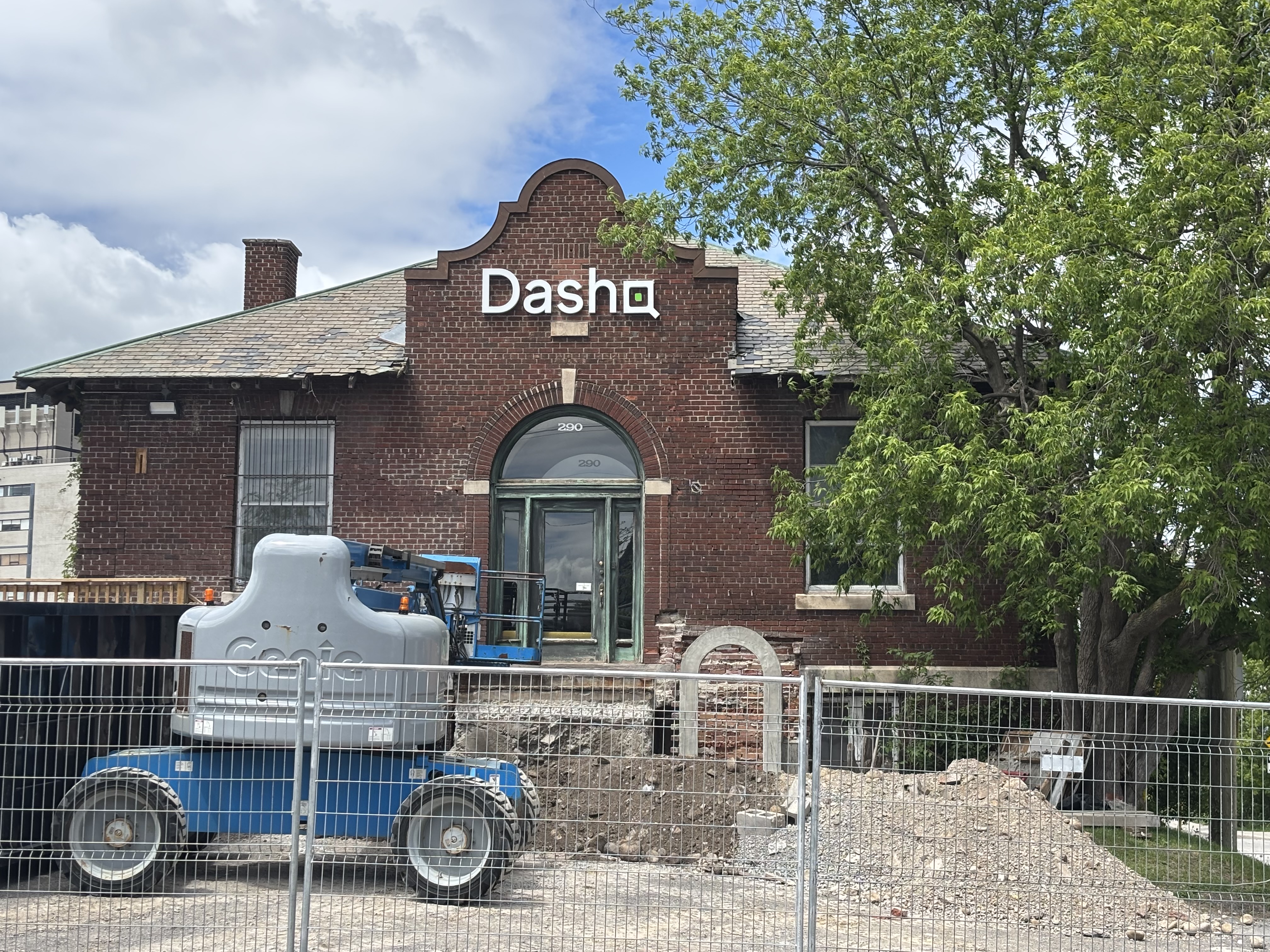 Former Orange Gallery under renovation with the logo of DashQ over door.
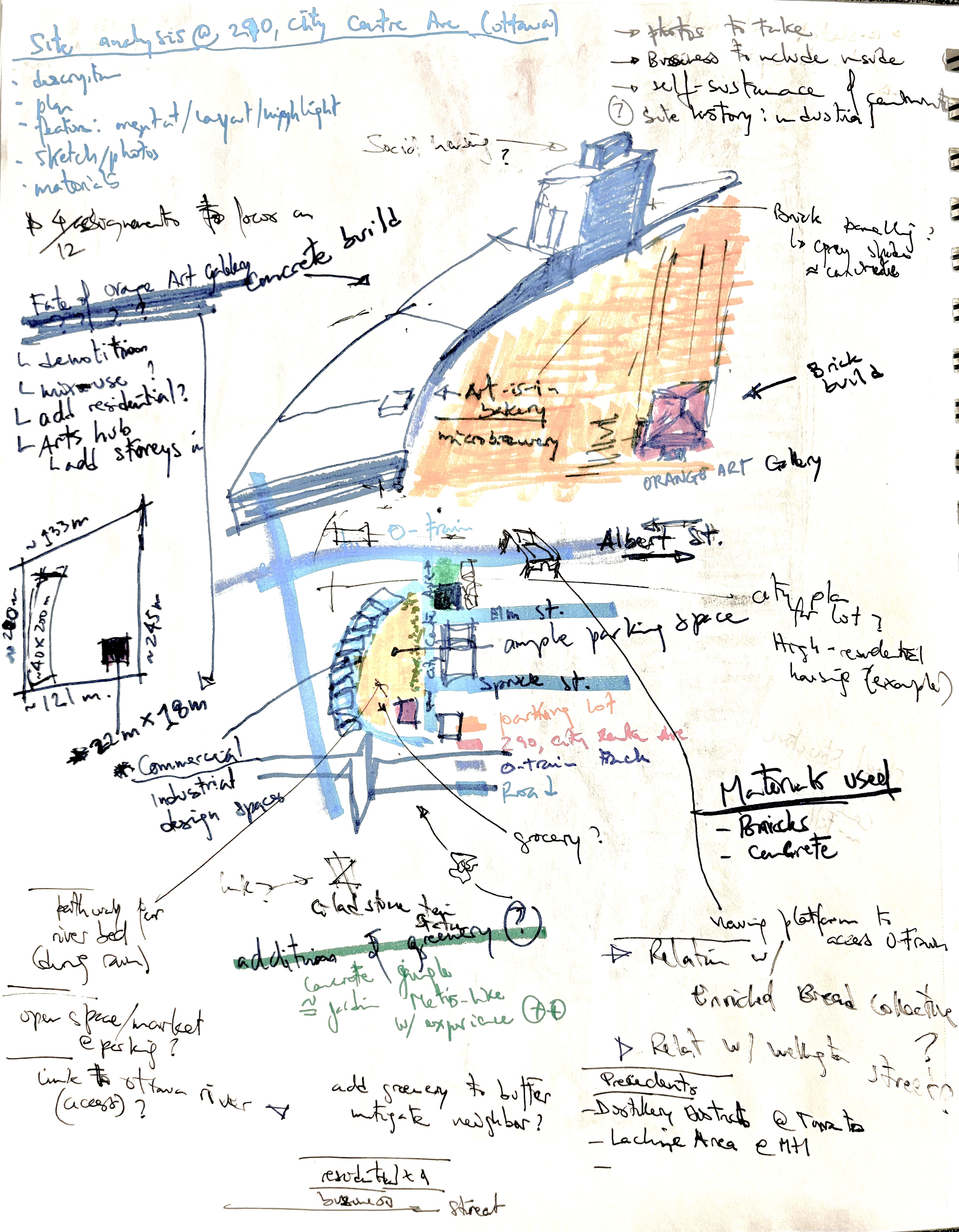 Sketch describing the Orange Gallery environment.
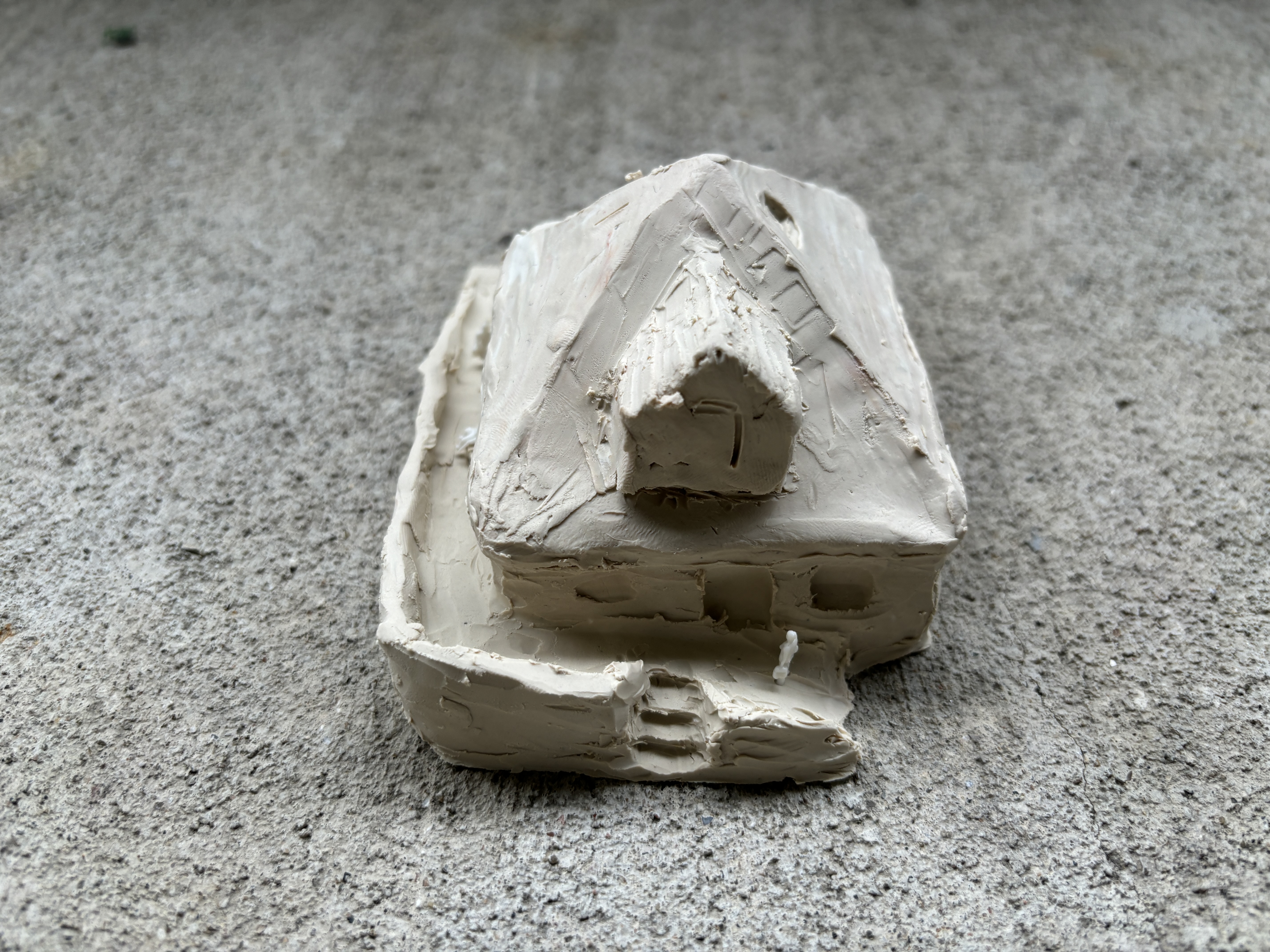 Sculpted model of the Orange Gallery
I learned that the Orange Art Gallery had closed when I inadvertently biked past it last summer.
Located at 290 City Centre Avenue, just steps from the OC-Transpo Bayview Station, the building that housed the gallery is a striking red-brick structure — part industrial relic, part architectural anomaly. Standing as its own island in a sea of parking spaces, it looks, somehow, like a fortress that over time sought to become a sanctuary. When I pulled my bicycle up to its locked doors, the realization landed with a quiet thud: another “third space” had disappeared.
For nearly a decade, the gallery had been exactly that — a third space. This term refers to the few places outside of work or home where we can feel a sense of attachment and community, like a café, a gym, a library, a workshop, a bar... These are spaces we can walk through, spend time, meet people, connect with acquaintances.
Now, this two-storey masonry structure sits empty, caught in the gravitational pull of a rapidly changing neighbourhood.
To understand what Ottawa lost, you have to start with the building itself.
Constructed in the early 20th century — likely in the 1930s — this masonry building originally served as the headquarters of the W.C. Edwards Lumber Company, once a major economic force in the region’s established timber, industrial, and economic fabric. Its thick masonry walls and utilitarian design reflect its origins in Ottawa’s industrial west end, when this area was defined by rail lines, warehouses, and yards, rather than condos, single-family homes, small businesses, bike paths, microbreweries and bakeries.
Like many buildings of its kind, its history has accumulated layers — some documented, others anecdotal. I was told that it once served railway-related functions, even as a kind of “bank” for rail workers. In the northern part of the building, a secure fireproof vault remains. Whether fully accurate or not, those stories speak to how deeply the structure is embedded in the city’s industrial and economic memory.
What is certain is this: it was built to endure. And like so many industrial buildings across North America, it has outlived its original functions.
There is a familiar urban pattern here. When industry and capitalists abandon a building, it’s often artists who congregate and re-occupy the space. In so doing, they breathe new life into it, and new possibilities. By reinvigorating it, they attract others. They transform it into a place of community and foster a sense of belonging and cohesion.
Spaces that can no longer produce profits in their original form — too deserted, too bare, too isolated, too urban, too costly, too old — become fertile ground for cultural, community and artistic reuse. The very qualities that make them unattractive to conventional commercial tenants — scale, texture, irregularity — make them ideal for arts and artists.
The walls that once safeguarded commerce begin to hold something else entirely.
During 2013 and 2014, co-owners Jim and Ingrid Hollander, in partnership with Matthew Jeffrey, moved their recently founded arts gallery from the Parkdale Market into the building at 290 City Centre Ave.
What they created was something organic, communitarian, warm, and able to respond to multiple needs and mandates. The Orange Gallery was: a curated place for arts exhibition, showcasing paintings, installations, and sculptures; a place where art, workshops and community activities took place; an already well-decorated venue for weddings and corporate events; and finally, a gathering place for community activities of all kinds.
This strategy allowed them to be sustainable and secure a multiplicity of revenue sources while serving the primary mandate of being an art gallery showcasing local talents. As a visitor, you weren't just seeing a gallery, you were entering an ecosystem. In the process of booking and making use of the space for even a single event, you were offered, as part of the package, a generous discount on a piece of art that caught your eye. You could keep the piece or eventually offer it as a gift. Just like that, you had paid not only for a community space — and thus helped to keep it open and accessible — but you had also encouraged a local artist, brought their arts into your world, and in so doing spread their visibility to new potential audiences.

That ecosystem was how my partner found the Orange Art Gallery for the first time.
We were searching for a place to get married on a very limited budget in the time of COVID. The Orange Art Gallery was one of the few venues in the city whose cost was within our limited means. The art on the walls allowed us to save on decoration costs and materials. The parking around the gallery made it accessible for relatives and friends coming from out of town. Its location made it central to iconic sites our relatives got to visit later (like the Canadian War Museum, the Parliament and the Peace Tower, the Canadian Museum of Histories, the National Gallery, and more). Because the two-storey building stands on its own, surrounded only by parking spaces and roads, it meant we could celebrate as late and loud as our hearts desired without fear of waking neighbours that summer night. The space didn’t just demand performance—it invited our presence.
While inside, you could find yourself a nice awkward space to catch your breath, and you may be surprised to see a piece of art that stays with you long past that visit.
The owners treated us with a kind of openness that felt distinctly removed from the transactional tone so rampant in the wedding planning industry. Other venue vendors wanted us to reserve their venues along with additional decor, catering, bar, sound systems and other services, providing us invoices ranging up to $5000 or $10,000. We preferred to take care of a lot of those details ourselves by soliciting our relatives and friends for their contributions instead of giving in to the imposed cuisine or additional services of a third-party.
The gallery was about $1000 to rent and they were gracefully open and flexible as to how we set up the room for our wedding night. Even now, their social media archives hold pictures of years of folks celebrating their love for a moment within and around those walls. People seem to inhabit the space, not just rent it.
For me, visits to an art space have often been brief and quiet, charged with emotions I am still unable to fully translate today.
Among them, I recognise the fact that I come from a place in the global South where art galleries are tightly bound to class, wealth, and Western recognition. Showcasing art in such contexts is less about artistic expression and more about confirming an artist has made it abroad and has Western patrons to look after them.
I visited a handful of art galleries in my home country, often in the capital while visiting family friends. I would not be able to retrace the locations of those galleries today; it all felt like a twirling car ride until we were asked to come down and, with our parents, venture in to greet this or that person.
Even now, in more formal galleries such as the ones you will find on Sussex Drive or Bank Street in Ottawa, there is often an atmosphere that quietly communicates who belongs and who doesn’t. Even when I love the artist I find that very soon, I am unable to focus on the arts piece, or connect with the reverie it normally triggers in me. Instead I am constantly imagining some person’s gaze locked onto me, leaving my throat dry and my palms sweaty or cold. It doesn’t take long for me to conclude that I have extended my stay a bit too long.
But the Orange Art Gallery felt different there.
It offered places where you could sit, talk, linger at your own pace and not feel as if you were being watched. It lowered the threshold of entry without lowering the seriousness of the art.
I find that balance rare in most galleries.
The Orange Art Gallery’s closure in 2023 came not with spectacle, but with absence.
The building’s owner, District Realty, chose not to renew the lease to the gallery owners. Around the same time, the property became the subject of a heritage designation process under the Ontario Heritage Act, recognizing architectural and historical significance of this lone oddity.
The designation was an effort by the art gallery owners to protect the structure of the building (its Dutch Mansard roof, its masonry made of red-brick cladding, its stairs, etc.) and prevent the owner-developer District Realty from tearing down the building and replacing it with another multi-storey condominium. This recently-acquired status does not guarantee what happens inside the building, however, or what the next resident may change in the space. Three years later, the Orange building is finally being renovated.
After its eviction, the Orange Art Gallery’s operations did not so much end as dissolve.
There was a brief continuation online by the gallery owners — an attempt to maintain visibility for artists without a physical venue. But a gallery without a room is something else entirely. It becomes a selling platform rather than a place. The connection to these arts pieces becomes a private experience too, only possible if one has the capital to purchase them or the privilege of exclusivity - connections with the owners and/or the artists.
Around this time, the founders of the art gallery also appeared in a different context: partnering with MW Dream Properties (affiliated with Christie’s International Real Estate - yes the giant art dealer house). The partnership promoted “L’Orangerie.” Marketed as a condo “curated by the owners of the Orange Art Gallery”, it translated their sensibilities into a private interior — carefully composed sightlines, material contrasts, with art integrated into the domestic space. The name - l’Orangerie - echoes the well-known art gallery in France; musée de l'Orangerie, which exhibits pieces of Impressionist and Post-Impressionist arts. The condo project was not a new gallery. It was something more private, exclusive — a venture into interior design in a high-end, luxurious condo.
This shift from a relatively public venue to a curated private, luxurious environment, feels emblematic of a more profit-driven vocation. While any socio-economic endeavour - be it for-profit or nonprofit - requires revenues to keep on going, this change from a community-focus to a more capitalist focus has dramatically abandoned the role that this gallery had previously played within the Ottawa visual arts landscape.
The same forces that make artist-led spaces possible often make them temporary. As cultural cachet accumulates, they eventually attract capitalists and their money. This affects the value of the land where the social exchanges and cultural activities have been happening. The buildings and land gain value, and eventually the conditions that allowed the artist to exist in the space are erased by the very success they helped generate. The cultural boom that had happened ended up pushed out of that same community and neighbourhood. All that remains is the shell, the story we re-tell, and the profits made.
The building at 290 City Centre has been recognized as a Heritage building since 2023. The designation of that almost-100 year old building is its passport to endure and move into its next life. Its red-brick cladding, its Dutch mansard roof, its 5000 sq ft, and its distinctive presence are now recognized as part of Ottawa’s heritage.
But buildings do not carry culture on their own. They are vessels that require us to turn up, and as we navigate them, shed a piece of our experiences and emotions into a piece of art, so that the work in turn can speak to others in a communal silence.

As I biked away, what stayed with me wasn’t just the loss of a gallery, but the loss of a particular kind of access — a space where people who might otherwise feel out of place when venturing into the art galleries on Sussex Drive feel welcome; a space where anybody could enter, stay, and participate without needing permission, and (perhaps without their knowing) tap into a new passion they didn’t suspect they carried within them.
Those environments are harder to build than the buildings that house them, and are much easier to lose. This is why I still mourn the closing of the Orange Art Gallery, considering how this piece of our urban fabric since 2013 has now been integrated into the kind of luxurious developments pushing us apart. The gallery owners have certainly transitioned into a new capitalist venture providing arts into curated private, luxurious places. Considering the cost of these condos to buy or lease, the few who will continue to access these arts are those whose mantra screams: business as usual no matter where, no matter the price.
As for the building at 290 City Centre Avenue, it is already embarking on its next life cycle. On-site photos reveal the logo of DashQ, a rising prop-tech (property technology) startup founded right here in Ottawa in 2020. Unlike traditional property managers, DashQ uses AI-driven software to automate the entire leasing process, from virtual tours to digital leases. It is an industry transformation that many of us are beginning to encounter as renters or consumers. How that move from Art to AI fits within this lovely heritage building has yet to be seen.
Please subscribe to The Media Co-op's newsletter!