
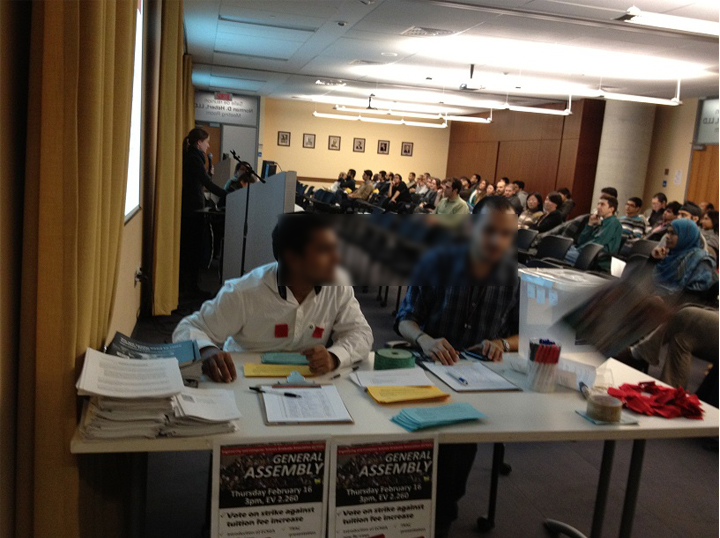
The last General Assembly of our Graduate Students’ Association sparked a series of controversial complaints, like engineers attended only for the elections; that they ‘took over’ the assembly and that one of them was intimidating others to vote for a particular candidate; that he should thus be excluded from future assemblies; that elections should not take place in an assembly again; and that GSA democracy had a ‘miscarriage.’ Yet all these complaints missed the essential point: The problem can not be pinned on one faculty, one person, nor on General Assemblies themselves; the problem is that student associations and unions at Concordia University still need to work hard to build a culture of general assemblies, the essence of Direct Democracy.
Direct Democracy has been at the heart of Quebec student movement since the 1960s, and without it, Concordia associations would not have made their historic entry to the General Student Strike in 2012. Commentaries saying that GSA’s democracy is going downhill forget that during the 2012 strike GSA’s democratic culture went through a major improvement that is still in its infancy and needs a lot of nurturing and deserves a dose of institutional and historical context.
Indeed our 2012 experience challenged latent GSA institutional stereotypes whispered behind closed doors for several years and only recently publicly implied about Engineers (like “if Engineers come to the GA they will only focus on elections instead of important political issues”). Let’s not forget that in 2012 the Engineering and Computer Science Graduate Students’ Association held general assemblies to discuss the strike before the GSA did; they voted to join the strike before the GSA did; and those same Engineering students carried out that mandate by blocking classes despite many of them being new to Canada and, arguably, having more to fear and to lose.
Some of the critiques of GSA elections taking place in a GA also ignore that before by-elections were allowed in GSA GAs, traditional ballot box elections already provided ample opportunity for voting for one’s friends or for the best-looking person (just like anywhere else). Such elections were accompanied by the oft-heard hushed phrase, “We have to make a coalition with engineers, or this ethnic community, if not we will never win the vote.” In contrast, properly carried-out General Assembly elections provide a greater level of transparency around such practices and guarantee on-the-spot public answers to students’ questions, and the knowledge that if this student candidate’s promises are not fulfilled, there is always the next General Assembly to call them out on it directly. Those elected in a GA would also feel more in touch with students’ concerns from the very start of their mandate.
So rather than make unfair stereotypes and inaccurate assumptions (in the francophone GA world, referred to as ‘procès d’intention’) about certain faculties, about one person’s angry comment at the microphone (as if angry comments never happen in GAs across the province!), or about the impossibility of fair elections at a General Assembly, we need to work harder at fostering the legacy of Direct Democracy brought to us during the 2012 strike.
We can do this by focusing on the proper mobilization, processes, and education around General Assemblies.
Mobilization means that all student union representatives have as their top priority reaching out to and dialoguing with members, to ensure that students from all faculties are aware of all the topics of an upcoming GA and their importance (not just elections). The GSA announced the anti-austerity strike motion in an email only the night before the October GA; the failure to vote on the strike was then blamed on “engineers” for leaving the GA thus losing quorum - yet without knowing what the strike was about, why should anyone care to vote on it? And why criticize those students who actually took the time to show up and debate in a general assembly, while not questioning why others were not even in the room?
Some complained that students from one faculty “took over” the assembly; yet these complaints imply a picture of Direct Democracy that is all upside-down. Students are supposed to appropriate general assemblies through discussion and debate to get informed and make collective decisions, to ensure that all the power does not rest solely in the hands of elected representatives.
It is thus only normal that disagreements and, yes, even heated arguments take place at a General Assembly; just attend a GA at UQAM or another educational institution across Quebec - it will make our disagreements at the last GA look like peanuts. Addressing such inevitable disagreements entails institutionalizing adequate processes, such as those suggested by women’s groups in our province after the 2005 student strike to make General Assembly meetings as smooth and inclusive as possible - most notably, the introduction of the ‘mood-watcher’ or ‘gardien-ne du senti’ which was forgotten at the last GSA GA (you can read more about Direct Democracy’s heritage in the Quebec student movement here).
And of course we need to look forward, as every new cohort of student members (and elected representatives of the GSA) deserves the opportunity to be educated, beyond mass emails, about the practices of Direct Democracy of our provincial student movement. Making Direct Democracy part of our institutional culture means holding orientation, other educational events and regular mobilization so that students can at least have the chance to understand its history and its purpose, and thus be incited and properly prepared to attend a GA.
All members need to know that if they have an issue the General Assembly is the most effective place to take it, because it is their highest decision-making body that gives all members a voice.
Elected representatives have a special responsibility to bridge the gap between themselves and the rest of the graduate student body by creating an atmosphere where students can appropriate their decision-making space: the GA. Yet for Direct Democracy to empower every student, everyone has to contribute to it. We don’t want to pinpoint any individuals; what we want is to stress our collective responsibility towards Direct Democracy, our heritage from our 2012 experience. And that heritage tells us: the General Assembly is our power and our voice, so let’s take it seriously!
Nadia Hausfather and Rushdia Mehreen are graduate students and were involved in student activism at Concordia University leading up to the 2012 General Unlimited Strike, as well as during and after the strike.